




In a right-angled triangle, the hypotenuse is $2\sqrt{2}$ times the length of the perpendicular drawn from the opposite vertex on the hypotenuse. Then, find the acute angles of the triangle.
Answer
 Verified
582.3k+ views
Hint: Let the length of the perpendicular BD dropped from the opposite vertex onto the hypotenuse be of length p, the length of the hypotenuse AC be h, the side AB be of length a and the side BC be of length b. The part AD of the hypotenuse is of length x. Then, the part DC be of length will be $AC-AD=h-x$ . Now, applying Pythagoras theorem to $\Delta ABD$ , $\Delta BDC$ and $\Delta ABC$ , and solving, we get the equation ${{p}^{2}}+{{x}^{2}}-hx=0$ . This can be solved using the Sridhar Acharya formula. Once we get the value of x and $h-x$ , we find the two acute angles by $\angle ABD={{\tan }^{-1}}\left( \dfrac{x}{p} \right)={{22.5}^{\circ }}$ , $\angle BAC={{90}^{\circ }}-\angle ABD={{90}^{\circ }}-{{22.5}^{\circ }}={{67.5}^{\circ }}$ and \[\angle ACB={{90}^{\circ }}-\angle BAC={{90}^{\circ }}-{{67.5}^{\circ }}={{22.5}^{\circ }}\] .
Complete step by step answer:
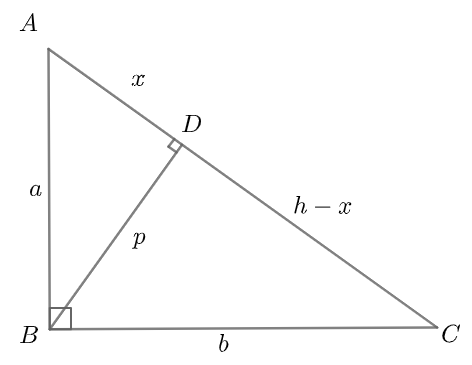
Let the length of the perpendicular BD dropped from the opposite vertex onto the hypotenuse be of length p, the length of the hypotenuse AC be h, the side AB be of length a and the side BC be of length b. The part AD of the hypotenuse is of length x. Then, the part DC be of length will be $AC-AD=h-x$ .
Now, applying Pythagoras theorem to $\Delta ABD$ , we get,
${{p}^{2}}+{{x}^{2}}={{a}^{2}}....\left( i \right)$
Applying Pythagoras theorem to $\Delta BDC$ , we get,
${{p}^{2}}+{{\left( h-x \right)}^{2}}={{b}^{2}}....\left( ii \right)$
Adding the two equations (i) and (ii), we get,
$\begin{align}
& \Rightarrow {{p}^{2}}+{{x}^{2}}+{{p}^{2}}+{{\left( h-x \right)}^{2}}={{a}^{2}}+{{b}^{2}} \\
& \Rightarrow 2{{p}^{2}}+2{{x}^{2}}+{{h}^{2}}-2hx={{a}^{2}}+{{b}^{2}}....\left( iii \right) \\
\end{align}$
Now, applying Pythagoras theorem to $\Delta ABC$ , we get,
${{a}^{2}}+{{b}^{2}}={{h}^{2}}$
So, we can write equation (iii) as,
$\begin{align}
& \Rightarrow 2{{p}^{2}}+2{{x}^{2}}+{{h}^{2}}-2hx={{h}^{2}} \\
& \Rightarrow 2{{p}^{2}}+2{{x}^{2}}-2hx=0 \\
& \Rightarrow {{p}^{2}}+{{x}^{2}}-hx=0 \\
\end{align}$
Applying SridharAcharya formula to the above equation, we get,
$\begin{align}
& x=\dfrac{-b\pm \sqrt{{{b}^{2}}-4ac}}{2a} \\
& \Rightarrow x=\dfrac{-\left( -h \right)\pm \sqrt{{{\left( -h \right)}^{2}}-4\left( {{p}^{2}} \right)}}{2} \\
& \Rightarrow x=\dfrac{h\pm \sqrt{{{h}^{2}}-4{{p}^{2}}}}{2} \\
\end{align}$
It is given that $h=2\sqrt{2}p$ . So, the above equation can be written as,
$\begin{align}
& \Rightarrow x=\dfrac{2\sqrt{2}p\pm \sqrt{{{\left( 2\sqrt{2}p \right)}^{2}}-4{{p}^{2}}}}{2} \\
& \Rightarrow x=\dfrac{2\sqrt{2}p\pm \sqrt{8{{p}^{2}}-4{{p}^{2}}}}{2} \\
& \Rightarrow x=\sqrt{2}p\pm p \\
& \Rightarrow x=\left( \sqrt{2}-1 \right)p,h-x=\left( \sqrt{2}+1 \right)p \\
\end{align}$
Now,
$\begin{align}
& \tan \angle ABD=\dfrac{AD}{BD}=\dfrac{x}{p}=\dfrac{\sqrt{2}-1}{1}=\sqrt{2}-1 \\
& \Rightarrow \angle ABD={{22.5}^{\circ }} \\
\end{align}$
Now,
$\angle BAC={{90}^{\circ }}-\angle ABD={{90}^{\circ }}-{{22.5}^{\circ }}={{67.5}^{\circ }}$
This gives, \[\angle ACB={{90}^{\circ }}-\angle BAC={{90}^{\circ }}-{{67.5}^{\circ }}={{22.5}^{\circ }}\]
Thus, we can conclude that the acute angles of the triangle are \[{{67.5}^{\circ }},{{22.5}^{\circ }}\] .
Note: Drawing a diagram before starting the solution is a must as it helps in visualising the problem. This problem can also be solved by using similarity. In $\Delta ABD$ and $\Delta BDC$ ,
This gives,
$\begin{align}
& {{p}^{2}}=hx-{{x}^{2}} \\
& \Rightarrow {{x}^{2}}-hx+{{p}^{2}}=0 \\
\end{align}$
Which can be solved by Sridhar Acharya as done in the solution.
Complete step by step answer:
Let the length of the perpendicular BD dropped from the opposite vertex onto the hypotenuse be of length p, the length of the hypotenuse AC be h, the side AB be of length a and the side BC be of length b. The part AD of the hypotenuse is of length x. Then, the part DC be of length will be $AC-AD=h-x$ .
Now, applying Pythagoras theorem to $\Delta ABD$ , we get,
${{p}^{2}}+{{x}^{2}}={{a}^{2}}....\left( i \right)$
Applying Pythagoras theorem to $\Delta BDC$ , we get,
${{p}^{2}}+{{\left( h-x \right)}^{2}}={{b}^{2}}....\left( ii \right)$
Adding the two equations (i) and (ii), we get,
$\begin{align}
& \Rightarrow {{p}^{2}}+{{x}^{2}}+{{p}^{2}}+{{\left( h-x \right)}^{2}}={{a}^{2}}+{{b}^{2}} \\
& \Rightarrow 2{{p}^{2}}+2{{x}^{2}}+{{h}^{2}}-2hx={{a}^{2}}+{{b}^{2}}....\left( iii \right) \\
\end{align}$
Now, applying Pythagoras theorem to $\Delta ABC$ , we get,
${{a}^{2}}+{{b}^{2}}={{h}^{2}}$
So, we can write equation (iii) as,
$\begin{align}
& \Rightarrow 2{{p}^{2}}+2{{x}^{2}}+{{h}^{2}}-2hx={{h}^{2}} \\
& \Rightarrow 2{{p}^{2}}+2{{x}^{2}}-2hx=0 \\
& \Rightarrow {{p}^{2}}+{{x}^{2}}-hx=0 \\
\end{align}$
Applying SridharAcharya formula to the above equation, we get,
$\begin{align}
& x=\dfrac{-b\pm \sqrt{{{b}^{2}}-4ac}}{2a} \\
& \Rightarrow x=\dfrac{-\left( -h \right)\pm \sqrt{{{\left( -h \right)}^{2}}-4\left( {{p}^{2}} \right)}}{2} \\
& \Rightarrow x=\dfrac{h\pm \sqrt{{{h}^{2}}-4{{p}^{2}}}}{2} \\
\end{align}$
It is given that $h=2\sqrt{2}p$ . So, the above equation can be written as,
$\begin{align}
& \Rightarrow x=\dfrac{2\sqrt{2}p\pm \sqrt{{{\left( 2\sqrt{2}p \right)}^{2}}-4{{p}^{2}}}}{2} \\
& \Rightarrow x=\dfrac{2\sqrt{2}p\pm \sqrt{8{{p}^{2}}-4{{p}^{2}}}}{2} \\
& \Rightarrow x=\sqrt{2}p\pm p \\
& \Rightarrow x=\left( \sqrt{2}-1 \right)p,h-x=\left( \sqrt{2}+1 \right)p \\
\end{align}$
Now,
$\begin{align}
& \tan \angle ABD=\dfrac{AD}{BD}=\dfrac{x}{p}=\dfrac{\sqrt{2}-1}{1}=\sqrt{2}-1 \\
& \Rightarrow \angle ABD={{22.5}^{\circ }} \\
\end{align}$
Now,
$\angle BAC={{90}^{\circ }}-\angle ABD={{90}^{\circ }}-{{22.5}^{\circ }}={{67.5}^{\circ }}$
This gives, \[\angle ACB={{90}^{\circ }}-\angle BAC={{90}^{\circ }}-{{67.5}^{\circ }}={{22.5}^{\circ }}\]
Thus, we can conclude that the acute angles of the triangle are \[{{67.5}^{\circ }},{{22.5}^{\circ }}\] .
Note: Drawing a diagram before starting the solution is a must as it helps in visualising the problem. This problem can also be solved by using similarity. In $\Delta ABD$ and $\Delta BDC$ ,
| Reason | |
| $\angle ADB=\angle BDC$ | ${{90}^{\circ }}$ |
| $\angle BAD=\angle CBD$ | $\angle CBD={{90}^{\circ }}-\angle BCD=\angle BAD$ |
| $\Delta ABD\tilde{\ }\Delta BDC$ | AA axiom of similarity |
| $\dfrac{p}{x}=\dfrac{h-x}{p}$ | Corresponding parts of similar triangles are proportional |
This gives,
$\begin{align}
& {{p}^{2}}=hx-{{x}^{2}} \\
& \Rightarrow {{x}^{2}}-hx+{{p}^{2}}=0 \\
\end{align}$
Which can be solved by Sridhar Acharya as done in the solution.
Recently Updated Pages
Class 10 Question and Answer - Your Ultimate Solutions Guide

Master Class 10 Computer Science: Engaging Questions & Answers for Success
Master Class 10 General Knowledge: Engaging Questions & Answers for Success
Master Class 12 Economics: Engaging Questions & Answers for Success
Master Class 12 Social Science: Engaging Questions & Answers for Success
Master Class 12 English: Engaging Questions & Answers for Success
Trending doubts
Explain the Treaty of Vienna of 1815 class 10 social science CBSE
The slogan Jai Hind was given by A Lal Bahadur Shastri class 10 social science CBSE
10 examples of evaporation in daily life with explanations
What is the full form of POSCO class 10 social science CBSE
Identify the feminine form of noun nephew a shenephew class 10 english CBSE
CSIR full form?