




In a right angled triangle, the hypotenuse is \[2\sqrt 2 \] times the length of the perpendicular drawn from the opposite vertex on the hypotenuse then the acute angles of the triangle.
Answer
 Verified
536.4k+ views
Hint: Let us name the right angles triangle as ABC, right angle situated at B. First, we consider area of triangle as half the product of two sides containing the right angle and next we consider we consider area of triangle as half the product of hypotenuse and the perpendicular drawn from the opposite vertex on the hypotenuse. From this we get two equations for the area of the triangle, we need to equate both. From the formula of hypotenuse, ${a^2} + {c^2} = {b^2}$ we will have equations in the sides of the triangle .We simplify both and get the value of both sides. Finally, we have two sides so we divide the both to get the tangent of an appropriate side angle. From here we can find the value of acute angles of a triangle.
Complete answer:
Let us consider the value of side AB as ‘c’, BC as ‘a’, CA as ’b’.
Hypotenuse=CA=b
We consider BD to be perpendicularly drawn from the opposite vertex on the hypotenuse whose length is ‘x’, as shown in figure.
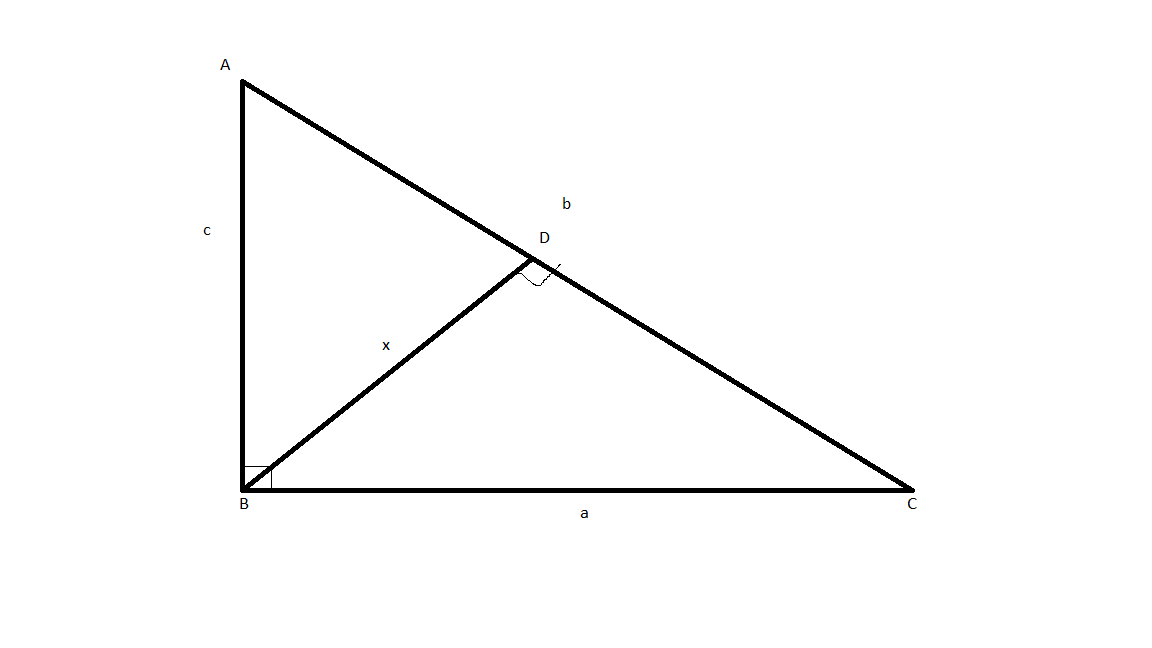
From the question, $b = 2\sqrt 2 \times x$.
Area of triangle= $\dfrac{1}{2}ac$………….(1)
Area of triangle=$\dfrac{1}{2}b \times x$
$
= \dfrac{1}{2}2\sqrt 2 x \times x \\
= \dfrac{{2\sqrt 2 {x^2}}}{2} \\
$
Area of triangle=$\dfrac{{2\sqrt 2 {x^2}}}{2}$ …………(2)
By equating (1) and (2)
\[
\dfrac{1}{2}ac = \dfrac{{2\sqrt 2 {x^2}}}{2} \\
\Rightarrow ac = 2\sqrt 2 {x^2}........(3) \\
\]
By applying hypotenuse theorem,
${a^2} + {c^2} = {b^2}$
\[
{a^2} + {c^2} = {\left( {2\sqrt 2 x} \right)^2} \\
\Rightarrow {a^2} + {c^2} = 8{x^2}........(4) \\
\]
From (3), $a = \dfrac{{2\sqrt 2 {x^2}}}{c}$
By substituting value of ‘a’ in (4),
\[
{\left( {\left. {\dfrac{{2\sqrt 2 {x^2}}}{c}} \right)} \right.^2} + {c^2} = 8{x^2} \\
\Rightarrow \dfrac{{8{x^4}}}{{{c^2}}} + {c^2} = 8{x^2} \\
\Rightarrow 8{x^4} + {c^4} = 8{x^2}{c^2} \\
\Rightarrow {c^4} - 8{x^2}{c^2} + 8{x^4} = 0 \\
\\
\]
It is a quadratic equation in ${c^2}$.
So we can use formula $\dfrac{{ - b \pm \sqrt {{b^2} - 4ac} }}{{2a}}$ to find c
\[
{c^2} = \dfrac{{8{x^2} \pm \sqrt {{{(8{x^2})}^2} - 4 \times 8{x^4}} }}{{2 \times 1}} \\
\Rightarrow {c^2} = \dfrac{{8{x^2} \pm \sqrt {64{x^4} - 32{x^4}} }}{2} \\
\Rightarrow {c^2} = \dfrac{{2 \times (4{x^2} \pm \sqrt {16{x^4} - 8{x^4}} )}}{2} \\
\Rightarrow {c^2} = 4{x^2} \pm \sqrt {8{x^4}} \\
\Rightarrow c = \sqrt {4{x^2} \pm \sqrt {8{x^4}} } \\
\]
We take \[c = \sqrt {4{x^2} - 2\sqrt 2 {x^2}} \] as if \[c = \sqrt {4{x^2} + 2\sqrt 2 {x^2}} \] is taken then equation 4 is not satisfied.
For finding the value of angle ‘C’,
$
\tan c = \dfrac{c}{a} \\
\\
$
$
\tan C = \dfrac{c}{{\left( {\left. {\dfrac{{2\sqrt 2 {x^2}}}{c}} \right)} \right.}} \\
\Rightarrow \tan C = \dfrac{{{c^2}}}{{2\sqrt 2 {x^2}}} \\
\Rightarrow \tan C = \dfrac{{\left( {{{\left. {\sqrt {4{x^2} - 2\sqrt 2 {x^2}} } \right)}^2}} \right.}}{{2\sqrt 2 {x^2}}} \\
\Rightarrow \tan C = \dfrac{{4{x^2} - 2\sqrt 2 {x^2}}}{{2\sqrt 2 {x^2}}} \\
\Rightarrow \tan C = \dfrac{{2\sqrt 2 {x^2}(\sqrt 2 - 1)}}{{2\sqrt 2 {x^2}}} \\
\Rightarrow \tan C = \sqrt 2 - 1 \\
\\
$
Hence,
\[
C = {\tan ^{ - 1}}\left( {\sqrt 2 - 1} \right) \\
\Rightarrow C = {22.5^ \circ } \\
\]
In the triangle ABC,
$
A + B + C = {180^ \circ } \\
\Rightarrow A + C + {90^ \circ } = {180^ \circ } \\
\Rightarrow A + C = {90^ \circ } \\
$
\[A = {90^ \circ } - {22.5^ \circ } = {67.5^ \circ }\]
So the acute angles of the right angled triangle are\[{22.5^ \circ },{67.5^ \circ }\].
Note:
In this question we use the concept of area of the triangle, that is area of triangle remains same irrespective of the side we choose in the formula. Hypotenuse side is the special condition for the right angled triangle. This condition makes the right angled triangle special and different from other triangles.
Complete answer:
Let us consider the value of side AB as ‘c’, BC as ‘a’, CA as ’b’.
Hypotenuse=CA=b
We consider BD to be perpendicularly drawn from the opposite vertex on the hypotenuse whose length is ‘x’, as shown in figure.
From the question, $b = 2\sqrt 2 \times x$.
Area of triangle= $\dfrac{1}{2}ac$………….(1)
Area of triangle=$\dfrac{1}{2}b \times x$
$
= \dfrac{1}{2}2\sqrt 2 x \times x \\
= \dfrac{{2\sqrt 2 {x^2}}}{2} \\
$
Area of triangle=$\dfrac{{2\sqrt 2 {x^2}}}{2}$ …………(2)
By equating (1) and (2)
\[
\dfrac{1}{2}ac = \dfrac{{2\sqrt 2 {x^2}}}{2} \\
\Rightarrow ac = 2\sqrt 2 {x^2}........(3) \\
\]
By applying hypotenuse theorem,
${a^2} + {c^2} = {b^2}$
\[
{a^2} + {c^2} = {\left( {2\sqrt 2 x} \right)^2} \\
\Rightarrow {a^2} + {c^2} = 8{x^2}........(4) \\
\]
From (3), $a = \dfrac{{2\sqrt 2 {x^2}}}{c}$
By substituting value of ‘a’ in (4),
\[
{\left( {\left. {\dfrac{{2\sqrt 2 {x^2}}}{c}} \right)} \right.^2} + {c^2} = 8{x^2} \\
\Rightarrow \dfrac{{8{x^4}}}{{{c^2}}} + {c^2} = 8{x^2} \\
\Rightarrow 8{x^4} + {c^4} = 8{x^2}{c^2} \\
\Rightarrow {c^4} - 8{x^2}{c^2} + 8{x^4} = 0 \\
\\
\]
It is a quadratic equation in ${c^2}$.
So we can use formula $\dfrac{{ - b \pm \sqrt {{b^2} - 4ac} }}{{2a}}$ to find c
\[
{c^2} = \dfrac{{8{x^2} \pm \sqrt {{{(8{x^2})}^2} - 4 \times 8{x^4}} }}{{2 \times 1}} \\
\Rightarrow {c^2} = \dfrac{{8{x^2} \pm \sqrt {64{x^4} - 32{x^4}} }}{2} \\
\Rightarrow {c^2} = \dfrac{{2 \times (4{x^2} \pm \sqrt {16{x^4} - 8{x^4}} )}}{2} \\
\Rightarrow {c^2} = 4{x^2} \pm \sqrt {8{x^4}} \\
\Rightarrow c = \sqrt {4{x^2} \pm \sqrt {8{x^4}} } \\
\]
We take \[c = \sqrt {4{x^2} - 2\sqrt 2 {x^2}} \] as if \[c = \sqrt {4{x^2} + 2\sqrt 2 {x^2}} \] is taken then equation 4 is not satisfied.
For finding the value of angle ‘C’,
$
\tan c = \dfrac{c}{a} \\
\\
$
$
\tan C = \dfrac{c}{{\left( {\left. {\dfrac{{2\sqrt 2 {x^2}}}{c}} \right)} \right.}} \\
\Rightarrow \tan C = \dfrac{{{c^2}}}{{2\sqrt 2 {x^2}}} \\
\Rightarrow \tan C = \dfrac{{\left( {{{\left. {\sqrt {4{x^2} - 2\sqrt 2 {x^2}} } \right)}^2}} \right.}}{{2\sqrt 2 {x^2}}} \\
\Rightarrow \tan C = \dfrac{{4{x^2} - 2\sqrt 2 {x^2}}}{{2\sqrt 2 {x^2}}} \\
\Rightarrow \tan C = \dfrac{{2\sqrt 2 {x^2}(\sqrt 2 - 1)}}{{2\sqrt 2 {x^2}}} \\
\Rightarrow \tan C = \sqrt 2 - 1 \\
\\
$
Hence,
\[
C = {\tan ^{ - 1}}\left( {\sqrt 2 - 1} \right) \\
\Rightarrow C = {22.5^ \circ } \\
\]
In the triangle ABC,
$
A + B + C = {180^ \circ } \\
\Rightarrow A + C + {90^ \circ } = {180^ \circ } \\
\Rightarrow A + C = {90^ \circ } \\
$
\[A = {90^ \circ } - {22.5^ \circ } = {67.5^ \circ }\]
So the acute angles of the right angled triangle are\[{22.5^ \circ },{67.5^ \circ }\].
Note:
In this question we use the concept of area of the triangle, that is area of triangle remains same irrespective of the side we choose in the formula. Hypotenuse side is the special condition for the right angled triangle. This condition makes the right angled triangle special and different from other triangles.
Recently Updated Pages
Master Class 11 English: Engaging Questions & Answers for Success

Master Class 11 Maths: Engaging Questions & Answers for Success
Class 11 Question and Answer - Your Ultimate Solutions Guide
Master Class 11 Biology: Engaging Questions & Answers for Success
Master Class 11 Physics: Engaging Questions & Answers for Success
Master Class 11 Accountancy: Engaging Questions & Answers for Success
Trending doubts
Differentiate between an exothermic and an endothermic class 11 chemistry CBSE
One Metric ton is equal to kg A 10000 B 1000 C 100 class 11 physics CBSE
Difference Between Prokaryotic Cells and Eukaryotic Cells
There are 720 permutations of the digits 1 2 3 4 5 class 11 maths CBSE
Draw a diagram of a plant cell and label at least eight class 11 biology CBSE
1 Quintal is equal to a 110 kg b 10 kg c 100kg d 1000 class 11 physics CBSE