



In a quadrilateral\[ABCD\], \[\cos A\cos B + \sin C\sin D = \]
\[A.\] \[\cos C\cos D + \sin A\sin B\]
\[B.\] \[\cos C\cos D - \sin A\sin B\]
\[C.\] \[\sin C\sin D - \cos A\cos B\]
\[D.\] \[\sin A + \sin B + \sin C + \sin D\]
Answer
 Verified
568.8k+ views
Hint: We need to apply general rules of a quadrilateral.
We have to equalize the opposite sides of the quadrilateral and then we will take \[{\text{Cosine}}\] on both the sides.
Then we will simplify the equation.
Formula used: Sum of all the angles of a quadrilateral is \[{360^ \circ }\].
We can use the following \[{\text{Cosine}}\] formula:
\[\cos (P + Q) = \cos P\cos Q - \sin P\sin Q\] .
Sum of opposite angles of a quadrilateral is \[ = {180^ \circ }\].
Complete step-by-step solution:
Let say, the following picture is of \[ABCD\] quadrilateral.
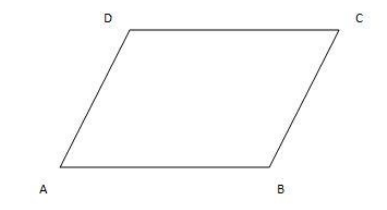
So, according to the properties of a quadrilateral, the opposite angles of a quadrilateral is \[ = {180^ \circ }\].
So, we can say that,
\[A + C = 180{}^ \circ .\]
Also, we can write it as,
\[B + D = 180{}^ \circ .\]
So, we can say that the sum of opposite angles of a quadrilateral is always equal.
So, we can say that the sum of all the angles of a quadrilateral is \[{360^ \circ }\].
So, \[A + B + C + D = {360^ \circ }\].
By taking \[(C + D)\] to the RHS of the equation, we get:
\[A + B = {360^ \circ } - (C + D)\].
By taking cosine on the both sides of the equation, we get:
\[\cos (A + B) = \cos ({360^ \circ } - (C + D))\]
But we know that, \[\cos ({360^ \circ } - \theta ) = \cos (\theta )\] .
So, we can say that,
\[\cos (A + B) = \cos (C + D)\]
Using the formula, we can simplify it following way:
\[ \Rightarrow \cos A\cos B - \sin A\sin B = \cos C\cos D - \sin C\sin D\]
Taking the negative parts to the opposite side of the equation, we get:
\[ \Rightarrow \cos A\cos B + \sin C\sin D = \cos C\cos D + \sin A\sin B\]
\[\therefore \] Option A is the correct choice.
Note: A quadrilateral has four sides and the length of all the sides may or may not be equal but the sum of all angles are always \[{360^ \circ }\].
Always try to remember that we have to take the positive and negative part to the right side of the equation before we apply the cosine or sine on the sum of angles.
We have to equalize the opposite sides of the quadrilateral and then we will take \[{\text{Cosine}}\] on both the sides.
Then we will simplify the equation.
Formula used: Sum of all the angles of a quadrilateral is \[{360^ \circ }\].
We can use the following \[{\text{Cosine}}\] formula:
\[\cos (P + Q) = \cos P\cos Q - \sin P\sin Q\] .
Sum of opposite angles of a quadrilateral is \[ = {180^ \circ }\].
Complete step-by-step solution:
Let say, the following picture is of \[ABCD\] quadrilateral.
So, according to the properties of a quadrilateral, the opposite angles of a quadrilateral is \[ = {180^ \circ }\].
So, we can say that,
\[A + C = 180{}^ \circ .\]
Also, we can write it as,
\[B + D = 180{}^ \circ .\]
So, we can say that the sum of opposite angles of a quadrilateral is always equal.
So, we can say that the sum of all the angles of a quadrilateral is \[{360^ \circ }\].
So, \[A + B + C + D = {360^ \circ }\].
By taking \[(C + D)\] to the RHS of the equation, we get:
\[A + B = {360^ \circ } - (C + D)\].
By taking cosine on the both sides of the equation, we get:
\[\cos (A + B) = \cos ({360^ \circ } - (C + D))\]
But we know that, \[\cos ({360^ \circ } - \theta ) = \cos (\theta )\] .
So, we can say that,
\[\cos (A + B) = \cos (C + D)\]
Using the formula, we can simplify it following way:
\[ \Rightarrow \cos A\cos B - \sin A\sin B = \cos C\cos D - \sin C\sin D\]
Taking the negative parts to the opposite side of the equation, we get:
\[ \Rightarrow \cos A\cos B + \sin C\sin D = \cos C\cos D + \sin A\sin B\]
\[\therefore \] Option A is the correct choice.
Note: A quadrilateral has four sides and the length of all the sides may or may not be equal but the sum of all angles are always \[{360^ \circ }\].
Always try to remember that we have to take the positive and negative part to the right side of the equation before we apply the cosine or sine on the sum of angles.
Recently Updated Pages
Master Class 8 Social Science: Engaging Questions & Answers for Success

Master Class 8 English: Engaging Questions & Answers for Success
Class 8 Question and Answer - Your Ultimate Solutions Guide
Master Class 8 Maths: Engaging Questions & Answers for Success
Master Class 8 Science: Engaging Questions & Answers for Success
Master Class 7 English: Engaging Questions & Answers for Success
Trending doubts
Difference Between Plant Cell and Animal Cell
Fill the blanks with the suitable prepositions 1 The class 9 english CBSE
Which places in India experience sunrise first and class 9 social science CBSE
Who is eligible for RTE class 9 social science CBSE
What is pollution? How many types of pollution? Define it
Name 10 Living and Non living things class 9 biology CBSE