




In a quadrilateral PQRS
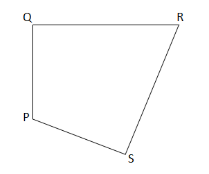
(i) Name the sides, angles, vertices and diagonals.
(ii) Also name all the pairs of adjacent sides, adjacent angles, opposite sides and opposite angles.
Answer
 Verified
636.6k+ views
Hint: In order to solve the problem use the figure and simple visualization. Basic definitions of quadrilateral will be used to solve the second part of the problem.
Complete step-by-step answer:
For the quadrilateral PQRS
Sides: $PQ,QR,RS,SP$
Angles: $\angle PQR,\angle QRS,\angle RSP,\angle SPQ$
Vertices: $P,Q,R,S$
Diagonal: $PR,QS$
Pairs of adjacent sides:
$\left\{ {PQ,QR} \right\},\left\{ {QR,RS} \right\},\left\{ {RS,SP} \right\},\left\{ {SP,PQ} \right\}$
Pairs of adjacent angles:
$\left\{ {\angle PQR,\angle QRS} \right\},\left\{ {\angle QRS,\angle RSP} \right\},\left\{ {\angle RSP,\angle SPQ} \right\},\left\{ {\angle SPQ,\angle PQR} \right\}$
Pairs of opposite sides:
$PS,QR{\text{ and }}QP,RS$
Pairs of opposite angles
$\angle QRS,\angle SPQ{\text{ and }}\angle RSP\angle PQR$
Note: A quadrilateral is a polygon with four edges and four vertices or corners. Adjacent sides are sides of a polygon that have a common vertex. Two angles are Adjacent when they have a common side and a common vertex (corner point) and don't overlap.
Complete step-by-step answer:
For the quadrilateral PQRS
Sides: $PQ,QR,RS,SP$
Angles: $\angle PQR,\angle QRS,\angle RSP,\angle SPQ$
Vertices: $P,Q,R,S$
Diagonal: $PR,QS$
Pairs of adjacent sides:
$\left\{ {PQ,QR} \right\},\left\{ {QR,RS} \right\},\left\{ {RS,SP} \right\},\left\{ {SP,PQ} \right\}$
Pairs of adjacent angles:
$\left\{ {\angle PQR,\angle QRS} \right\},\left\{ {\angle QRS,\angle RSP} \right\},\left\{ {\angle RSP,\angle SPQ} \right\},\left\{ {\angle SPQ,\angle PQR} \right\}$
Pairs of opposite sides:
$PS,QR{\text{ and }}QP,RS$
Pairs of opposite angles
$\angle QRS,\angle SPQ{\text{ and }}\angle RSP\angle PQR$
Note: A quadrilateral is a polygon with four edges and four vertices or corners. Adjacent sides are sides of a polygon that have a common vertex. Two angles are Adjacent when they have a common side and a common vertex (corner point) and don't overlap.

Recently Updated Pages
Three beakers labelled as A B and C each containing 25 mL of water were taken A small amount of NaOH anhydrous CuSO4 and NaCl were added to the beakers A B and C respectively It was observed that there was an increase in the temperature of the solutions contained in beakers A and B whereas in case of beaker C the temperature of the solution falls Which one of the following statements isarecorrect i In beakers A and B exothermic process has occurred ii In beakers A and B endothermic process has occurred iii In beaker C exothermic process has occurred iv In beaker C endothermic process has occurred

Master Class 9 Social Science: Engaging Questions & Answers for Success
Master Class 9 Science: Engaging Questions & Answers for Success
Master Class 9 Maths: Engaging Questions & Answers for Success
Master Class 9 General Knowledge: Engaging Questions & Answers for Success
Class 9 Question and Answer - Your Ultimate Solutions Guide
Three beakers labelled as A B and C each containing 25 mL of water were taken A small amount of NaOH anhydrous CuSO4 and NaCl were added to the beakers A B and C respectively It was observed that there was an increase in the temperature of the solutions contained in beakers A and B whereas in case of beaker C the temperature of the solution falls Which one of the following statements isarecorrect i In beakers A and B exothermic process has occurred ii In beakers A and B endothermic process has occurred iii In beaker C exothermic process has occurred iv In beaker C endothermic process has occurred
Master Class 9 Social Science: Engaging Questions & Answers for Success
Master Class 9 Science: Engaging Questions & Answers for Success
Trending doubts
Find the sum of series 1 + 2 + 3 + 4 + 5 + + 100 class 9 maths CBSE
Fill the blanks with the suitable prepositions 1 The class 9 english CBSE
Difference Between Plant Cell and Animal Cell
What is pollution? How many types of pollution? Define it
Name 10 Living and Non living things class 9 biology CBSE
Which are the Top 10 Largest States of India?