




In a p-type semiconductor majority charge carriers are _________
A. Holes
B. Electrons
C. Both holes and electrons
D. ions
Answer
 Verified
602.1k+ views
Hint: The majority of charge carriers in p-type semiconductor depends on the doping of trivalent impurity atoms. Intrinsic semiconductors are pure semiconductors and the process of adding the atoms is termed as doping. After doping the semiconductor is known as extrinsic semiconductor.
Complete step by step solution:
Let us consider, an intrinsic (pure) semiconductor is doped with a trivalent impurity atom such as Gallium (Ga) or Boron (B). After doping the atoms form a covalent bond with the pure semiconductor atom but the bond lacks one electron for a complete outer shell of eight as shown in the below figure:-
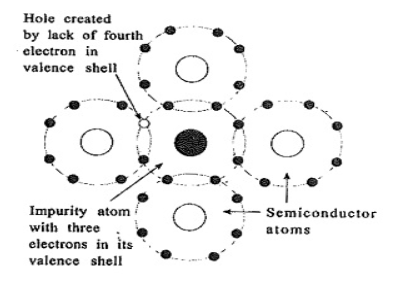
Now, as we know that the impurity atom is trivalent impurity which means it has only three valence electrons, so, extra positive charge carriers i.e., holes are created in this way in the bond with the surrounding atoms thus increasing the positive charge carriers i.e., holes.
Therefore, the answer is holes i.e., option A is correct.
Note: In case of semiconductors, the energy gap between valence and conduction band is finite. So, some electrons from the valence band, at room temperature, acquire enough energy to cross the energy gap and enter the conduction band, leaving behind a gap or vacancy with an effective positive charge, called holes. In semiconductors, the electrons and holes are called charge carriers. As ions are not produced nor considered charge carriers, so option D is incorrect.
Complete step by step solution:
Let us consider, an intrinsic (pure) semiconductor is doped with a trivalent impurity atom such as Gallium (Ga) or Boron (B). After doping the atoms form a covalent bond with the pure semiconductor atom but the bond lacks one electron for a complete outer shell of eight as shown in the below figure:-
Now, as we know that the impurity atom is trivalent impurity which means it has only three valence electrons, so, extra positive charge carriers i.e., holes are created in this way in the bond with the surrounding atoms thus increasing the positive charge carriers i.e., holes.
Therefore, the answer is holes i.e., option A is correct.
Note: In case of semiconductors, the energy gap between valence and conduction band is finite. So, some electrons from the valence band, at room temperature, acquire enough energy to cross the energy gap and enter the conduction band, leaving behind a gap or vacancy with an effective positive charge, called holes. In semiconductors, the electrons and holes are called charge carriers. As ions are not produced nor considered charge carriers, so option D is incorrect.
Recently Updated Pages
Master Class 11 Social Science: Engaging Questions & Answers for Success

Master Class 11 Physics: Engaging Questions & Answers for Success
Master Class 11 Maths: Engaging Questions & Answers for Success
Master Class 11 Economics: Engaging Questions & Answers for Success
Master Class 11 Computer Science: Engaging Questions & Answers for Success
Master Class 11 Chemistry: Engaging Questions & Answers for Success
Trending doubts
One Metric ton is equal to kg A 10000 B 1000 C 100 class 11 physics CBSE
There are 720 permutations of the digits 1 2 3 4 5 class 11 maths CBSE
1 Quintal is equal to a 110 kg b 10 kg c 100kg d 1000 class 11 physics CBSE
State and prove Bernoullis theorem class 11 physics CBSE
Difference Between Prokaryotic Cells and Eukaryotic Cells
Which among the following are examples of coming together class 11 social science CBSE