




In a plasmid vector, the number of sites for a restriction endonuclease is present
(a) Twice
(b) Only once
(c)Any number
(d) Restriction site not needed
Answer
 Verified
615.3k+ views
Hint: Since multiple copies of the same restriction site will digest the vector to produce various fragments of DNA so the number of sides should be less than two.
Complete answer:
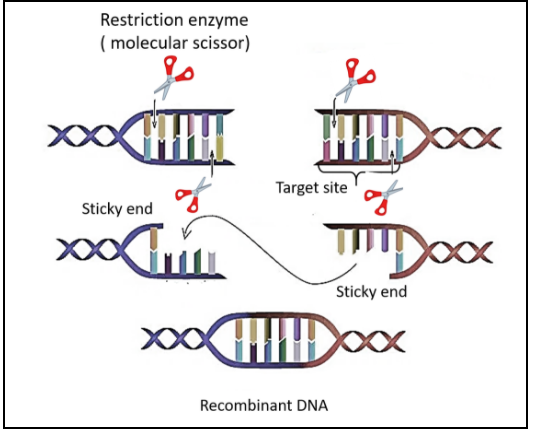
In a plasmid vector, the number of sites for a restriction endonuclease is present only once. There may be multiple cloning sites in a plasmid vector made up of different types of restriction sites. But all of them will be repeated only once because multiple copies of the same restriction site will digest the vector to produce various fragments of DNA, after the action of the restriction enzyme. Due to this the factor will fail to serve its function of producing a recombinant DNA. This will cause the presence of only one site of restriction endonuclease.
Additional Information: -The restriction enzymes are found in bacteria and the sequences of DNA which they recognize and bind are called the restriction sites.
-The DNA cutting enzymes are restriction enzymes also known as restriction endonuclease.
-One or a few target sequence is recognized by each enzyme and they cut the DNA at or near those sequences
-Plasmid vectors are double-stranded circular DNA molecules that are small and with a bacterial replication origin.
-The plasmid vectors are capable of producing a very high level of replication and convenient restriction sites.
So, the correct answer is,'Only once'.
Note: -The plasmid vectors are designed to work in bacteria.
-Replication of the plasmid vector occurs along with their host cells.
-A vector is generally a vehicle that is used by the researchers in the laboratory to introduce DNA into a host cell.
Complete answer:
In a plasmid vector, the number of sites for a restriction endonuclease is present only once. There may be multiple cloning sites in a plasmid vector made up of different types of restriction sites. But all of them will be repeated only once because multiple copies of the same restriction site will digest the vector to produce various fragments of DNA, after the action of the restriction enzyme. Due to this the factor will fail to serve its function of producing a recombinant DNA. This will cause the presence of only one site of restriction endonuclease.
Additional Information: -The restriction enzymes are found in bacteria and the sequences of DNA which they recognize and bind are called the restriction sites.
-The DNA cutting enzymes are restriction enzymes also known as restriction endonuclease.
-One or a few target sequence is recognized by each enzyme and they cut the DNA at or near those sequences
-Plasmid vectors are double-stranded circular DNA molecules that are small and with a bacterial replication origin.
-The plasmid vectors are capable of producing a very high level of replication and convenient restriction sites.
So, the correct answer is,'Only once'.
Note: -The plasmid vectors are designed to work in bacteria.
-Replication of the plasmid vector occurs along with their host cells.
-A vector is generally a vehicle that is used by the researchers in the laboratory to introduce DNA into a host cell.
Recently Updated Pages
Master Class 12 Business Studies: Engaging Questions & Answers for Success

Master Class 12 Chemistry: Engaging Questions & Answers for Success
Master Class 12 Biology: Engaging Questions & Answers for Success
Class 12 Question and Answer - Your Ultimate Solutions Guide
Master Class 11 English: Engaging Questions & Answers for Success
Master Class 11 Social Science: Engaging Questions & Answers for Success
Trending doubts
Which are the Top 10 Largest Countries of the World?
Draw a labelled sketch of the human eye class 12 physics CBSE
Differentiate between homogeneous and heterogeneous class 12 chemistry CBSE
Differentiate between Pyramid of energy and pyramid class 12 biology CBSE
Why is the cell called the structural and functional class 12 biology CBSE
Draw the diagram of the pyramid of energy Explain In class 12 biology CBSE