




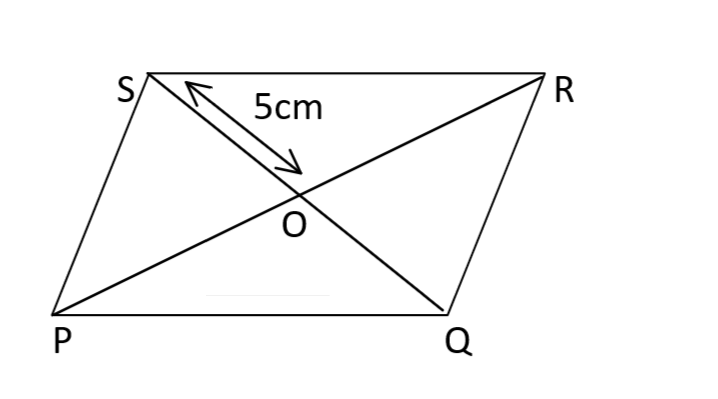
In a parallelogram, $OS = 5cm$ and $PR$ is $6cm$ more than $QS$. Find $OP$.
Answer
 Verified
616.2k+ views
Hint: To solve this question you have to use the property which states that diagonals of parallelogram bisect each other equally and then put the given values in equations and find the answer.
Complete step by step answer:
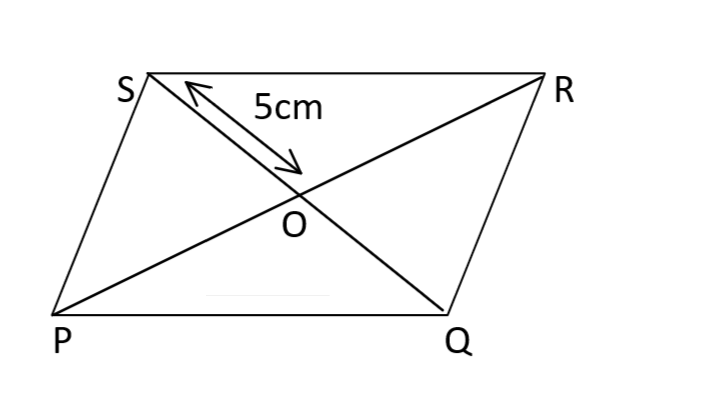
Given: $PQRS$ is a parallelogram
$OS = 5cm$
Using the property of parallelogram which states that diagonals of the parallelogram bisect each other equally which means the intersection point of both the diagonals is the midpoint of the diagonals.
So O point will be the mid point of line SQ and PR.
$OS = OQ$--(1) and $PO = OR$ ---(2)
We know
$SQ$ is made from 2 parts which are $OS$ and $OQ$ or is the midpoint of side $SQ$.
$SQ = OS + OQ$
Putting the value of $OQ$ using equation (1)
$
SQ = 2OS \\
OS = 5 cm \\
\\
$
So, $SQ = 10cm$--(3)
And we are given that $PR$ is $6cm$ more than $QS$. This means
$PR = QS + 6$
Putting the value of side $QS$ using equation (3)
$PR = 10 + 6$
$PR = 16cm$---(4)
So ,length of the side PR will be 16cm
And we know O is the midpoint of $PR$, so we can make an equation
$PR = OP + OR$
Putting the value of side OP using equation (2)
So ,side $PR$ will be the twice of side $OP$
$
PR = 2OP \\
OP = \dfrac{1}{2}PR \\
$
Now put the value of side PR using equation (4)
$OP = \dfrac{1}{2} \times 16$
$OP = 8cm$
Therefore , the length of side $OP$ is $8cm$
Note:
A parallelogram is a quadrilateral with opposite sides parallel (and therefore opposite angles equal). A quadrilateral with equal sides is called a rhombus, and a parallelogram whose angles are all right angles is called a rectangle.
Complete step by step answer:
Given: $PQRS$ is a parallelogram
$OS = 5cm$
Using the property of parallelogram which states that diagonals of the parallelogram bisect each other equally which means the intersection point of both the diagonals is the midpoint of the diagonals.
So O point will be the mid point of line SQ and PR.
$OS = OQ$--(1) and $PO = OR$ ---(2)
We know
$SQ$ is made from 2 parts which are $OS$ and $OQ$ or is the midpoint of side $SQ$.
$SQ = OS + OQ$
Putting the value of $OQ$ using equation (1)
$
SQ = 2OS \\
OS = 5 cm \\
\\
$
So, $SQ = 10cm$--(3)
And we are given that $PR$ is $6cm$ more than $QS$. This means
$PR = QS + 6$
Putting the value of side $QS$ using equation (3)
$PR = 10 + 6$
$PR = 16cm$---(4)
So ,length of the side PR will be 16cm
And we know O is the midpoint of $PR$, so we can make an equation
$PR = OP + OR$
Putting the value of side OP using equation (2)
So ,side $PR$ will be the twice of side $OP$
$
PR = 2OP \\
OP = \dfrac{1}{2}PR \\
$
Now put the value of side PR using equation (4)
$OP = \dfrac{1}{2} \times 16$
$OP = 8cm$
Therefore , the length of side $OP$ is $8cm$
Note:
A parallelogram is a quadrilateral with opposite sides parallel (and therefore opposite angles equal). A quadrilateral with equal sides is called a rhombus, and a parallelogram whose angles are all right angles is called a rectangle.
Recently Updated Pages
Master Class 11 Social Science: Engaging Questions & Answers for Success

Master Class 11 Chemistry: Engaging Questions & Answers for Success
Master Class 9 General Knowledge: Engaging Questions & Answers for Success
Master Class 9 Maths: Engaging Questions & Answers for Success
Master Class 9 Science: Engaging Questions & Answers for Success
Master Class 9 English: Engaging Questions & Answers for Success
Trending doubts
One Metric ton is equal to kg A 10000 B 1000 C 100 class 11 physics CBSE
Difference Between Prokaryotic Cells and Eukaryotic Cells
Two of the body parts which do not appear in MRI are class 11 biology CBSE
1 ton equals to A 100 kg B 1000 kg C 10 kg D 10000 class 11 physics CBSE
10 examples of friction in our daily life
Name the Largest and the Smallest Cell in the Human Body ?