




In a parallelogram ABCD, if $AB=2x+5$, $CD=y+1$, $AD=y+5$ and $BC=3x-4$ then find the ratio of $AB:BC$.
A. $71:21$
B. $12:11$
C. $31:35$
D. $4:7$
Answer
 Verified
629.1k+ views
Hint: We first use the property of parallelogram which tells us that opposite sides of a parallelogram are equal in length. We have been given the length of all the sides. We equate the corresponding equal sides and get two linear equations of two variables. We solve them to find the side lengths and then find the ratio $AB:BC$.
Complete step by step answer:
It’s given that ABCD is a parallelogram. We know that opposite sides of a parallelogram are equal. This means $AB=CD,AD=BC$. It’s given that $AB=2x+5$, $CD=y+1$, $AD=y+5$ and $BC=3x-4$.
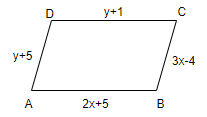
So, we have the values of the sides. Those are made of two variables. We also have two equations to solve them.
So, putting the values we get
$\begin{align}
& 2x+5=y+1 \\
& \Rightarrow 2x-y=-4.....(i) \\
\end{align}$
and
$\begin{align}
& y+5=3x-4 \\
& \Rightarrow 3x-y=9......(ii) \\
\end{align}$
We subtract equation (i) from equation (ii) to get
$\begin{align}
& \left( 3x-y \right)-\left( 2x-y \right)=9-\left( -4 \right) \\
& \Rightarrow x=13 \\
\end{align}$
Putting the value of x we get $y=2x+4=2\times 13+4=30$.
Now we find the values of AB and BC which are $AB=2x+5=2\times 13+5=31$ and $BC=3x-4=3\times 13-4=35$ respectively.
Now we can find $AB:BC$ which is $31:35$.
So, the correct answer is “Option C”.
Note: We always have to equate the opposite sides. We can never equate two consecutive sides whatsoever. Also, we can’t take the given equations as those equations of lines. They are merely representative numbers or variables.
Complete step by step answer:
It’s given that ABCD is a parallelogram. We know that opposite sides of a parallelogram are equal. This means $AB=CD,AD=BC$. It’s given that $AB=2x+5$, $CD=y+1$, $AD=y+5$ and $BC=3x-4$.
So, we have the values of the sides. Those are made of two variables. We also have two equations to solve them.
So, putting the values we get
$\begin{align}
& 2x+5=y+1 \\
& \Rightarrow 2x-y=-4.....(i) \\
\end{align}$
and
$\begin{align}
& y+5=3x-4 \\
& \Rightarrow 3x-y=9......(ii) \\
\end{align}$
We subtract equation (i) from equation (ii) to get
$\begin{align}
& \left( 3x-y \right)-\left( 2x-y \right)=9-\left( -4 \right) \\
& \Rightarrow x=13 \\
\end{align}$
Putting the value of x we get $y=2x+4=2\times 13+4=30$.
Now we find the values of AB and BC which are $AB=2x+5=2\times 13+5=31$ and $BC=3x-4=3\times 13-4=35$ respectively.
Now we can find $AB:BC$ which is $31:35$.
So, the correct answer is “Option C”.
Note: We always have to equate the opposite sides. We can never equate two consecutive sides whatsoever. Also, we can’t take the given equations as those equations of lines. They are merely representative numbers or variables.
Recently Updated Pages
Class 10 Question and Answer - Your Ultimate Solutions Guide

Master Class 10 Computer Science: Engaging Questions & Answers for Success
Master Class 10 General Knowledge: Engaging Questions & Answers for Success
Master Class 12 Economics: Engaging Questions & Answers for Success
Master Class 12 Social Science: Engaging Questions & Answers for Success
Master Class 12 English: Engaging Questions & Answers for Success
Trending doubts
Explain the Treaty of Vienna of 1815 class 10 social science CBSE
The slogan Jai Hind was given by A Lal Bahadur Shastri class 10 social science CBSE
10 examples of evaporation in daily life with explanations
What is the full form of POSCO class 10 social science CBSE
Identify the feminine form of noun nephew a shenephew class 10 english CBSE
CSIR full form?