




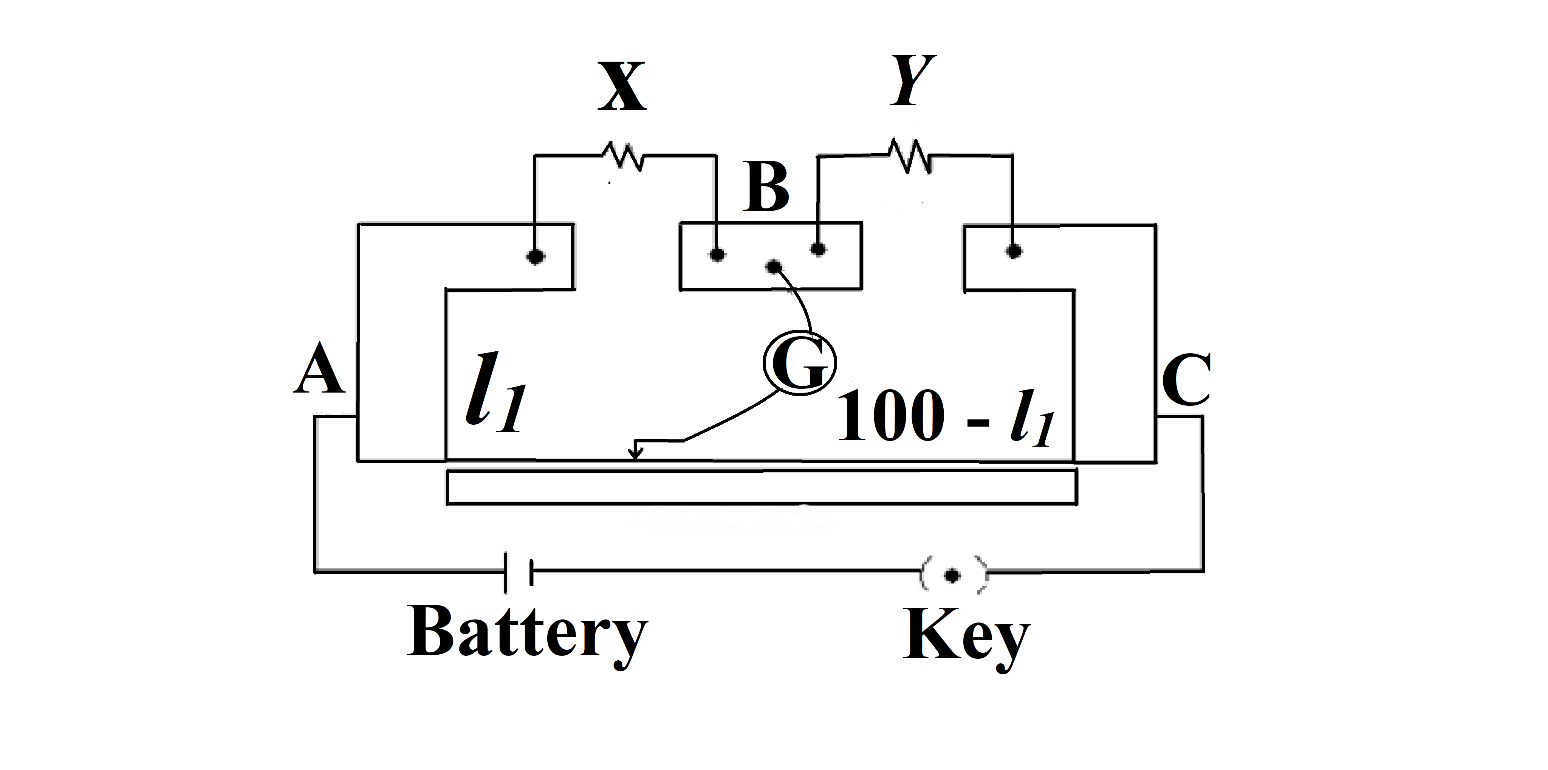
In a meter bridge, as shown in the figure, it is given that resistance \[Y=12.5\Omega \] and that balance is obtained at distance 39.5 cm, from the end A (by the jockey J). After interchanging the resistances X and Y, a new balance point is found at a distance ${{l}_{2}}$ from end A. What are the values of X and ${{l}_{2}}$?
Answer
 Verified
596.7k+ views
Hint: A meter bridge, also known as a slide wire bridge, is an instrument that functions on the Wheatstone bridge principle. A meter bridge is used to describe a conductor 's uncertain resistance as that of a Wheatstone bridge, which was invented in 1843 by The Wheatstone bridge was invented by Samuel Hunter Christie. We can solve this question using the meter bridge formula.
Formula used:
For solving this question, we will be using the formula for the meter bridge, i.e.,
$X=Y\dfrac{l}{(100-l)}$
Complete answer:
Before solving the question, let us take a look at the given parameters
$X=12.5\Omega $
$l=39.5cm$
By using the values given above, we can find the value of the other resistance, i.e., Y
So,
$X=Y\dfrac{l}{(100-l)}$
$\Rightarrow 12.5=Y\times \dfrac{39.5}{(100-39.5)}$
$\Rightarrow X=12.5\times \dfrac{60.5}{39.5}$
$\Rightarrow X=8.16\Omega $
Now, we have the values of both X and Y, so moving on to the second part
The resistances are interchanged
Again, applying the same method
We have,
$Y=X\dfrac{{{l}_{2}}}{(100-{{l}_{2}})}$
$\Rightarrow \dfrac{12.5}{8.16}=\dfrac{{{l}_{2}}}{(100-{{l}_{2}})}$
$\Rightarrow 1.53(100-{{l}_{2}})={{l}_{2}}$
$\Rightarrow \dfrac{153}{2.53}={{l}_{2}}$
$\Rightarrow {{l}_{2}}=60.5cm$
So after solving, we have the values
$X=8.16\Omega $
${{l}_{2}}=60.5cm$
Note:
The reason why we subtract the length of the balance point by 100 is because the meter bridge is 100 cm long (or 1 m long as the name suggests itself). The meter bridge works on the theory that the ratio of resistances is equal to the ratio of their corresponding lengths, i.e., distance of the balance point from their respective sides.
Formula used:
For solving this question, we will be using the formula for the meter bridge, i.e.,
$X=Y\dfrac{l}{(100-l)}$
Complete answer:
Before solving the question, let us take a look at the given parameters
$X=12.5\Omega $
$l=39.5cm$
By using the values given above, we can find the value of the other resistance, i.e., Y
So,
$X=Y\dfrac{l}{(100-l)}$
$\Rightarrow 12.5=Y\times \dfrac{39.5}{(100-39.5)}$
$\Rightarrow X=12.5\times \dfrac{60.5}{39.5}$
$\Rightarrow X=8.16\Omega $
Now, we have the values of both X and Y, so moving on to the second part
The resistances are interchanged
Again, applying the same method
We have,
$Y=X\dfrac{{{l}_{2}}}{(100-{{l}_{2}})}$
$\Rightarrow \dfrac{12.5}{8.16}=\dfrac{{{l}_{2}}}{(100-{{l}_{2}})}$
$\Rightarrow 1.53(100-{{l}_{2}})={{l}_{2}}$
$\Rightarrow \dfrac{153}{2.53}={{l}_{2}}$
$\Rightarrow {{l}_{2}}=60.5cm$
So after solving, we have the values
$X=8.16\Omega $
${{l}_{2}}=60.5cm$
Note:
The reason why we subtract the length of the balance point by 100 is because the meter bridge is 100 cm long (or 1 m long as the name suggests itself). The meter bridge works on the theory that the ratio of resistances is equal to the ratio of their corresponding lengths, i.e., distance of the balance point from their respective sides.
Recently Updated Pages
Master Class 10 Social Science: Engaging Questions & Answers for Success

Master Class 10 Science: Engaging Questions & Answers for Success
Master Class 10 Maths: Engaging Questions & Answers for Success
Master Class 10 General Knowledge: Engaging Questions & Answers for Success
Master Class 10 Computer Science: Engaging Questions & Answers for Success
Class 10 Question and Answer - Your Ultimate Solutions Guide
Trending doubts
What is the full form of PNG A Petrol Natural Gas B class 10 chemistry CBSE
Explain the Treaty of Vienna of 1815 class 10 social science CBSE
In cricket, how many legal balls are there in a standard over?
Why is there a time difference of about 5 hours between class 10 social science CBSE
Who Won 36 Oscar Awards? Record Holder Revealed
What is the median of the first 10 natural numbers class 10 maths CBSE