




In a lifting machine, an effort of $500N$ is to be moved by a distance of $20m$ to raise a load of $10000N$ by a distance of $0.8m$. Calculate the velocity ratio and mechanical advantage?
$\begin{align}
& A.10\text{ and }35 \\
& B.20\text{ and }35 \\
& C.10\text{ and }25 \\
& D.25\text{ and }20 \\
\end{align}$
Answer
 Verified
582.6k+ views
Hint: The velocity ratio can be found by taking the ratio of the distance moved by effort to the distance moved by the load. The mechanical advantage is given by taking the ratio of the weight of the load to the weight of the effort. First of all find the velocity ratio and then mechanical advantage. These all will help you in solving out this question.
Complete step by step answer:
The velocity ratio can be found by the ratio of the distance moved by effort to the distance moved by the load. This can be expressed as an equation,
${{V}_{R}}=\dfrac{{{E}_{d}}}{{{L}_{d}}}$
It has been already mentioned in the question that the distance moved by the effort will be,
${{E}_{d}}=20m$
And the distance moved by the load can be written as,
${{L}_{d}}=0.8m$
Therefore we can substitute this in the equation of velocity ratio. That is,
$\begin{align}
& {{V}_{R}}=\dfrac{{{E}_{d}}}{{{L}_{d}}}=\dfrac{20}{0.8} \\
& {{V}_{R}}=25 \\
\end{align}$
Now let us find out the mechanical advantage of the machine,
It is found by the ratio of the weight of the load to the weight of the effort.
This can be expressed in an equation as,
$MA=\dfrac{\text{load}}{\text{effort}}$
It has been mentioned in the question that the weight of the effort is given as,
$effort=500N$
And the weight of the load can be calculated as,
$load=10000N$
Substituting the values in the equation of mechanical advantage will give,
$MA=\dfrac{10000}{500}=20$
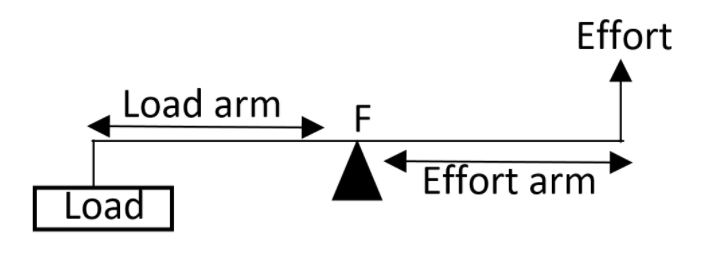
So, the correct answer is “Option D”.
Note: Mechanical advantage is a quantity for the calculation of the force amplification produced by using a tool, mechanical device or machine system. An example for this is the law of the lever. Velocity ratio is the ratio of a distance through which a component of a machine moves to that which the driving component is moving during the identical time.
Complete step by step answer:
The velocity ratio can be found by the ratio of the distance moved by effort to the distance moved by the load. This can be expressed as an equation,
${{V}_{R}}=\dfrac{{{E}_{d}}}{{{L}_{d}}}$
It has been already mentioned in the question that the distance moved by the effort will be,
${{E}_{d}}=20m$
And the distance moved by the load can be written as,
${{L}_{d}}=0.8m$
Therefore we can substitute this in the equation of velocity ratio. That is,
$\begin{align}
& {{V}_{R}}=\dfrac{{{E}_{d}}}{{{L}_{d}}}=\dfrac{20}{0.8} \\
& {{V}_{R}}=25 \\
\end{align}$
Now let us find out the mechanical advantage of the machine,
It is found by the ratio of the weight of the load to the weight of the effort.
This can be expressed in an equation as,
$MA=\dfrac{\text{load}}{\text{effort}}$
It has been mentioned in the question that the weight of the effort is given as,
$effort=500N$
And the weight of the load can be calculated as,
$load=10000N$
Substituting the values in the equation of mechanical advantage will give,
$MA=\dfrac{10000}{500}=20$
So, the correct answer is “Option D”.
Note: Mechanical advantage is a quantity for the calculation of the force amplification produced by using a tool, mechanical device or machine system. An example for this is the law of the lever. Velocity ratio is the ratio of a distance through which a component of a machine moves to that which the driving component is moving during the identical time.
Recently Updated Pages
Master Class 11 Computer Science: Engaging Questions & Answers for Success

Master Class 11 Business Studies: Engaging Questions & Answers for Success
Master Class 11 Economics: Engaging Questions & Answers for Success
Master Class 11 English: Engaging Questions & Answers for Success
Master Class 11 Maths: Engaging Questions & Answers for Success
Master Class 11 Biology: Engaging Questions & Answers for Success
Trending doubts
One Metric ton is equal to kg A 10000 B 1000 C 100 class 11 physics CBSE
There are 720 permutations of the digits 1 2 3 4 5 class 11 maths CBSE
Discuss the various forms of bacteria class 11 biology CBSE
Draw a diagram of a plant cell and label at least eight class 11 biology CBSE
State the laws of reflection of light
Explain zero factorial class 11 maths CBSE