




In a group of 500 people, 310 can speak Hindi, 260 can speak English. How many people can speak both English and Hindi?
Answer
 Verified
604.5k+ views
Hint: Now here we have 310 people speak Hindi and 260 can speak English. Let us call set A and B as the set of people who speak English and people who speak Hindi respectively. Now $A\cup B$ represents the total number of people while $A\cap B$ represents the people speaking both the languages. Now we know that $n\left( A\cup B \right)=n\left( A \right)+n\left( B \right)-n\left( A\cap B \right)$ . Hence we will use this result to find the number of people who speak both the languages.
Complete step by step answer:
Now we know that the total number of people is 500.
It is given that the number of people that speak Hindi is 310.
Let A be the set of people that speak Hindi. Hence we get n(A) = 310, Where n(A) means number of elements in set A.
Now also the number of people speaking English is 260.
Let B be the set whose elements are the people who speak English.
Hence we get n(B) = 260, where n(B) means number of elements in set B.
Now in the group of 500, people are either Hindi speaking or English speaking or both.
Now what does set $A\cup B$mean?
$A\cup B$ consists of elements which are either in A or in B.
Hence the set $A\cup B$ represents the set of all people who speak Hindi or English.
Now $n\left( A\cup B \right)=500$ . Where $n\left( A\cup B \right)$ means the number of elements in the set $A\cup B$ .
Now let us understand what does $A\cap B$ means,
$A\cap B$ means the set of all the elements which are in A and B.
Hence $A\cap B$ represents the set of people speaking English and Hindi.
Hence $n\left( A\cap B \right)$ shows the number of people speaking English and Hindi.
Now we know that
$n\left( A\cup B \right)=n\left( A \right)+n\left( B \right)-n\left( A\cap B \right)$
Now substituting the values in the equation we get,
\[\begin{align}
& 500=310+260-n\left( A\cap B \right) \\
& \Rightarrow 500=570-n\left( A\cap B \right) \\
& \Rightarrow n\left( A\cap B \right)=570-500 \\
& \Rightarrow n\left( A\cap B \right)=70 \\
\end{align}\]
Hence the number of people speaking both the languages English and Hindi are 70.
Note: Now note that here in the group of 500 people either people speak English or Hindi. Hence we could say that $\left( A\cup B \right)$ represents the total number of people. Also remember that the number of elements in $\left( A\cup B \right)$ is given by \[n\left( A\cup B \right)=n\left( A \right)+n\left( B \right)-n\left( A\cap B \right)\]
and not $n\left( A\cup B \right)=n\left( A \right)+n\left( B \right)$ We can also understand this by drawing a venn diagram.
Venn diagrams are nothing but representations of sets as closed figures. For example If A and B are two sets then we can represent them by
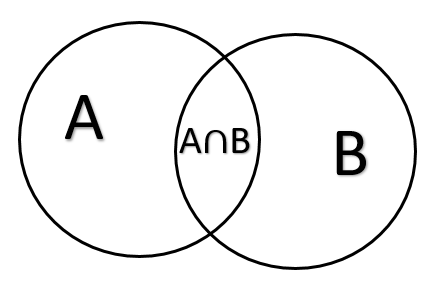
Note that the common part in both the figures represents the intersection of two sets.
Complete step by step answer:
Now we know that the total number of people is 500.
It is given that the number of people that speak Hindi is 310.
Let A be the set of people that speak Hindi. Hence we get n(A) = 310, Where n(A) means number of elements in set A.
Now also the number of people speaking English is 260.
Let B be the set whose elements are the people who speak English.
Hence we get n(B) = 260, where n(B) means number of elements in set B.
Now in the group of 500, people are either Hindi speaking or English speaking or both.
Now what does set $A\cup B$mean?
$A\cup B$ consists of elements which are either in A or in B.
Hence the set $A\cup B$ represents the set of all people who speak Hindi or English.
Now $n\left( A\cup B \right)=500$ . Where $n\left( A\cup B \right)$ means the number of elements in the set $A\cup B$ .
Now let us understand what does $A\cap B$ means,
$A\cap B$ means the set of all the elements which are in A and B.
Hence $A\cap B$ represents the set of people speaking English and Hindi.
Hence $n\left( A\cap B \right)$ shows the number of people speaking English and Hindi.
Now we know that
$n\left( A\cup B \right)=n\left( A \right)+n\left( B \right)-n\left( A\cap B \right)$
Now substituting the values in the equation we get,
\[\begin{align}
& 500=310+260-n\left( A\cap B \right) \\
& \Rightarrow 500=570-n\left( A\cap B \right) \\
& \Rightarrow n\left( A\cap B \right)=570-500 \\
& \Rightarrow n\left( A\cap B \right)=70 \\
\end{align}\]
Hence the number of people speaking both the languages English and Hindi are 70.
Note: Now note that here in the group of 500 people either people speak English or Hindi. Hence we could say that $\left( A\cup B \right)$ represents the total number of people. Also remember that the number of elements in $\left( A\cup B \right)$ is given by \[n\left( A\cup B \right)=n\left( A \right)+n\left( B \right)-n\left( A\cap B \right)\]
and not $n\left( A\cup B \right)=n\left( A \right)+n\left( B \right)$ We can also understand this by drawing a venn diagram.
Venn diagrams are nothing but representations of sets as closed figures. For example If A and B are two sets then we can represent them by
Note that the common part in both the figures represents the intersection of two sets.
Recently Updated Pages
Master Class 11 Social Science: Engaging Questions & Answers for Success

Master Class 11 English: Engaging Questions & Answers for Success
Master Class 11 Maths: Engaging Questions & Answers for Success
Master Class 11 Chemistry: Engaging Questions & Answers for Success
Master Class 11 Biology: Engaging Questions & Answers for Success
Master Class 11 Physics: Engaging Questions & Answers for Success
Trending doubts
Differentiate between an exothermic and an endothermic class 11 chemistry CBSE
One Metric ton is equal to kg A 10000 B 1000 C 100 class 11 physics CBSE
Difference Between Prokaryotic Cells and Eukaryotic Cells
There are 720 permutations of the digits 1 2 3 4 5 class 11 maths CBSE
Draw a diagram of a plant cell and label at least eight class 11 biology CBSE
1 Quintal is equal to a 110 kg b 10 kg c 100kg d 1000 class 11 physics CBSE