




In a group of 50 students, the number of students studying French, English, Sanskrit were found to be as follows French \[ = 17\], English \[ = 13\], Sanskrit \[ = 15\], French and English \[ = 09\], English and Sanskrit \[ = 4\], French and Sanskrit \[ = 5\], English, French and Sanskrit \[ = 3\]. Find the number of students who study
1) Only Sanskrit
2) French and Sanskrit but not English
Answer
 Verified
558.3k+ views
Hint:
Here, we will find the number of students by using the concept of applications on the cardinality of the set. A set is defined as the collection of well defined objects. Cardinality of a set is defined as the number of elements in a set.
Complete step by step solution:
Let F be the number of students studying French, E be the number of students studying English, S be the number of students studying Sanskrit
Number of students studying French:
\[n\left( F \right) = 17\]
Number of students studying English:
\[n\left( E \right) = 13\]
Number of students studying Sanskrit:
\[n\left( S \right) = 15\]
Number of students studying French and English:
\[n\left( {F \cap E} \right) = 09\]
Number of students studying English and Sanskrit:
\[n\left( {E \cap S} \right) = 4\]
Number of students studying French and Sanskrit:
\[n\left( {F \cap S} \right) = 5\]
Number of students studying all the three languages:
\[n\left( {F \cap E \cap S} \right) = 3\]
Now, we have to find the number of students who study only Sanskrit.
Number of students who study only Sanskrit: \[n\left( {\overline F \cap \overline E \cap S} \right) = n\left( S \right) - n\left( {F \cap S} \right) - n\left( {E \cap S} \right) + n\left( {F \cap E \cap S} \right)\]
Substituting the values in the above equation, we get
\[ \Rightarrow n\left( {\overline F \cap \overline E \cap S} \right) = 15 - 5 - 4 + 3\]
Adding and subtracting the terms, we get
\[ \Rightarrow n\left( {\overline F \cap \overline E \cap S} \right) = 9\]
Now, we will find the number of students who study French and Sanskrit but not English.
\[n\left( {F \cap \overline E \cap S} \right) = n\left( {F \cap S} \right) - n\left( {F \cap E \cap S} \right)\]
Substituting the values in the above equation, we get
\[ \Rightarrow n\left( {F \cap \overline E \cap S} \right) = 5 - 3\]
Subtracting the terms, we get
\[ \Rightarrow n\left( {F \cap \overline E \cap S} \right) = 2\]
Therefore, the number of students who study only Sanskrit is \[9\] and the number of students who study French and Sanskrit but not English is \[2\].
Note:
We can also solve the problem on set by using venn diagrams. Venn diagram is a method to represent the relationships between the finite sets. A finite set is defined as the set which is countable.
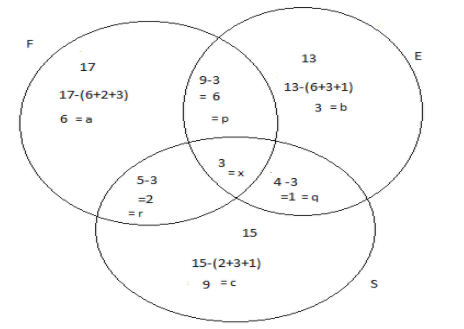
From the venn diagram, we get
Number of students who study only Sanskrit, \[c = 9\]
Number of students who study French and Sanskrit but not English, \[r = 2\]
Here, we will find the number of students by using the concept of applications on the cardinality of the set. A set is defined as the collection of well defined objects. Cardinality of a set is defined as the number of elements in a set.
Complete step by step solution:
Let F be the number of students studying French, E be the number of students studying English, S be the number of students studying Sanskrit
Number of students studying French:
\[n\left( F \right) = 17\]
Number of students studying English:
\[n\left( E \right) = 13\]
Number of students studying Sanskrit:
\[n\left( S \right) = 15\]
Number of students studying French and English:
\[n\left( {F \cap E} \right) = 09\]
Number of students studying English and Sanskrit:
\[n\left( {E \cap S} \right) = 4\]
Number of students studying French and Sanskrit:
\[n\left( {F \cap S} \right) = 5\]
Number of students studying all the three languages:
\[n\left( {F \cap E \cap S} \right) = 3\]
Now, we have to find the number of students who study only Sanskrit.
Number of students who study only Sanskrit: \[n\left( {\overline F \cap \overline E \cap S} \right) = n\left( S \right) - n\left( {F \cap S} \right) - n\left( {E \cap S} \right) + n\left( {F \cap E \cap S} \right)\]
Substituting the values in the above equation, we get
\[ \Rightarrow n\left( {\overline F \cap \overline E \cap S} \right) = 15 - 5 - 4 + 3\]
Adding and subtracting the terms, we get
\[ \Rightarrow n\left( {\overline F \cap \overline E \cap S} \right) = 9\]
Now, we will find the number of students who study French and Sanskrit but not English.
\[n\left( {F \cap \overline E \cap S} \right) = n\left( {F \cap S} \right) - n\left( {F \cap E \cap S} \right)\]
Substituting the values in the above equation, we get
\[ \Rightarrow n\left( {F \cap \overline E \cap S} \right) = 5 - 3\]
Subtracting the terms, we get
\[ \Rightarrow n\left( {F \cap \overline E \cap S} \right) = 2\]
Therefore, the number of students who study only Sanskrit is \[9\] and the number of students who study French and Sanskrit but not English is \[2\].
Note:
We can also solve the problem on set by using venn diagrams. Venn diagram is a method to represent the relationships between the finite sets. A finite set is defined as the set which is countable.
From the venn diagram, we get
Number of students who study only Sanskrit, \[c = 9\]
Number of students who study French and Sanskrit but not English, \[r = 2\]
Recently Updated Pages
Master Class 11 Computer Science: Engaging Questions & Answers for Success

Master Class 11 Business Studies: Engaging Questions & Answers for Success
Master Class 11 Economics: Engaging Questions & Answers for Success
Master Class 11 English: Engaging Questions & Answers for Success
Master Class 11 Maths: Engaging Questions & Answers for Success
Master Class 11 Biology: Engaging Questions & Answers for Success
Trending doubts
One Metric ton is equal to kg A 10000 B 1000 C 100 class 11 physics CBSE
There are 720 permutations of the digits 1 2 3 4 5 class 11 maths CBSE
Discuss the various forms of bacteria class 11 biology CBSE
Draw a diagram of a plant cell and label at least eight class 11 biology CBSE
State the laws of reflection of light
Explain zero factorial class 11 maths CBSE