




In a group of 15 people, 7 read French, 8 read English while 3 of them read none of them. How many read French and English both?
$\begin{align}
& \left( a \right)3 \\
& \left( b \right)4 \\
& \left( c \right)5 \\
& \left( d \right)6 \\
\end{align}$
Answer
 Verified
599.4k+ views
Hint: To solve the question given above, we will make a venn diagram. First we will find out the actual number of people who read books. Then we will find out the number of people who are common to read both books with the help of venn diagrams.
Complete step-by-step answer:
In the question it is given that there are a total of 15 people. So, in the universal set we can say that there are 15 people. Thus n(U)=15 (Universal set is denoted by U). Now, we will assume that the total number of people who are reading at least one book is n (x) where x is the set of people who read at least one book. Now, it is given that 3 people do not read any book. They belong to set $\overline{x}$. Thus n($\overline{x}$)=3. Now, we know that the universal set will be the combination of set x and$\overline{x}$.
So $n\left( x \right)=n\left( 0 \right)-n\left( \overline{x} \right)\Rightarrow n\left( x \right)=15-3\Rightarrow n\left( x \right)=12$
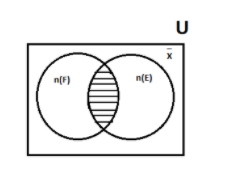
We can also say that the number of people who are reading French books are denoted by n (F). Thus n (F) =7. Similarly, we can say that n (E)=8. Now, we have to find the number of people who read both. This will be equal to the number of people in the set which is shown in the shaded portion. Now, we know that there are 12 actual readers. The total number of French readers=7 and the total number of English readers 8. Their total=8+7=15 readers. But the total actual readers are 12. So out of the 15 readers, some of them read both English and French and these are the extra readers that are denoted by the set in the shaded portion. So the extra readers will be =15-12=3 readers. Thus, these 3 read both English and French.
Hence option (a) is correct.
Note: The alternate method of solving the question is shown: we know that n (x)=12. We can also say that \[x=F\bigcup E\Rightarrow N\left( x \right)=n\left( F\bigcup E \right).\] Now, we will apply the formula for \[n\left( A\bigcup B \right)=n\left( A \right)+n\left( B \right)-n\left( A\bigcap B \right).\]
Thus, we have:
$\begin{align}
& n\left( x \right)=n\left( F \right)+n\left( E \right)-n\left( F\bigcap E \right) \\
& \Rightarrow 12=7+8-n\left( F\bigcap E \right) \\
& \Rightarrow 12-15=-n\left( F\bigcap E \right) \\
& \Rightarrow n\left( F\bigcap E \right)=3. \\
\end{align}$
Where $\bigcap $ is the intersection symbol and denotes people who are common to both.
Complete step-by-step answer:
In the question it is given that there are a total of 15 people. So, in the universal set we can say that there are 15 people. Thus n(U)=15 (Universal set is denoted by U). Now, we will assume that the total number of people who are reading at least one book is n (x) where x is the set of people who read at least one book. Now, it is given that 3 people do not read any book. They belong to set $\overline{x}$. Thus n($\overline{x}$)=3. Now, we know that the universal set will be the combination of set x and$\overline{x}$.
So $n\left( x \right)=n\left( 0 \right)-n\left( \overline{x} \right)\Rightarrow n\left( x \right)=15-3\Rightarrow n\left( x \right)=12$
We can also say that the number of people who are reading French books are denoted by n (F). Thus n (F) =7. Similarly, we can say that n (E)=8. Now, we have to find the number of people who read both. This will be equal to the number of people in the set which is shown in the shaded portion. Now, we know that there are 12 actual readers. The total number of French readers=7 and the total number of English readers 8. Their total=8+7=15 readers. But the total actual readers are 12. So out of the 15 readers, some of them read both English and French and these are the extra readers that are denoted by the set in the shaded portion. So the extra readers will be =15-12=3 readers. Thus, these 3 read both English and French.
Hence option (a) is correct.
Note: The alternate method of solving the question is shown: we know that n (x)=12. We can also say that \[x=F\bigcup E\Rightarrow N\left( x \right)=n\left( F\bigcup E \right).\] Now, we will apply the formula for \[n\left( A\bigcup B \right)=n\left( A \right)+n\left( B \right)-n\left( A\bigcap B \right).\]
Thus, we have:
$\begin{align}
& n\left( x \right)=n\left( F \right)+n\left( E \right)-n\left( F\bigcap E \right) \\
& \Rightarrow 12=7+8-n\left( F\bigcap E \right) \\
& \Rightarrow 12-15=-n\left( F\bigcap E \right) \\
& \Rightarrow n\left( F\bigcap E \right)=3. \\
\end{align}$
Where $\bigcap $ is the intersection symbol and denotes people who are common to both.
Recently Updated Pages
Master Class 11 Computer Science: Engaging Questions & Answers for Success

Master Class 11 Business Studies: Engaging Questions & Answers for Success
Master Class 11 Economics: Engaging Questions & Answers for Success
Master Class 11 English: Engaging Questions & Answers for Success
Master Class 11 Maths: Engaging Questions & Answers for Success
Master Class 11 Biology: Engaging Questions & Answers for Success
Trending doubts
One Metric ton is equal to kg A 10000 B 1000 C 100 class 11 physics CBSE
There are 720 permutations of the digits 1 2 3 4 5 class 11 maths CBSE
Discuss the various forms of bacteria class 11 biology CBSE
Draw a diagram of a plant cell and label at least eight class 11 biology CBSE
State the laws of reflection of light
Explain zero factorial class 11 maths CBSE