




In a grass-deer-tiger food chain, grass biomass is one tonne. The tiger biomass shall be
(a) 100 Kg
(b) 10Kg
(c) 200 Kg
(d) 1Kg
Answer
 Verified
570.9k+ views
Hint: The graphical representation of the organism that shows their relationship at different trophic levels is called the ecological pyramid. They are differentiated on the basis of their energy, biomass, and numbers.
Complete answer
The graphical representation of biomass present per unit area at any time in different trophic levels is called the pyramid of biomass. The pyramid of biomass in the case of the terrestrial (land) ecosystem is upright (more at base and less at top) while in the case of the aquatic ecosystem it is found to be inverted (lower at the bottom and more at top). According to the law of $10\%$, the biomass will be decreasing as it goes from bottom to top. The organisms at the bottom of the pyramid are the producers that produce 1 tonne of the biomass, then the second trophic level includes the herbivores that eat the organism of the first trophic level resulting in a decrease in $10\%$ of the biomass. They are then eaten by the carnivores of the third trophic level again decreasing the amount of the biomass. Thus the tiger comes in the category of carnivores found in the third trophic level and their biomass shall be 10 Kg.
Additional information
Other than the pyramid of biomass there are two other types of pyramids, the pyramid of energy, and the pyramid of biomass.
-A pyramid of energy is a graphic representation of the amount of energy trapped per unit of time and area in different trophic levels of a food chain. Energy is measured through kcal/m^{2}/year. The energy decreases as the trophic levels increase, this is explained with the help of the second law of thermodynamics. In the pyramid of energy, only $10\%$-$20\%$ of the energy is available to the next trophic level.
-In an ecosystem, the individuals of the food chain present at different trophic levels are differentiated based on the number of individuals present there, this can be explained through a graphical representation called the pyramid of numbers. The pyramid is upright (straight) in the case of the pond ecosystem while it is inverted (spindle-shaped) in the case of the forest ecosystem.
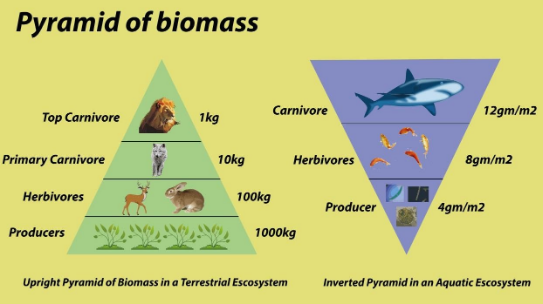
So, the correct answer is ‘10Kg’.
Note:
The ecological pyramids are helpful in observing the patterns or feeding among the organisms of various ecosystems. It can also give us an insight into how inefficient energy transfer is, also the influence that a change in numbers at one trophic level can have on the trophic levels above and below it. It is helpful in studying the changes that are occurring in the environment by comparing them from the data of several years.
Complete answer
The graphical representation of biomass present per unit area at any time in different trophic levels is called the pyramid of biomass. The pyramid of biomass in the case of the terrestrial (land) ecosystem is upright (more at base and less at top) while in the case of the aquatic ecosystem it is found to be inverted (lower at the bottom and more at top). According to the law of $10\%$, the biomass will be decreasing as it goes from bottom to top. The organisms at the bottom of the pyramid are the producers that produce 1 tonne of the biomass, then the second trophic level includes the herbivores that eat the organism of the first trophic level resulting in a decrease in $10\%$ of the biomass. They are then eaten by the carnivores of the third trophic level again decreasing the amount of the biomass. Thus the tiger comes in the category of carnivores found in the third trophic level and their biomass shall be 10 Kg.
Additional information
Other than the pyramid of biomass there are two other types of pyramids, the pyramid of energy, and the pyramid of biomass.
-A pyramid of energy is a graphic representation of the amount of energy trapped per unit of time and area in different trophic levels of a food chain. Energy is measured through kcal/m^{2}/year. The energy decreases as the trophic levels increase, this is explained with the help of the second law of thermodynamics. In the pyramid of energy, only $10\%$-$20\%$ of the energy is available to the next trophic level.
-In an ecosystem, the individuals of the food chain present at different trophic levels are differentiated based on the number of individuals present there, this can be explained through a graphical representation called the pyramid of numbers. The pyramid is upright (straight) in the case of the pond ecosystem while it is inverted (spindle-shaped) in the case of the forest ecosystem.
So, the correct answer is ‘10Kg’.
Note:
The ecological pyramids are helpful in observing the patterns or feeding among the organisms of various ecosystems. It can also give us an insight into how inefficient energy transfer is, also the influence that a change in numbers at one trophic level can have on the trophic levels above and below it. It is helpful in studying the changes that are occurring in the environment by comparing them from the data of several years.
Recently Updated Pages
Master Class 11 English: Engaging Questions & Answers for Success

Master Class 11 Social Science: Engaging Questions & Answers for Success
Master Class 11 Maths: Engaging Questions & Answers for Success
Master Class 11 Biology: Engaging Questions & Answers for Success
Master Class 11 Physics: Engaging Questions & Answers for Success
Master Class 11 Chemistry: Engaging Questions & Answers for Success
Trending doubts
First Cotton Mill of India
In which year voting age was reduced from 21 to 18?
In cricket, which Indian bowler is known as the "Yorker King"?
Who was the first Indian ruler to enter into the Subsidiary class 10 social science CBSE
Digdarshan the first monthly magazine in Marathi was class 10 social science CBSE
Fill the blanks with proper collective nouns 1 A of class 10 english CBSE