




In a glass prism, spectrum is produced due to:
A. Refraction
B. Dispersion
C. Scattering
D. diffraction
Answer
 Verified
637.5k+ views
Hint: A glass prism is made up of the glass which is having a variable refractive index for the different colours of the light having different wavelengths. So due to this reason the light rays got refracted at the different angles and split into the seven different colours.
Complete answer:
The phenomenon of Splitting of the light when it passes through the glass prism into the constituent spectrum of the colours (that are violet, indigo, blue, green, yellow, orange and red.) is known as dispersion of the light.
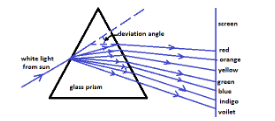
So, when the light passes through the prism then the refractive index for each colour of the light will be different and hence the angle at which the light will get refracted will be different for the different colours so the light will split into its seven constituent colours. So, in a glass prism, spectrum is produced due to the phenomenon of the dispersion.
So, the correct answer is “Option B”.
Note:
This dispersion phenomenon takes place in the glass prism but not in the glass slab, the reason behind this is that the geometry of the two pieces of the glass.
So, the difference in a prism and glass slab is that emerging colours from the second interface are not parallel to each other in the prism; instead they are diverging, so after a certain distance we see the spectrum with separated bands of colours. While in the glass slab emerging colours from the second interface are parallel to each other that’s why the spectrum of the colours does not happen.
Complete answer:
The phenomenon of Splitting of the light when it passes through the glass prism into the constituent spectrum of the colours (that are violet, indigo, blue, green, yellow, orange and red.) is known as dispersion of the light.
So, when the light passes through the prism then the refractive index for each colour of the light will be different and hence the angle at which the light will get refracted will be different for the different colours so the light will split into its seven constituent colours. So, in a glass prism, spectrum is produced due to the phenomenon of the dispersion.
So, the correct answer is “Option B”.
Note:
This dispersion phenomenon takes place in the glass prism but not in the glass slab, the reason behind this is that the geometry of the two pieces of the glass.
So, the difference in a prism and glass slab is that emerging colours from the second interface are not parallel to each other in the prism; instead they are diverging, so after a certain distance we see the spectrum with separated bands of colours. While in the glass slab emerging colours from the second interface are parallel to each other that’s why the spectrum of the colours does not happen.
Recently Updated Pages
Basicity of sulphurous acid and sulphuric acid are

Master Class 12 Economics: Engaging Questions & Answers for Success
Master Class 12 Biology: Engaging Questions & Answers for Success
Master Class 11 English: Engaging Questions & Answers for Success
Master Class 11 Physics: Engaging Questions & Answers for Success
Master Class 11 Computer Science: Engaging Questions & Answers for Success
Trending doubts
Draw a labelled sketch of the human eye class 12 physics CBSE
The chemical formula of tear gas is A CO Cl 2 B C 10 class 12 chemistry CBSE
Draw ray diagrams each showing i myopic eye and ii class 12 physics CBSE
Which are the Top 10 Largest Countries of the World?
Differentiate between homogeneous and heterogeneous class 12 chemistry CBSE
Which is the correct genotypic ratio of mendel dihybrid class 12 biology CBSE