




In a forward biased photo-diode with increase in incident light intensity, the diode current:
A) Increases
B) Remains constant
C) Decreases
D) None of the above.
Answer
 Verified
627.9k+ views
Hint:The semiconductor diodes or p-n junctions in which charge carriers are generated by photons are called optoelectronic devices. A p-n junction consists of a p-type semiconductor on one side and n-type semiconductor at the other side of a single crystal of silicon or germanium. It is also known as semiconductor diode or junction diode.
Complete step by step answer:
A photo diode is a reverse biased p-n junction which is designed to respond to light absorption. The current in a photo diode is directly proportional to the intensity of light falling on its p-n junction.
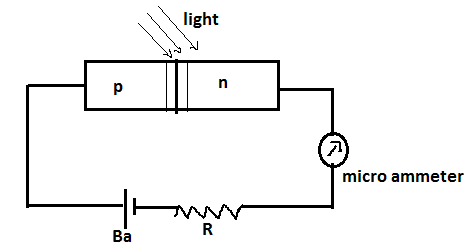
When light falls on the p-n junction, the energy is imparted by the photons to the atoms in the junction. This will create more free electrons (more holes). These excess free electrons will increase the reverse current. As the intensity of incident light on the p-n junction increases, the reverse current also increases. In other words, as the intensity of incident light increases, the resistance of the device decreases.
The circuit connections for a photo diode are as shown in fig. In reverse bias, the current through the junction is due to minority charge carriers. When a p-n junction is subjected to light, having a photon of energy greater than the energy gap. The photon will excite an electron from the valence band to the conduction band and a electron-hole pair is generated. The electron-hole pair generated in the depletion layer will be separated by the junction potential difference and made to flow across the junction. As a result there is an increase in reverse saturation current.
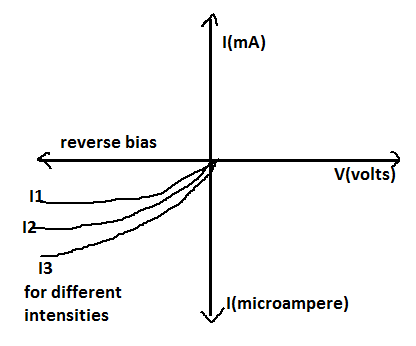
From these observations we can say, in a forward biased photo-diode with increase in incident light intensity, the diode current will also increase.
$\therefore $ Correct option is (A).
Note:
-Photo diodes are used in camera light meters and clock radios.
-In the receivers for remote controls in televisions, music systems and DVD players.
-For the accurate measurement of light intensity in science and industry.
Complete step by step answer:
A photo diode is a reverse biased p-n junction which is designed to respond to light absorption. The current in a photo diode is directly proportional to the intensity of light falling on its p-n junction.
When light falls on the p-n junction, the energy is imparted by the photons to the atoms in the junction. This will create more free electrons (more holes). These excess free electrons will increase the reverse current. As the intensity of incident light on the p-n junction increases, the reverse current also increases. In other words, as the intensity of incident light increases, the resistance of the device decreases.
The circuit connections for a photo diode are as shown in fig. In reverse bias, the current through the junction is due to minority charge carriers. When a p-n junction is subjected to light, having a photon of energy greater than the energy gap. The photon will excite an electron from the valence band to the conduction band and a electron-hole pair is generated. The electron-hole pair generated in the depletion layer will be separated by the junction potential difference and made to flow across the junction. As a result there is an increase in reverse saturation current.
From these observations we can say, in a forward biased photo-diode with increase in incident light intensity, the diode current will also increase.
$\therefore $ Correct option is (A).
Note:
-Photo diodes are used in camera light meters and clock radios.
-In the receivers for remote controls in televisions, music systems and DVD players.
-For the accurate measurement of light intensity in science and industry.
Recently Updated Pages
Master Class 12 Business Studies: Engaging Questions & Answers for Success

Master Class 12 Chemistry: Engaging Questions & Answers for Success
Master Class 12 Biology: Engaging Questions & Answers for Success
Class 12 Question and Answer - Your Ultimate Solutions Guide
Master Class 11 English: Engaging Questions & Answers for Success
Master Class 11 Social Science: Engaging Questions & Answers for Success
Trending doubts
Which are the Top 10 Largest Countries of the World?
Draw a labelled sketch of the human eye class 12 physics CBSE
Differentiate between homogeneous and heterogeneous class 12 chemistry CBSE
Differentiate between Pyramid of energy and pyramid class 12 biology CBSE
Why is the cell called the structural and functional class 12 biology CBSE
Draw the diagram of the pyramid of energy Explain In class 12 biology CBSE