




In a food chain such as $grass\rightarrow dear\rightarrow lion$ the energy cost of respiration as a proportion of total assimilated energy at each level would be
(a)60%-30%-20%
(b)20%-30%-60
(c)20%-60%-30%
(d)30%-30%-30%
Answer
 Verified
618k+ views
Hint: For plant and animal life flows through the ecosystem in both predator and detritus food chains. In the predatory food cycle, green plants, algae, or plankton are eaten up by plant eaters (herbivores) which are eaten up by flesh-eaters (carnivores) and omnivores that eat both plant and flesh. In the detritus food cycle, plant and animal matter are eaten up by bacteria and fungi (decomposers), detrital feeders (detritivores), and their predators (carnivores).
Complete answer:
Lindeman's law states that in the transfer of energy during an organic phenomenon from one trophic level to subsequent one-tenth of the energy obtained from organic matter is stored and other is lost within the transfer, indigestion, and respiration. Respiration is the process during which food is weakened by the organisms using energy. In an organic phenomenon, around one-half of the energy is lost through respiration at each trophic level. Hence it will be 60% - 30% - 20%.
Additional Information: During agricultural environments, amplifying energy move from the producer (food) to the consumer (domesticated animals) can yield monetary advantages. A sub-field of rural science has arisen that investigates techniques for checking and improving biological and related efficiencies.
In contrasting the web productivity of energy use by cows, breeds generally saved for meat production, similar to the Hereford, beat those saved for dairy production, similar to the Holstein, in changing over energy from feed into putting away energy as tissue. This is a result of the beef cattle storing more body fat than the dairy cattle, as energy stockpiling as protein was at a similar level for the two varieties. This implies that the cultivation of cattle for slaughter may be a more efficient use of feed than is cultivation for milk production.
So the correct answer is ‘60%-30%-20%’.
Note: Biomass in each trophic level declines up the food chain partially because a relatively high proportion of energy passed from one level to the next is lost in respiration. In agriculture, there's the much greater energy efficiency of manufacturing low trophic-level crops of soy and potatoes versus higher trophic level fish, chicken, or beef for human consumption. It is therefore more energetically efficient to determine a diet from lower trophic level foods.
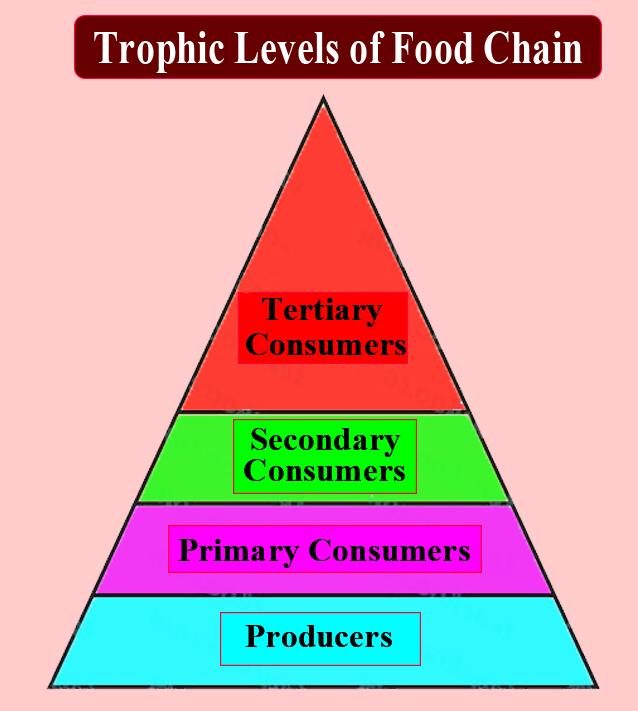
Complete answer:
Lindeman's law states that in the transfer of energy during an organic phenomenon from one trophic level to subsequent one-tenth of the energy obtained from organic matter is stored and other is lost within the transfer, indigestion, and respiration. Respiration is the process during which food is weakened by the organisms using energy. In an organic phenomenon, around one-half of the energy is lost through respiration at each trophic level. Hence it will be 60% - 30% - 20%.
Additional Information: During agricultural environments, amplifying energy move from the producer (food) to the consumer (domesticated animals) can yield monetary advantages. A sub-field of rural science has arisen that investigates techniques for checking and improving biological and related efficiencies.
In contrasting the web productivity of energy use by cows, breeds generally saved for meat production, similar to the Hereford, beat those saved for dairy production, similar to the Holstein, in changing over energy from feed into putting away energy as tissue. This is a result of the beef cattle storing more body fat than the dairy cattle, as energy stockpiling as protein was at a similar level for the two varieties. This implies that the cultivation of cattle for slaughter may be a more efficient use of feed than is cultivation for milk production.
So the correct answer is ‘60%-30%-20%’.
Note: Biomass in each trophic level declines up the food chain partially because a relatively high proportion of energy passed from one level to the next is lost in respiration. In agriculture, there's the much greater energy efficiency of manufacturing low trophic-level crops of soy and potatoes versus higher trophic level fish, chicken, or beef for human consumption. It is therefore more energetically efficient to determine a diet from lower trophic level foods.
Recently Updated Pages
Basicity of sulphurous acid and sulphuric acid are

Master Class 12 Economics: Engaging Questions & Answers for Success
Master Class 12 Biology: Engaging Questions & Answers for Success
Master Class 11 English: Engaging Questions & Answers for Success
Master Class 11 Physics: Engaging Questions & Answers for Success
Master Class 11 Computer Science: Engaging Questions & Answers for Success
Trending doubts
Draw a labelled sketch of the human eye class 12 physics CBSE
The chemical formula of tear gas is A CO Cl 2 B C 10 class 12 chemistry CBSE
Draw ray diagrams each showing i myopic eye and ii class 12 physics CBSE
Which are the Top 10 Largest Countries of the World?
Differentiate between homogeneous and heterogeneous class 12 chemistry CBSE
Which is the correct genotypic ratio of mendel dihybrid class 12 biology CBSE