




In a dry cell, what acts as a negative electrode?
A. Zinc
B. Graphite
C. Ammonium chloride
D. Manganese dioxide
Answer
 Verified
625.2k+ views
Hint: The dry cell is also called Leclanche cell and comes under the category of primary cell as it is not rechargeable. The negative electrode is a metal which is principally used in the galvanization of iron.
Complete step by step answer:
First, let us discuss the dry cell, it consists of two types i.e. primary cell, and secondary cell. The zinc-carbon cell is considered to be an example of a primary cell.
If we talk about the primary cells, that are neither reusable, nor it can be recharged. When there is completion of chemical reactions, it will not produce electricity again.
Talking about the zinc-carbon primary cell, it is a kind of metal container having the metal electrode covered by electrolyte paste. The zinc-carbon cell, as mentioned, consists of a zinc electrode, and a carbon rod. Thus, we can say a metal container has two electrodes, one acts as anode, and another as cathode.
The diagrammatic representation is shown below-
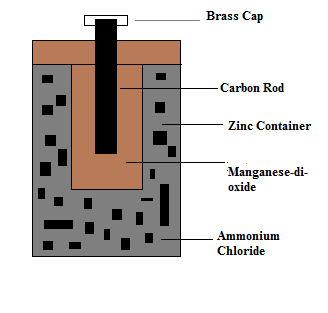
The zinc electrode will act as an anode, as it undergoes oxidation reaction; whereas inert carbon rod acts as cathode, or we can say positive electrode.
Further talking about the metal container, there is presence of manganese dioxide, as it surrounds the electrode, which is called electrolyte paste and it has low moisture. ammonium chloride is also considered as electrolyte paste.
Thus, in the last we can conclude that in the dry cell, zinc acts as a negative electrode, or anode.
Hence, the correct option is (A).
Note:
Another modified example of dry-cell is the alkaline battery. It is almost the same to the zinc-carbon batteries except with the fact that the electrolyte used is KOH (potassium hydroxide) instead of ammonium chloride. The potential of the dry cell reaction is 1.5V.
Complete step by step answer:
First, let us discuss the dry cell, it consists of two types i.e. primary cell, and secondary cell. The zinc-carbon cell is considered to be an example of a primary cell.
If we talk about the primary cells, that are neither reusable, nor it can be recharged. When there is completion of chemical reactions, it will not produce electricity again.
Talking about the zinc-carbon primary cell, it is a kind of metal container having the metal electrode covered by electrolyte paste. The zinc-carbon cell, as mentioned, consists of a zinc electrode, and a carbon rod. Thus, we can say a metal container has two electrodes, one acts as anode, and another as cathode.
The diagrammatic representation is shown below-
The zinc electrode will act as an anode, as it undergoes oxidation reaction; whereas inert carbon rod acts as cathode, or we can say positive electrode.
Further talking about the metal container, there is presence of manganese dioxide, as it surrounds the electrode, which is called electrolyte paste and it has low moisture. ammonium chloride is also considered as electrolyte paste.
Thus, in the last we can conclude that in the dry cell, zinc acts as a negative electrode, or anode.
Hence, the correct option is (A).
Note:
Another modified example of dry-cell is the alkaline battery. It is almost the same to the zinc-carbon batteries except with the fact that the electrolyte used is KOH (potassium hydroxide) instead of ammonium chloride. The potential of the dry cell reaction is 1.5V.
Recently Updated Pages
Master Class 12 Economics: Engaging Questions & Answers for Success

Master Class 12 English: Engaging Questions & Answers for Success
Master Class 12 Social Science: Engaging Questions & Answers for Success
Master Class 12 Maths: Engaging Questions & Answers for Success
Master Class 12 Physics: Engaging Questions & Answers for Success
Master Class 9 General Knowledge: Engaging Questions & Answers for Success
Trending doubts
Explain the Treaty of Vienna of 1815 class 10 social science CBSE
Why is it 530 pm in india when it is 1200 afternoon class 10 social science CBSE
What is the full form of POSCO class 10 social science CBSE
Define Potential, Developed, Stock and Reserved resources
Which Country Has the Largest Border with India?
Complete the sentence with the most appropriate word class 10 english CBSE