




In a diploid cell, at which stage cell cycle, the amount of DNA is doubled
a. $G_1$ and $G_2$ phase
b. $G_0$ phase
c. $S, G_2$ and M - Phase
d. S - phase
Answer
 Verified
628.2k+ views
Hint: Cell cycle is a biological process, in which a single cell divides and produces daughter cells. Cell division is two types, Mitotic cell division, and Meiosis cell division. The daughter cells of mitotic cell division are diploid while the daughter cells of meiosis cell division are haploid. But the mother cell in both divisions is diploid.
Complete answer:
In mitotic cell division, a single mother cell divides into two daughter cells this type of cell division is found in somatic cells while meiosis cell division is found in the germ cell during gamete formation, in such type of cell division a single germ cell divides into four daughter cells.
Cell cycle is gradually processed, it occurs in two phases, Interphase and M- phase, Interphase is a preparatory phase of cell cycle, in which cell prepares for division and, in M- phase cell divides. Interphase is further split into three phases.
- $G_1$ phase
- $S$ - phase
- $G_2$ - phase
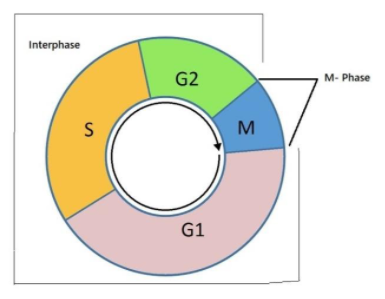
> $G_1$ phase: Cell recruits all the essential enzymes which take part in replication (synthesis of DNA).
> $S$- phase: After $G_1$ phase cell enters into S- phase, where the content of DNA becomes doubled by the process of Replication or DNA synthesis. The DNA content of cells becomes 4n from the 2n, due to the synthesis of DNA this phase is known as Synthesis phase.
> $G_2$ phase: After the amount of DNA becomes double, now it's all the cytoplasmic content divide double, due to this the size of cell increases. Apart from this, this phase cell also recruits all the enzymes and proteins required in cell division.
> $G_0$ phase: Before the cell division and after the cell division cell is in the $G_0$ phase, in this phase the cell is inactive. This phase comes between the M phase and $G_1$ phase.
Hence, the correct answer is option (D).
Note: M- phase is also further divided into four phases; prophase, metaphase, anaphase and telophase. After division of nucleus, cytoplasm also divides and the division of cytoplasm is known as cytokinesis (it lasts a part of M phase).
Complete answer:
In mitotic cell division, a single mother cell divides into two daughter cells this type of cell division is found in somatic cells while meiosis cell division is found in the germ cell during gamete formation, in such type of cell division a single germ cell divides into four daughter cells.
Cell cycle is gradually processed, it occurs in two phases, Interphase and M- phase, Interphase is a preparatory phase of cell cycle, in which cell prepares for division and, in M- phase cell divides. Interphase is further split into three phases.
- $G_1$ phase
- $S$ - phase
- $G_2$ - phase
> $G_1$ phase: Cell recruits all the essential enzymes which take part in replication (synthesis of DNA).
> $S$- phase: After $G_1$ phase cell enters into S- phase, where the content of DNA becomes doubled by the process of Replication or DNA synthesis. The DNA content of cells becomes 4n from the 2n, due to the synthesis of DNA this phase is known as Synthesis phase.
> $G_2$ phase: After the amount of DNA becomes double, now it's all the cytoplasmic content divide double, due to this the size of cell increases. Apart from this, this phase cell also recruits all the enzymes and proteins required in cell division.
> $G_0$ phase: Before the cell division and after the cell division cell is in the $G_0$ phase, in this phase the cell is inactive. This phase comes between the M phase and $G_1$ phase.
Hence, the correct answer is option (D).
Note: M- phase is also further divided into four phases; prophase, metaphase, anaphase and telophase. After division of nucleus, cytoplasm also divides and the division of cytoplasm is known as cytokinesis (it lasts a part of M phase).
Recently Updated Pages
Master Class 11 English: Engaging Questions & Answers for Success

Master Class 11 Social Science: Engaging Questions & Answers for Success
Master Class 11 Maths: Engaging Questions & Answers for Success
Master Class 11 Biology: Engaging Questions & Answers for Success
Master Class 11 Physics: Engaging Questions & Answers for Success
Master Class 11 Chemistry: Engaging Questions & Answers for Success
Trending doubts
One Metric ton is equal to kg A 10000 B 1000 C 100 class 11 physics CBSE
Difference Between Prokaryotic Cells and Eukaryotic Cells
Find the value of the expression given below sin 30circ class 11 maths CBSE
Difference between physical and chemical change class 11 chemistry CBSE
Two of the body parts which do not appear in MRI are class 11 biology CBSE
Draw a diagram of a plant cell and label at least eight class 11 biology CBSE