




In a $\Delta XYZ$, if the internal bisector of angle X meets YZ at ‘P’, then……
$
{\text{A}}{\text{.}}\dfrac{{{\text{XY + XZ}}}}{{{\text{XZ}}}}{\text{ = }}\dfrac{{{\text{YZ}}}}{{{\text{PZ}}}} \\
{\text{B}}{\text{.}}\dfrac{{{\text{XY}}}}{{{\text{PZ}}}}{\text{ = }}\dfrac{{{\text{XZ}}}}{{{\text{YP}}}} \\
{\text{C}}{\text{.}}\dfrac{{{\text{XY}}}}{{{\text{XZ}}}}{\text{ = }}\dfrac{{{\text{PZ}}}}{{{\text{YP}}}} \\
{\text{D}}{\text{.}}\dfrac{{{\text{XZ}}}}{{{\text{XY}}}}{\text{ = }}\dfrac{{{\text{YP}}}}{{{\text{PZ}}}} \\
$
Answer
 Verified
666.3k+ views
Hint – In order to get the right answer to this problem we need to use angle bisector theorem and solve accordingly to get anyone of the provided options then we will get the right answer.
Complete step-by-step answer:
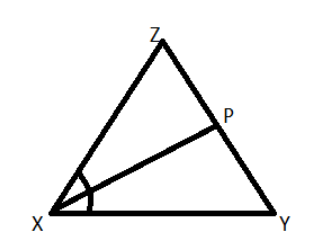
We can clearly see from the diagram that the internal angle bisector of X meets YZ at P.
We can say from angle bisector theorem that $\dfrac{{{\text{XY}}}}{{{\text{XZ}}}}{\text{ = }}\dfrac{{{\text{YP}}}}{{{\text{PZ}}}}$.
In geometry, the angle bisector theorem is concerned with the relative lengths of the two segments that a triangle's side is divided into by a line that bisects the opposite angle. It equates their relative lengths to the relative lengths of the other two sides of the triangle as done above.
So, we have $\dfrac{{{\text{XY}}}}{{{\text{XZ}}}}{\text{ = }}\dfrac{{{\text{YP}}}}{{{\text{PZ}}}}$.
Adding 1 to both sides of the equation we get,
$
\dfrac{{{\text{XY}}}}{{{\text{XZ}}}}{\text{ + 1 = }}\dfrac{{{\text{YP}}}}{{{\text{PZ}}}}{\text{ + 1}} \\
\dfrac{{{\text{XY + XZ}}}}{{{\text{XZ}}}}{\text{ = }}\dfrac{{{\text{YP + PZ}}}}{{{\text{PZ}}}} \\
\dfrac{{{\text{XY + XZ}}}}{{{\text{XZ}}}}{\text{ = }}\dfrac{{{\text{YZ}}}}{{{\text{PZ}}}} \\
$
Hence we got $\dfrac{{{\text{XY + XZ}}}}{{{\text{XZ}}}}{\text{ = }}\dfrac{{{\text{YZ}}}}{{{\text{PZ}}}}$ after solving which is nothing nut option A.
So, the correct option is A.
Note – Here we have a triangle with one of its angles bisected. Here we need to think of the property we can use to get any of the options provided. Here we have used the angle bisector theorem. Then solved it further to get the right answers. An angle bisector divides the opposite side of a triangle into two segments that are proportional to the triangle's other two sides.
Complete step-by-step answer:
We can clearly see from the diagram that the internal angle bisector of X meets YZ at P.
We can say from angle bisector theorem that $\dfrac{{{\text{XY}}}}{{{\text{XZ}}}}{\text{ = }}\dfrac{{{\text{YP}}}}{{{\text{PZ}}}}$.
In geometry, the angle bisector theorem is concerned with the relative lengths of the two segments that a triangle's side is divided into by a line that bisects the opposite angle. It equates their relative lengths to the relative lengths of the other two sides of the triangle as done above.
So, we have $\dfrac{{{\text{XY}}}}{{{\text{XZ}}}}{\text{ = }}\dfrac{{{\text{YP}}}}{{{\text{PZ}}}}$.
Adding 1 to both sides of the equation we get,
$
\dfrac{{{\text{XY}}}}{{{\text{XZ}}}}{\text{ + 1 = }}\dfrac{{{\text{YP}}}}{{{\text{PZ}}}}{\text{ + 1}} \\
\dfrac{{{\text{XY + XZ}}}}{{{\text{XZ}}}}{\text{ = }}\dfrac{{{\text{YP + PZ}}}}{{{\text{PZ}}}} \\
\dfrac{{{\text{XY + XZ}}}}{{{\text{XZ}}}}{\text{ = }}\dfrac{{{\text{YZ}}}}{{{\text{PZ}}}} \\
$
Hence we got $\dfrac{{{\text{XY + XZ}}}}{{{\text{XZ}}}}{\text{ = }}\dfrac{{{\text{YZ}}}}{{{\text{PZ}}}}$ after solving which is nothing nut option A.
So, the correct option is A.
Note – Here we have a triangle with one of its angles bisected. Here we need to think of the property we can use to get any of the options provided. Here we have used the angle bisector theorem. Then solved it further to get the right answers. An angle bisector divides the opposite side of a triangle into two segments that are proportional to the triangle's other two sides.
Recently Updated Pages
A Paragraph on Pollution in about 100-150 Words

What is BLO What is the full form of BLO class 8 social science CBSE
10 examples of friction in our daily life
Draw a diagram of nephron and explain its structur class 11 biology CBSE
Write structures of the following compounds i 2 Chloro3methylpentane class 11 chemistry CBSE
XIX+XXX A 49 B 51 C 55 D 44 class 5 maths CBSE
Trending doubts
Explain the Treaty of Vienna of 1815 class 10 social science CBSE
1 GB equals how many MB?
10 examples of evaporation in daily life with explanations
What is the full form of POSCO class 10 social science CBSE
Which is the hottest planet in the Solar system A Earth class 10 social science CBSE
Name any four life processes in living things class 10 biology CBSE