




In a \[\Delta ABC\], the value of \[\dfrac{{a\cos A + b\cos B + c\cos C}}{{a + b + c}}\] is equal to
A.\[\dfrac{r}{R}\]
B.\[\dfrac{R}{{2r}}\]
C.\[\dfrac{R}{r}\]
D.\[\dfrac{{2r}}{R}\]
Answer
 Verified
558.3k+ views
Hint: Here we will firstly use the sine rule to find the value of \[a,b\] and \[c\] in terms of the R. Then we will put the value of \[a,b,c\] in the given equation. Then we will simplify the equation using the trigonometric properties. Then we will use the basic conditions of the triangle to get the value of the given expression.
Complete step-by-step answer:
Here we will firstly use the sine rule to find the value of \[a,b\] and \[c\] in terms of the R. Then we will put the value of \[a,b,c\] in the given equation. Then we will simplify the equation using the trigonometric properties. Then we will use the basic conditions of the triangle to get the value of the given expression.
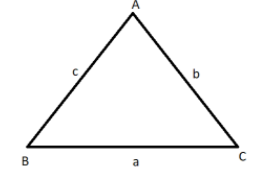
First, we will use the sine rule to get the value of the \[a,b,c\] in term of the R.
We know that according to the sine rule
\[\dfrac{a}{{\sin A}} = \dfrac{b}{{\sin B}} = \dfrac{c}{{\sin C}} = 2R\]
On cross multiplication, we get
\[a = 2R\sin A,b = 2R\sin B,c = 2R\sin C\]
Now we will put the value of \[a,b,c\] in the given equation \[\dfrac{{a\cos A + b\cos B + c\cos C}}{{a + b + c}}\]. Therefore, we get
\[\dfrac{{a\cos A + b\cos B + c\cos C}}{{a + b + c}} = \dfrac{{2R\sin A\cos A + 2R\sin B\cos B + 2R\sin C\cos C}}{{2R\sin A + 2R\sin B + 2R\sin C}}\]
We know the trigonometric property that \[\sin 2\theta = 2\sin \theta \cos \theta \]. Therefore, by using this we get
\[ \Rightarrow \dfrac{{a\cos A + b\cos B + c\cos C}}{{a + b + c}} = \dfrac{{R\sin 2A + R\sin 2B + R\sin 2C}}{{2R\sin A + 2R\sin B + 2R\sin C}}\]
We can write the above equation as
\[ \Rightarrow \dfrac{{a\cos A + b\cos B + c\cos C}}{{a + b + c}} = \dfrac{{R\left( {\sin 2A + \sin 2B + \sin 2C} \right)}}{{2R\left( {\sin A + \sin B + \sin C} \right)}}\]
We know that the sum of all the angles of the triangle is equal to \[180^\circ \] i.e. \[A + B + C = \pi \]. Therefore, by the properties of the triangle we know that
\[\sin 2A + \sin 2B + \sin 2C = 4\sin A\sin B\sin C\]
\[\sin A + \sin B + \sin C = 4\cos \dfrac{A}{2}\cos \dfrac{B}{2}\cos \dfrac{C}{2}\]
Therefore, by putting these values in the equation, we get
\[ \Rightarrow \dfrac{{a\cos A + b\cos B + c\cos C}}{{a + b + c}} = \dfrac{{R\left( {4\sin A\sin B\sin C} \right)}}{{2R\left( {4\cos \dfrac{A}{2}\cos \dfrac{B}{2}\cos \dfrac{C}{2}} \right)}}\]
We will simplify the equation further. Therefore, we get
\[ \Rightarrow \dfrac{{a\cos A + b\cos B + c\cos C}}{{a + b + c}} = \dfrac{{4R\left( {\sin A\sin B\sin C} \right)}}{{8R\left( {\cos \dfrac{A}{2}\cos \dfrac{B}{2}\cos \dfrac{C}{2}} \right)}}\]
Now again we will use the basic trigonometric property i.e. \[\sin 2\theta = 2\sin \theta \cos \theta \]. Therefore, we will use this in the numerator of the equation only. Therefore, we get
\[ \Rightarrow \dfrac{{a\cos A + b\cos B + c\cos C}}{{a + b + c}} = \dfrac{{4R\left( {2\sin \dfrac{A}{2}\cos \dfrac{A}{2} \cdot 2\sin \dfrac{B}{2}\cos \dfrac{B}{2} \cdot 2\sin \dfrac{C}{2}\cos \dfrac{C}{2}} \right)}}{{8R\left( {\cos \dfrac{A}{2}\cos \dfrac{B}{2}\cos \dfrac{C}{2}} \right)}}\]
Now we will simplify the above equation and cancel out the common terms. Therefore, we get
\[ \Rightarrow \dfrac{{a\cos A + b\cos B + c\cos C}}{{a + b + c}} = \dfrac{{4R\left( {8\sin \dfrac{A}{2}\sin \dfrac{B}{2}\sin \dfrac{C}{2}} \right)}}{{8R}}\]
\[ \Rightarrow \dfrac{{a\cos A + b\cos B + c\cos C}}{{a + b + c}} = 4\sin \dfrac{A}{2}\sin \dfrac{B}{2}\sin \dfrac{C}{2}\]
We know this property of a triangle that \[4\sin \dfrac{A}{2}\sin \dfrac{B}{2}\sin \dfrac{C}{2}\] is equal to the \[\dfrac{r}{R}\]. Therefore, we get
\[ \Rightarrow \dfrac{{a\cos A + b\cos B + c\cos C}}{{a + b + c}} = \dfrac{r}{R}\]
Hence, the value of the given expression is equal to \[\dfrac{r}{R}\].
So, option A is the correct answer.
Note: While solving the equation we have to use the properties of the triangles which are related to the variables \[r,R\]. We should know the basic property of the triangle that the sum of all the angles of the triangle is equal to \[180^\circ \]. Here we have used the law of sine to find the values of \[a,b\] and \[c\]. Law of sines, states that the ratio of sides of a given triangle and their respective sine angles are equivalent to each other.
Complete step-by-step answer:
Here we will firstly use the sine rule to find the value of \[a,b\] and \[c\] in terms of the R. Then we will put the value of \[a,b,c\] in the given equation. Then we will simplify the equation using the trigonometric properties. Then we will use the basic conditions of the triangle to get the value of the given expression.
First, we will use the sine rule to get the value of the \[a,b,c\] in term of the R.
We know that according to the sine rule
\[\dfrac{a}{{\sin A}} = \dfrac{b}{{\sin B}} = \dfrac{c}{{\sin C}} = 2R\]
On cross multiplication, we get
\[a = 2R\sin A,b = 2R\sin B,c = 2R\sin C\]
Now we will put the value of \[a,b,c\] in the given equation \[\dfrac{{a\cos A + b\cos B + c\cos C}}{{a + b + c}}\]. Therefore, we get
\[\dfrac{{a\cos A + b\cos B + c\cos C}}{{a + b + c}} = \dfrac{{2R\sin A\cos A + 2R\sin B\cos B + 2R\sin C\cos C}}{{2R\sin A + 2R\sin B + 2R\sin C}}\]
We know the trigonometric property that \[\sin 2\theta = 2\sin \theta \cos \theta \]. Therefore, by using this we get
\[ \Rightarrow \dfrac{{a\cos A + b\cos B + c\cos C}}{{a + b + c}} = \dfrac{{R\sin 2A + R\sin 2B + R\sin 2C}}{{2R\sin A + 2R\sin B + 2R\sin C}}\]
We can write the above equation as
\[ \Rightarrow \dfrac{{a\cos A + b\cos B + c\cos C}}{{a + b + c}} = \dfrac{{R\left( {\sin 2A + \sin 2B + \sin 2C} \right)}}{{2R\left( {\sin A + \sin B + \sin C} \right)}}\]
We know that the sum of all the angles of the triangle is equal to \[180^\circ \] i.e. \[A + B + C = \pi \]. Therefore, by the properties of the triangle we know that
\[\sin 2A + \sin 2B + \sin 2C = 4\sin A\sin B\sin C\]
\[\sin A + \sin B + \sin C = 4\cos \dfrac{A}{2}\cos \dfrac{B}{2}\cos \dfrac{C}{2}\]
Therefore, by putting these values in the equation, we get
\[ \Rightarrow \dfrac{{a\cos A + b\cos B + c\cos C}}{{a + b + c}} = \dfrac{{R\left( {4\sin A\sin B\sin C} \right)}}{{2R\left( {4\cos \dfrac{A}{2}\cos \dfrac{B}{2}\cos \dfrac{C}{2}} \right)}}\]
We will simplify the equation further. Therefore, we get
\[ \Rightarrow \dfrac{{a\cos A + b\cos B + c\cos C}}{{a + b + c}} = \dfrac{{4R\left( {\sin A\sin B\sin C} \right)}}{{8R\left( {\cos \dfrac{A}{2}\cos \dfrac{B}{2}\cos \dfrac{C}{2}} \right)}}\]
Now again we will use the basic trigonometric property i.e. \[\sin 2\theta = 2\sin \theta \cos \theta \]. Therefore, we will use this in the numerator of the equation only. Therefore, we get
\[ \Rightarrow \dfrac{{a\cos A + b\cos B + c\cos C}}{{a + b + c}} = \dfrac{{4R\left( {2\sin \dfrac{A}{2}\cos \dfrac{A}{2} \cdot 2\sin \dfrac{B}{2}\cos \dfrac{B}{2} \cdot 2\sin \dfrac{C}{2}\cos \dfrac{C}{2}} \right)}}{{8R\left( {\cos \dfrac{A}{2}\cos \dfrac{B}{2}\cos \dfrac{C}{2}} \right)}}\]
Now we will simplify the above equation and cancel out the common terms. Therefore, we get
\[ \Rightarrow \dfrac{{a\cos A + b\cos B + c\cos C}}{{a + b + c}} = \dfrac{{4R\left( {8\sin \dfrac{A}{2}\sin \dfrac{B}{2}\sin \dfrac{C}{2}} \right)}}{{8R}}\]
\[ \Rightarrow \dfrac{{a\cos A + b\cos B + c\cos C}}{{a + b + c}} = 4\sin \dfrac{A}{2}\sin \dfrac{B}{2}\sin \dfrac{C}{2}\]
We know this property of a triangle that \[4\sin \dfrac{A}{2}\sin \dfrac{B}{2}\sin \dfrac{C}{2}\] is equal to the \[\dfrac{r}{R}\]. Therefore, we get
\[ \Rightarrow \dfrac{{a\cos A + b\cos B + c\cos C}}{{a + b + c}} = \dfrac{r}{R}\]
Hence, the value of the given expression is equal to \[\dfrac{r}{R}\].
So, option A is the correct answer.
Note: While solving the equation we have to use the properties of the triangles which are related to the variables \[r,R\]. We should know the basic property of the triangle that the sum of all the angles of the triangle is equal to \[180^\circ \]. Here we have used the law of sine to find the values of \[a,b\] and \[c\]. Law of sines, states that the ratio of sides of a given triangle and their respective sine angles are equivalent to each other.
Recently Updated Pages
Master Class 11 Computer Science: Engaging Questions & Answers for Success

Master Class 11 Business Studies: Engaging Questions & Answers for Success
Master Class 11 Economics: Engaging Questions & Answers for Success
Master Class 11 English: Engaging Questions & Answers for Success
Master Class 11 Maths: Engaging Questions & Answers for Success
Master Class 11 Biology: Engaging Questions & Answers for Success
Trending doubts
One Metric ton is equal to kg A 10000 B 1000 C 100 class 11 physics CBSE
There are 720 permutations of the digits 1 2 3 4 5 class 11 maths CBSE
Discuss the various forms of bacteria class 11 biology CBSE
Draw a diagram of a plant cell and label at least eight class 11 biology CBSE
State the laws of reflection of light
10 examples of friction in our daily life