




In a \[\Delta ABC\], \[\tan A\] and\[\tan B\] satisfy the inequation \[\sqrt 3 {x^2} - 4x + \sqrt 3 < 0\], then
A.\[{a^2} + {b^2} + ab > {c^2}\]
B.\[{a^2} + {b^2} - ab < {c^2}\]
C.\[{a^2} + {b^2} > {c^2}\]
D.None of these
Answer
 Verified
532.5k+ views
Hint: In this problem, we need to solve the given inequality satisfied by \[\tan A\] and \[\tan B\] in \[\Delta ABC\]First, we use factorization method for finding the value of\[x.\]Here, We use the quadratic formula is \[x = \dfrac{{ - b \pm \sqrt {{b^2} - 4ac} }}{{2a}}\]. then, comparing with the formula \[A + B + C = \pi \] and also substitute all the values in to this equation, \[\cos C = \dfrac{{{a^2} + {b^2} - {c^2}}}{{2ab}}\].
An inequation is a statement that an inequality or a non-equality holds between two values.
Complete step by step solution:
In the given problem,
Let \[\tan A\]and\[\tan B\]satisfies the inequation
\[\sqrt 3 {x^2} - 4x + \sqrt 3 < 0\] ----------(1)
By using the quadratic equation for factoring the equation (1), we can get
The quadratic formula is \[x = \dfrac{{ - b \pm \sqrt {{b^2} - 4ac} }}{{2a}}\]
From the equation (1), we have \[a = \sqrt 3 ,b = - 4,c = \sqrt 3 \]
\[x = \dfrac{{ - ( - 4) \pm \sqrt {{{( - 4)}^2} - 4(\sqrt 3 )(\sqrt 3 )} }}{{2\sqrt 3 }}\]
\[x = \dfrac{{4 \pm \sqrt {16 - 4(3)} }}{{2\sqrt 3 }}\], since \[{(\sqrt 3 )^2} = 3\]
On further simplification, then
\[x = \dfrac{{4 \pm \sqrt {16 - 12} }}{{2\sqrt 3 }} = \dfrac{{4 \pm \sqrt 4 }}{{2\sqrt 3 }}\]
By solving the square root of the numerator, we get
\[x = \dfrac{{4 \pm 2}}{{2\sqrt 3 }}\]
Now, We have to find the value of ‘x’, then
If \[x = \dfrac{{4 + 2}}{{2\sqrt 3 }}\], then
\[ \Rightarrow x = \dfrac{6}{{2\sqrt 3 }} = \dfrac{3}{{\sqrt 3 }} = \sqrt 3 \]
If \[x = \dfrac{{4 - 2}}{{2\sqrt 3 }}\], then
\[ \Rightarrow x = \dfrac{2}{{2\sqrt 3 }} = \dfrac{1}{{\sqrt 3 }}\]
Therefore, \[x \in \left( {\sqrt 3 ,\dfrac{1}{{\sqrt 3 }}} \right)\]
The factors of \[\sqrt 3 {x^2} - 4x + \sqrt 3 < 0\] is \[(x - \sqrt 3 )(\sqrt 3 x - 1) < 0\]
Therefore,\[\dfrac{1}{{\sqrt 3 }} < x < \sqrt 3 \]
Let us assume, tan A and tan B satisfies ‘x’ value, then
Since, \[\dfrac{1}{{\sqrt 3 }} < x < \sqrt 3 \]
\[ \Rightarrow \dfrac{1}{{\sqrt 3 }} < \tan A < \sqrt 3 \] or \[\dfrac{1}{{\sqrt 3 }} < \tan B < \sqrt 3 \]
Now, expanding the equation of tan (x) as \[{\tan ^{ - 1}}x\], we get
\[ \Rightarrow {\tan ^{ - 1}}(\dfrac{1}{{\sqrt 3 }}) < A < {\tan ^{ - 1}}(\sqrt 3 )\] or \[{\tan ^{ - 1}}(\dfrac{1}{{\sqrt 3 }}) < B < {\tan ^{ - 1}}(\sqrt 3 )\] ------(2)
We know that, from the trigonometric degree table, \[{\tan ^{ - 1}}\left( {\sqrt 3 } \right) = {30^ \circ },{\tan ^{ - 1}}\left( {\dfrac{1}{{\sqrt 3 }}} \right) = {60^ \circ }\].
Now, we have to draw a triangle ABC as given below.
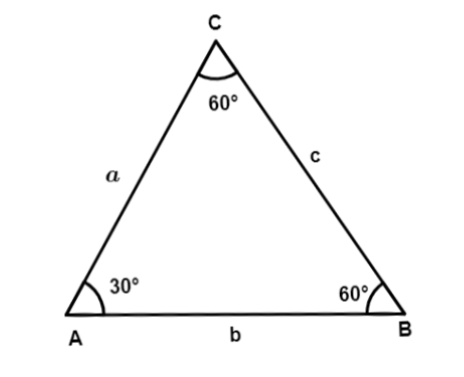
From the equation (2), we need to finding the radian of \[{\tan ^{ - 1}}\left( {\sqrt 3 } \right) = \dfrac{\pi }{6},{\tan ^{ - 1}}\left( {\dfrac{1}{{\sqrt 3 }}} \right) = \dfrac{\pi }{3}\].
\[ \Rightarrow \dfrac{\pi }{6} < A < \dfrac{\pi }{3}\]or\[\dfrac{\pi }{6} < B < \dfrac{\pi }{3}\]
By adding\[A\]and\[B\], we can get
\[ \Rightarrow \dfrac{\pi }{6} + \dfrac{\pi }{6} < A + B < \dfrac{\pi }{3} + \dfrac{\pi }{3}\]
\[ \Rightarrow \dfrac{{2\pi }}{6} < A + B < \dfrac{{2\pi }}{3}\]
\[ \Rightarrow \dfrac{\pi }{3} < A + B < \dfrac{{2\pi }}{3}\]
Now, on comparing the formula \[A + B + C = \pi \], then the value of\[A + B = \pi - C\]
\[ \Rightarrow \dfrac{\pi }{3} < \pi - C < \dfrac{{2\pi }}{3}\]
\[ \Rightarrow - \pi + \dfrac{\pi }{3} < - C < - \pi + \dfrac{{2\pi }}{3}\]\[\]
By solving radian of both sides of the equation, we get
\[ \Rightarrow - \dfrac{{2\pi }}{3} < - C < - \dfrac{\pi }{3}\]
\[ \Rightarrow \dfrac{{2\pi }}{3} > C > \dfrac{\pi }{3}\]
Since, \[C > \dfrac{\pi }{3}\], then \[\cos C > \cos \dfrac{\pi }{3}\]
We know that from the trigonometric table \[\cos \dfrac{\pi }{3} = \dfrac{1}{2}\].
Therefore, The value of \[\cos \dfrac{\pi }{3}\] is \[\dfrac{1}{2}\], then we can get
We use the \[\cos C < \dfrac{1}{2}\] substitute into the formula
we know the formula is \[\cos C = \dfrac{{{a^2} + {b^2} - {c^2}}}{{2ab}}\], then we can get
\[ \Rightarrow \dfrac{{{a^2} + {b^2} - {c^2}}}{{2ab}} < \dfrac{1}{2}\]
\[ \Rightarrow {a^2} + {b^2} - {c^2} < \dfrac{{2ab}}{2}\]
On further simplification, we can expanding the ‘ab’ to LHS we can get
\[ \Rightarrow {a^2} + {b^2} - ab < {c^2}\]
Since, \[C < \dfrac{{2\pi }}{3}\],\[\cos C < \cos \dfrac{{2\pi }}{3}\]
By using the ASTC rule of trigonometry, the angle \[\pi - \dfrac{\pi }{3}\] or angle \[180 - \theta \] lies in the second quadrant. cosine function are negative here, hence the angle must in negative, then
\[ \Rightarrow \cos \left( {\dfrac{{2\pi }}{3}} \right) = \cos \left( {\pi - \dfrac{\pi }{3}} \right)\]
\[ \Rightarrow \cos \left( {\dfrac{{2\pi }}{3}} \right) = - \dfrac{1}{2}\]
The value of \[\cos \dfrac{{2\pi }}{3}\] is \[ - \dfrac{1}{2}\]
Therefore, \[\cos C > \dfrac{{ - 1}}{2}\]
We use the formula is \[\cos C = \dfrac{{{a^2} + {b^2} - {c^2}}}{{2ab}}\], then we can get
\[\dfrac{{{a^2} + {b^2} - {c^2}}}{{2ab}} > \dfrac{{ - 1}}{2}\]
\[{a^2} + {b^2} - {c^2} > \dfrac{{ - 2ab}}{2}\]
Bu cancel the 2 from numerator and denominator, then
\[{a^2} + {b^2} + ab > {c^2}\]
Therefore, the final answer is option (A) \[{a^2} + {b^2} + ab > {c^2}\].
So, the correct answer is “Option A”.
Note: Simply this can also be solve by using a ASTC rule i.e.,
\[ \Rightarrow \cos \left( {\dfrac{{2\pi }}{3}} \right) = \cos \left( {\pi - \dfrac{\pi }{3}} \right)\]
By using the ASTC rule of trigonometry, the angle \[\pi - \dfrac{\pi }{3}\] or angle \[180 - \theta \] lies in the second quadrant. cosine function are negative here, hence the angle must in negative, then
\[ \Rightarrow \cos \left( {\dfrac{{2\pi }}{3}} \right) = \cos \left( {\pi - \dfrac{\pi }{3}} \right)\]
\[ \Rightarrow \cos \left( {\dfrac{{2\pi }}{3}} \right) = - \dfrac{1}{2}\]
While solving this type of question, we must know about the ASTC rule.
And also know the cosine sum or difference identity, for this we have a standard formula. To find the value for the trigonometry function we need the table of trigonometry ratios for standard angles
An inequation is a statement that an inequality or a non-equality holds between two values.
Complete step by step solution:
In the given problem,
Let \[\tan A\]and\[\tan B\]satisfies the inequation
\[\sqrt 3 {x^2} - 4x + \sqrt 3 < 0\] ----------(1)
By using the quadratic equation for factoring the equation (1), we can get
The quadratic formula is \[x = \dfrac{{ - b \pm \sqrt {{b^2} - 4ac} }}{{2a}}\]
From the equation (1), we have \[a = \sqrt 3 ,b = - 4,c = \sqrt 3 \]
\[x = \dfrac{{ - ( - 4) \pm \sqrt {{{( - 4)}^2} - 4(\sqrt 3 )(\sqrt 3 )} }}{{2\sqrt 3 }}\]
\[x = \dfrac{{4 \pm \sqrt {16 - 4(3)} }}{{2\sqrt 3 }}\], since \[{(\sqrt 3 )^2} = 3\]
On further simplification, then
\[x = \dfrac{{4 \pm \sqrt {16 - 12} }}{{2\sqrt 3 }} = \dfrac{{4 \pm \sqrt 4 }}{{2\sqrt 3 }}\]
By solving the square root of the numerator, we get
\[x = \dfrac{{4 \pm 2}}{{2\sqrt 3 }}\]
Now, We have to find the value of ‘x’, then
If \[x = \dfrac{{4 + 2}}{{2\sqrt 3 }}\], then
\[ \Rightarrow x = \dfrac{6}{{2\sqrt 3 }} = \dfrac{3}{{\sqrt 3 }} = \sqrt 3 \]
If \[x = \dfrac{{4 - 2}}{{2\sqrt 3 }}\], then
\[ \Rightarrow x = \dfrac{2}{{2\sqrt 3 }} = \dfrac{1}{{\sqrt 3 }}\]
Therefore, \[x \in \left( {\sqrt 3 ,\dfrac{1}{{\sqrt 3 }}} \right)\]
The factors of \[\sqrt 3 {x^2} - 4x + \sqrt 3 < 0\] is \[(x - \sqrt 3 )(\sqrt 3 x - 1) < 0\]
Therefore,\[\dfrac{1}{{\sqrt 3 }} < x < \sqrt 3 \]
Let us assume, tan A and tan B satisfies ‘x’ value, then
Since, \[\dfrac{1}{{\sqrt 3 }} < x < \sqrt 3 \]
\[ \Rightarrow \dfrac{1}{{\sqrt 3 }} < \tan A < \sqrt 3 \] or \[\dfrac{1}{{\sqrt 3 }} < \tan B < \sqrt 3 \]
Now, expanding the equation of tan (x) as \[{\tan ^{ - 1}}x\], we get
\[ \Rightarrow {\tan ^{ - 1}}(\dfrac{1}{{\sqrt 3 }}) < A < {\tan ^{ - 1}}(\sqrt 3 )\] or \[{\tan ^{ - 1}}(\dfrac{1}{{\sqrt 3 }}) < B < {\tan ^{ - 1}}(\sqrt 3 )\] ------(2)
We know that, from the trigonometric degree table, \[{\tan ^{ - 1}}\left( {\sqrt 3 } \right) = {30^ \circ },{\tan ^{ - 1}}\left( {\dfrac{1}{{\sqrt 3 }}} \right) = {60^ \circ }\].
Now, we have to draw a triangle ABC as given below.
From the equation (2), we need to finding the radian of \[{\tan ^{ - 1}}\left( {\sqrt 3 } \right) = \dfrac{\pi }{6},{\tan ^{ - 1}}\left( {\dfrac{1}{{\sqrt 3 }}} \right) = \dfrac{\pi }{3}\].
\[ \Rightarrow \dfrac{\pi }{6} < A < \dfrac{\pi }{3}\]or\[\dfrac{\pi }{6} < B < \dfrac{\pi }{3}\]
By adding\[A\]and\[B\], we can get
\[ \Rightarrow \dfrac{\pi }{6} + \dfrac{\pi }{6} < A + B < \dfrac{\pi }{3} + \dfrac{\pi }{3}\]
\[ \Rightarrow \dfrac{{2\pi }}{6} < A + B < \dfrac{{2\pi }}{3}\]
\[ \Rightarrow \dfrac{\pi }{3} < A + B < \dfrac{{2\pi }}{3}\]
Now, on comparing the formula \[A + B + C = \pi \], then the value of\[A + B = \pi - C\]
\[ \Rightarrow \dfrac{\pi }{3} < \pi - C < \dfrac{{2\pi }}{3}\]
\[ \Rightarrow - \pi + \dfrac{\pi }{3} < - C < - \pi + \dfrac{{2\pi }}{3}\]\[\]
By solving radian of both sides of the equation, we get
\[ \Rightarrow - \dfrac{{2\pi }}{3} < - C < - \dfrac{\pi }{3}\]
\[ \Rightarrow \dfrac{{2\pi }}{3} > C > \dfrac{\pi }{3}\]
Since, \[C > \dfrac{\pi }{3}\], then \[\cos C > \cos \dfrac{\pi }{3}\]
We know that from the trigonometric table \[\cos \dfrac{\pi }{3} = \dfrac{1}{2}\].
Therefore, The value of \[\cos \dfrac{\pi }{3}\] is \[\dfrac{1}{2}\], then we can get
We use the \[\cos C < \dfrac{1}{2}\] substitute into the formula
we know the formula is \[\cos C = \dfrac{{{a^2} + {b^2} - {c^2}}}{{2ab}}\], then we can get
\[ \Rightarrow \dfrac{{{a^2} + {b^2} - {c^2}}}{{2ab}} < \dfrac{1}{2}\]
\[ \Rightarrow {a^2} + {b^2} - {c^2} < \dfrac{{2ab}}{2}\]
On further simplification, we can expanding the ‘ab’ to LHS we can get
\[ \Rightarrow {a^2} + {b^2} - ab < {c^2}\]
Since, \[C < \dfrac{{2\pi }}{3}\],\[\cos C < \cos \dfrac{{2\pi }}{3}\]
By using the ASTC rule of trigonometry, the angle \[\pi - \dfrac{\pi }{3}\] or angle \[180 - \theta \] lies in the second quadrant. cosine function are negative here, hence the angle must in negative, then
\[ \Rightarrow \cos \left( {\dfrac{{2\pi }}{3}} \right) = \cos \left( {\pi - \dfrac{\pi }{3}} \right)\]
\[ \Rightarrow \cos \left( {\dfrac{{2\pi }}{3}} \right) = - \dfrac{1}{2}\]
The value of \[\cos \dfrac{{2\pi }}{3}\] is \[ - \dfrac{1}{2}\]
Therefore, \[\cos C > \dfrac{{ - 1}}{2}\]
We use the formula is \[\cos C = \dfrac{{{a^2} + {b^2} - {c^2}}}{{2ab}}\], then we can get
\[\dfrac{{{a^2} + {b^2} - {c^2}}}{{2ab}} > \dfrac{{ - 1}}{2}\]
\[{a^2} + {b^2} - {c^2} > \dfrac{{ - 2ab}}{2}\]
Bu cancel the 2 from numerator and denominator, then
\[{a^2} + {b^2} + ab > {c^2}\]
Therefore, the final answer is option (A) \[{a^2} + {b^2} + ab > {c^2}\].
So, the correct answer is “Option A”.
Note: Simply this can also be solve by using a ASTC rule i.e.,
\[ \Rightarrow \cos \left( {\dfrac{{2\pi }}{3}} \right) = \cos \left( {\pi - \dfrac{\pi }{3}} \right)\]
By using the ASTC rule of trigonometry, the angle \[\pi - \dfrac{\pi }{3}\] or angle \[180 - \theta \] lies in the second quadrant. cosine function are negative here, hence the angle must in negative, then
\[ \Rightarrow \cos \left( {\dfrac{{2\pi }}{3}} \right) = \cos \left( {\pi - \dfrac{\pi }{3}} \right)\]
\[ \Rightarrow \cos \left( {\dfrac{{2\pi }}{3}} \right) = - \dfrac{1}{2}\]
While solving this type of question, we must know about the ASTC rule.
And also know the cosine sum or difference identity, for this we have a standard formula. To find the value for the trigonometry function we need the table of trigonometry ratios for standard angles
Recently Updated Pages
Master Class 11 Social Science: Engaging Questions & Answers for Success

Master Class 11 Physics: Engaging Questions & Answers for Success
Master Class 11 Maths: Engaging Questions & Answers for Success
Master Class 11 Economics: Engaging Questions & Answers for Success
Master Class 11 Computer Science: Engaging Questions & Answers for Success
Master Class 11 Chemistry: Engaging Questions & Answers for Success
Trending doubts
One Metric ton is equal to kg A 10000 B 1000 C 100 class 11 physics CBSE
There are 720 permutations of the digits 1 2 3 4 5 class 11 maths CBSE
1 Quintal is equal to a 110 kg b 10 kg c 100kg d 1000 class 11 physics CBSE
State and prove Bernoullis theorem class 11 physics CBSE
Difference Between Prokaryotic Cells and Eukaryotic Cells
Discuss the various forms of bacteria class 11 biology CBSE