




In a $\Delta $ ABC, D and E are points on AB and AC respectively such that $DE||BC$ . If AD=2.4cm, AE = 3.2cm, DE = 2cm and BC = 5cm, Find BD and CE.
Answer
 Verified
613.2k+ views
Hint: Consider $\Delta ADE,\Delta ABC$ , prove that the triangles are similar by A.A similarity criteria. Then the corresponding sides of both triangles are also similar. Thus substitute and find BD and CE.
Complete step-by-step answer:
Let us draw $\Delta ABC$ , let us mark points D and E on the sides AB and AC of the $\Delta ABC$ . It is said that $DE||BC$ , we have been given the sides as AD = 2.4cm, DE = 2cm, AE = 3.2cm and BC=5cm.
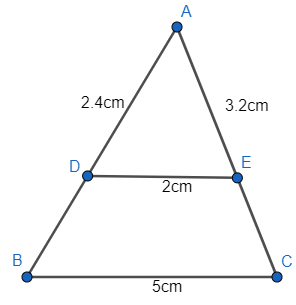
So let us find the length of AB and AC first. Thus, from the figure,
$\begin{align}
& AB=AD+BD\Rightarrow BD=AB-AD.........................\left( i \right) \\
& AC=AE+EC\Rightarrow CE=AC-AE........................\left( ii \right) \\
\end{align}$
So, from the figure let us first consider $\Delta ADE,\Delta ABC$ it is said that $DE||BC$ . Thus we can say that
$\begin{align}
& \angle ADE=\angle ABC \\
& \angle AED=\angle ACB \\
\end{align}$
Corresponding angles means that 2 angles correspond by being on the same side of the transversal. Thus by AA similarity postulates, the same side of two triangle are congruent, then $\Delta ADE,\Delta ABC$ are similar
i.e $\Delta ADE\cong \Delta ABC$
Hence we can say that as the triangles are similar, their corresponding sides are proportional. Thus we can write,
$\dfrac{AE}{AC}=\dfrac{AD}{AB}=\dfrac{DE}{BC}$
Now, let us consider the value of AE = 3.2cm, AD = 2.5cm, DE = 2cm and BC = 5cm,
$\therefore \dfrac{3.2}{AC}=\dfrac{2.5}{AB}=\dfrac{2}{5}$
Now let us equate
$\dfrac{3.2}{AC}=\dfrac{2}{5},\dfrac{2.5}{AB}=\dfrac{2}{5}$
Now apply cross multiplication property on both the equation and get the value of AB and AC.
$\begin{align}
& 2AC=5\times 3.2 \\
& \Rightarrow AC=\dfrac{5\times 3.2}{2}=5\times 1.6=8cm \\
& 2AB=2.4\times 5 \\
& \Rightarrow AB=\dfrac{2.4\times 5}{2}=5\times 1.2=6cm \\
\end{align}$
Hence we got AC = 8cm and AB = 6cm. Now, put these values in equation (i) and (ii)
BD = AB – AD = 6 – 2.4 = 3.6cm
CE = AC- AE = 8 – 3.2 = 4.8cm
Hence we got BD = 3.6cm and CE = 4.8cm. Thus we got the required value.
Note: The AA similarity postulate is a shortcut for showing that two triangles are similar. If you know that two angles in one triangle are congruent to 2 angles in another, which is now enough information to show that the 2 triangles are similar. Then you can use the similarity to get the length of sides.
Complete step-by-step answer:
Let us draw $\Delta ABC$ , let us mark points D and E on the sides AB and AC of the $\Delta ABC$ . It is said that $DE||BC$ , we have been given the sides as AD = 2.4cm, DE = 2cm, AE = 3.2cm and BC=5cm.
So let us find the length of AB and AC first. Thus, from the figure,
$\begin{align}
& AB=AD+BD\Rightarrow BD=AB-AD.........................\left( i \right) \\
& AC=AE+EC\Rightarrow CE=AC-AE........................\left( ii \right) \\
\end{align}$
So, from the figure let us first consider $\Delta ADE,\Delta ABC$ it is said that $DE||BC$ . Thus we can say that
$\begin{align}
& \angle ADE=\angle ABC \\
& \angle AED=\angle ACB \\
\end{align}$
Corresponding angles means that 2 angles correspond by being on the same side of the transversal. Thus by AA similarity postulates, the same side of two triangle are congruent, then $\Delta ADE,\Delta ABC$ are similar
i.e $\Delta ADE\cong \Delta ABC$
Hence we can say that as the triangles are similar, their corresponding sides are proportional. Thus we can write,
$\dfrac{AE}{AC}=\dfrac{AD}{AB}=\dfrac{DE}{BC}$
Now, let us consider the value of AE = 3.2cm, AD = 2.5cm, DE = 2cm and BC = 5cm,
$\therefore \dfrac{3.2}{AC}=\dfrac{2.5}{AB}=\dfrac{2}{5}$
Now let us equate
$\dfrac{3.2}{AC}=\dfrac{2}{5},\dfrac{2.5}{AB}=\dfrac{2}{5}$
Now apply cross multiplication property on both the equation and get the value of AB and AC.
$\begin{align}
& 2AC=5\times 3.2 \\
& \Rightarrow AC=\dfrac{5\times 3.2}{2}=5\times 1.6=8cm \\
& 2AB=2.4\times 5 \\
& \Rightarrow AB=\dfrac{2.4\times 5}{2}=5\times 1.2=6cm \\
\end{align}$
Hence we got AC = 8cm and AB = 6cm. Now, put these values in equation (i) and (ii)
BD = AB – AD = 6 – 2.4 = 3.6cm
CE = AC- AE = 8 – 3.2 = 4.8cm
Hence we got BD = 3.6cm and CE = 4.8cm. Thus we got the required value.
Note: The AA similarity postulate is a shortcut for showing that two triangles are similar. If you know that two angles in one triangle are congruent to 2 angles in another, which is now enough information to show that the 2 triangles are similar. Then you can use the similarity to get the length of sides.
Recently Updated Pages
Master Class 10 Computer Science: Engaging Questions & Answers for Success

Master Class 10 General Knowledge: Engaging Questions & Answers for Success
Master Class 10 English: Engaging Questions & Answers for Success
Master Class 10 Social Science: Engaging Questions & Answers for Success
Master Class 10 Maths: Engaging Questions & Answers for Success
Master Class 10 Science: Engaging Questions & Answers for Success
Trending doubts
What is the median of the first 10 natural numbers class 10 maths CBSE
Which women's tennis player has 24 Grand Slam singles titles?
Who is the Brand Ambassador of Incredible India?
Why is there a time difference of about 5 hours between class 10 social science CBSE
Write a letter to the principal requesting him to grant class 10 english CBSE
A moving boat is observed from the top of a 150 m high class 10 maths CBSE