




In a \[\Delta ABC\], \[AD\] is altitude from \[A\], \[b > c\], \[C = {23^ \circ }\], \[AD = \dfrac{{abc}}{{{b^2} - {c^2}}}\], then \[B\]=
A. \[{70^ \circ }\]
B. \[{113^ \circ }\]
C. \[{123^ \circ }\]
D. \[{103^ \circ }\]
Answer
 Verified
630k+ views
Hint: Here is given that, a triangle with its altitude, they give the relation of the altitude and angle of one side in the triangle. We solve this problem by using the following trigonometric relation.
Formula used: We know that sine law of a triangle we get,
\[\dfrac{a}{{\sin A}} = \dfrac{b}{{\sin B}} = \dfrac{c}{{\sin C}}\]
We will equate the ratio with a certain constant value.
Using this formula and given conditions we can find the value of \[\angle B\].
Complete step-by-step answer:
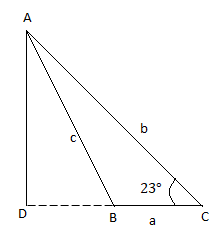
Consider \[ABC\] is any triangle. The opposite sides of each angle \[\angle A,\angle B,\angle C\] is \[a,b,c\].
It is given that; \[ABC\] is any triangle such that \[AD\] is an altitude from \[A.\] It is also given that, \[C = {23^ \circ }\] and \[AD = \dfrac{{abc}}{{{b^2} - {c^2}}}\]provided \[b > c\]
We have to find the value of \[\angle B\].
Let us consider \[ABC\] is any triangle. The opposite sides of each angle \[\angle A,\angle B,\angle C\] is \[a,b,c\]. Then by sine law of a triangle we get,
\[ \Rightarrow \dfrac{a}{{\sin A}} = \dfrac{b}{{\sin B}} = \dfrac{c}{{\sin C}}\]
Let us take, \[\dfrac{a}{{\sin A}} = \dfrac{b}{{\sin B}} = \dfrac{c}{{\sin C}} = k\], where \[k\] be any constant.
Equating the term relation $a$ with \[k\] we get,
\[ \Rightarrow \dfrac{a}{{\sin A}} = k\]
\[ \Rightarrow a = k\sin A\]
Equating the term relation $b$ with \[k\] we get,
\[ \Rightarrow \dfrac{b}{{\sin B}} = k\]
\[ \Rightarrow b = k\sin B\]
Equating the term relation $c$ with \[k\] we get,
\[ \Rightarrow \dfrac{c}{{\sin C}} = k\]
\[ \Rightarrow c = k\sin C\]
We have, \[AD = \dfrac{{abc}}{{{b^2} - {c^2}}}\]
Substitute the values of $a$, $b$ and $c$ in \[AD\] we get,
\[ \Rightarrow AD = \dfrac{{k\sin A.b.k\sin C}}{{{k^2}({{\sin }^2}B - {{\sin }^2}C)}}\]
Simplifying we get,
\[ \Rightarrow AD = \dfrac{{b.\sin A.\sin C}}{{({{\sin }^2}B - {{\sin }^2}C)}}\]
Simplifying again we get,
\[ \Rightarrow AD = \dfrac{{b.\sin A.\sin C}}{{\sin (B + C) - \sin (B - C)}} \ldots {\text{ }}\left( 1 \right)\]
But we also know that, \[AD = b.\sin C \ldots {\text{ }}\left( 2 \right)\]
Comparing (1) and (2) we get,
\[ \Rightarrow \sin (B - C) = 1\]
We know that, the value of \[\sin {90^ \circ } = 1\]
So, we have,
\[ \Rightarrow \sin (B - C) = \sin {90^ \circ }\]
So, we have,
\[ \Rightarrow (B - C) = {90^ \circ }\]
It is given \[C = {23^ \circ }\]
Therefore, \[B = {90^ \circ } + {23^ \circ } = {113^ \circ }\]
$\therefore $ The value of \[\angle B\] is \[{113^ \circ }\]
So, the correct answer is “Option B”.
Note: The Law of Sines the relationship between the sides and angles of non-right (oblique) triangles. Simply, it states that the ratio of the length of a side of a triangle to the sine of the angle opposite that side is the same for all sides and angles in a given triangle.
Formula used: We know that sine law of a triangle we get,
\[\dfrac{a}{{\sin A}} = \dfrac{b}{{\sin B}} = \dfrac{c}{{\sin C}}\]
We will equate the ratio with a certain constant value.
Using this formula and given conditions we can find the value of \[\angle B\].
Complete step-by-step answer:
Consider \[ABC\] is any triangle. The opposite sides of each angle \[\angle A,\angle B,\angle C\] is \[a,b,c\].
It is given that; \[ABC\] is any triangle such that \[AD\] is an altitude from \[A.\] It is also given that, \[C = {23^ \circ }\] and \[AD = \dfrac{{abc}}{{{b^2} - {c^2}}}\]provided \[b > c\]
We have to find the value of \[\angle B\].
Let us consider \[ABC\] is any triangle. The opposite sides of each angle \[\angle A,\angle B,\angle C\] is \[a,b,c\]. Then by sine law of a triangle we get,
\[ \Rightarrow \dfrac{a}{{\sin A}} = \dfrac{b}{{\sin B}} = \dfrac{c}{{\sin C}}\]
Let us take, \[\dfrac{a}{{\sin A}} = \dfrac{b}{{\sin B}} = \dfrac{c}{{\sin C}} = k\], where \[k\] be any constant.
Equating the term relation $a$ with \[k\] we get,
\[ \Rightarrow \dfrac{a}{{\sin A}} = k\]
\[ \Rightarrow a = k\sin A\]
Equating the term relation $b$ with \[k\] we get,
\[ \Rightarrow \dfrac{b}{{\sin B}} = k\]
\[ \Rightarrow b = k\sin B\]
Equating the term relation $c$ with \[k\] we get,
\[ \Rightarrow \dfrac{c}{{\sin C}} = k\]
\[ \Rightarrow c = k\sin C\]
We have, \[AD = \dfrac{{abc}}{{{b^2} - {c^2}}}\]
Substitute the values of $a$, $b$ and $c$ in \[AD\] we get,
\[ \Rightarrow AD = \dfrac{{k\sin A.b.k\sin C}}{{{k^2}({{\sin }^2}B - {{\sin }^2}C)}}\]
Simplifying we get,
\[ \Rightarrow AD = \dfrac{{b.\sin A.\sin C}}{{({{\sin }^2}B - {{\sin }^2}C)}}\]
Simplifying again we get,
\[ \Rightarrow AD = \dfrac{{b.\sin A.\sin C}}{{\sin (B + C) - \sin (B - C)}} \ldots {\text{ }}\left( 1 \right)\]
But we also know that, \[AD = b.\sin C \ldots {\text{ }}\left( 2 \right)\]
Comparing (1) and (2) we get,
\[ \Rightarrow \sin (B - C) = 1\]
We know that, the value of \[\sin {90^ \circ } = 1\]
So, we have,
\[ \Rightarrow \sin (B - C) = \sin {90^ \circ }\]
So, we have,
\[ \Rightarrow (B - C) = {90^ \circ }\]
It is given \[C = {23^ \circ }\]
Therefore, \[B = {90^ \circ } + {23^ \circ } = {113^ \circ }\]
$\therefore $ The value of \[\angle B\] is \[{113^ \circ }\]
So, the correct answer is “Option B”.
Note: The Law of Sines the relationship between the sides and angles of non-right (oblique) triangles. Simply, it states that the ratio of the length of a side of a triangle to the sine of the angle opposite that side is the same for all sides and angles in a given triangle.
Recently Updated Pages
Master Class 11 English: Engaging Questions & Answers for Success

Master Class 11 Social Science: Engaging Questions & Answers for Success
Master Class 11 Maths: Engaging Questions & Answers for Success
Master Class 11 Biology: Engaging Questions & Answers for Success
Master Class 11 Physics: Engaging Questions & Answers for Success
Master Class 11 Chemistry: Engaging Questions & Answers for Success
Trending doubts
Explain the Treaty of Vienna of 1815 class 10 social science CBSE
What is the Total Duration of Football Match?
The shortest day of the year in India
In which year voting age was reduced from 21 to 18?
10 examples of evaporation in daily life with explanations
What planets have no moons Which one has only one moon class 10 physics CBSE