




In a cyclic quadrilateral ABCD, angle A = (2x + 4) °, angle B = (y + 3) °, angle C = (2y + 10) ° and angle D = (4x – 5) °. Find the smallest angle.
Answer
 Verified
604.8k+ views
Hint: Before solving this question, let us know about Cyclic Quadrilateral first.
CYCLIC QUADRILATERAL: A cyclic quadrilateral is a quadrilateral whose all vertices lie on a single circle.
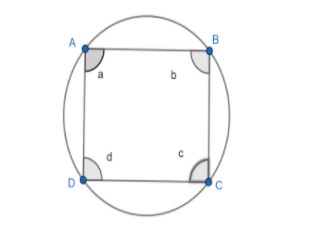
The sum of the opposite angles of a cyclic quadrilateral is always 180°.
Complete step by step answer:
As we know that, the sum of the opposite angles of a cyclic quadrilateral is always 180°.
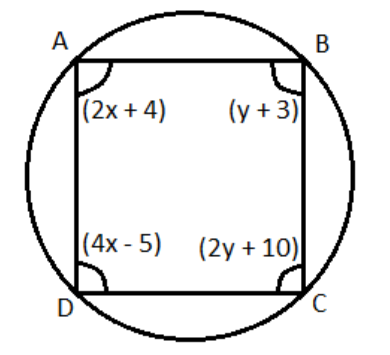
Therefore, angle A + angle C = 180°
And, angle B + angle D = 180°
According to the question,
Angle A = (2x + 4) °
Angle B = (y + 3) °
Angle C = (2y + 10) °
Angle D = (4x – 5) °
Therefore, (2x + 4) + (2y + 10) = 180°
And (y + 3) + (4x – 5) = 180°
Let us solve (2x + 4) + (2y + 10) = 180° first.
\[\Rightarrow \] 2x + 4 + 2y + 10 = 180
\[\Rightarrow \]2x + 2y + 14 = 180
\[\Rightarrow \]2x + 2y = 166
\[\Rightarrow \]2x = 166 – 2y
\[\begin{align}
& x=\dfrac{166-2y}{2} \\
&\Rightarrow y=\dfrac{166-2x}{2} \\
\end{align}\]
Let us solve (y + 3) + (4x – 5) = 180° now.
\[\Rightarrow \]y + 3 + 4x – 5 = 180
\[\Rightarrow \]y + 4x – 2 = 180
\[\Rightarrow \]y + 4x = 182
\[\Rightarrow \]4x = 182 – y
\[x=\dfrac{182-y}{4}\]
\[\Rightarrow \]y = 182 – 4x
Let us now equate the values of ‘x’.
\[\dfrac{166-2y}{2}=\dfrac{182-y}{4}\]
\[\Rightarrow \]4 (166 – 2y) = 2 (182 – y)
\[\Rightarrow \]664 – 8y = 364 – 2y
\[\Rightarrow \]664 – 364 = -2y + 8y
\[\Rightarrow \]300 = 6y
\[\Rightarrow \]50 = y
Let us now equate the values of ‘y’.
\[\dfrac{166-2y}{2}\] = 182 – 4x
\[\Rightarrow \]166 – 2x = 2 (182 – 4x)
\[\Rightarrow \]166 – 2x = 364 – 8x
\[\Rightarrow \]-2x + 8x = 364 – 166
\[\Rightarrow \]6x = 198
\[\Rightarrow \]x = 33
Now, as we have calculated the values of ‘x’ and ‘y’, let us substitute the values of ‘x’ and ‘y’ in the measures of the angles of the quadrilateral ABCD.
Angle A = (2x + 4) ° = \[\left( 2\times 33+\text{ }4 \right)\]= (66 + 4) = 70°
Angle B = (y + 3) ° = (50 + 3) = 53°
Angle C = (2y + 10) ° = \[\left( 2\times 50+\text{ 10} \right)\] = (100 + 10) = 110°
Angle D = (4x – 5) ° = \[\left( 4\times 33\text{ }\text{ }5 \right)\] = (132 – 5) = 127°
So, the smallest angle, i.e. the angle with the smallest measure is Angle B, whose measure is 53°.
Note: Let us discuss the other properties of a cyclic quadrilateral.
The opposite angles of a cyclic quadrilateral are supplementary. In other words, the sum of the either pair of opposite angles of a cyclic quadrilateral is 180°.
If one side of a cyclic quadrilateral is produced, then the exterior angles will be equal to the opposite interior angle.
If the sum of any pair of opposite angles of a quadrilateral is 180°, then the quadrilateral is cyclic.
CYCLIC QUADRILATERAL: A cyclic quadrilateral is a quadrilateral whose all vertices lie on a single circle.
The sum of the opposite angles of a cyclic quadrilateral is always 180°.
Complete step by step answer:
As we know that, the sum of the opposite angles of a cyclic quadrilateral is always 180°.
Therefore, angle A + angle C = 180°
And, angle B + angle D = 180°
According to the question,
Angle A = (2x + 4) °
Angle B = (y + 3) °
Angle C = (2y + 10) °
Angle D = (4x – 5) °
Therefore, (2x + 4) + (2y + 10) = 180°
And (y + 3) + (4x – 5) = 180°
Let us solve (2x + 4) + (2y + 10) = 180° first.
\[\Rightarrow \] 2x + 4 + 2y + 10 = 180
\[\Rightarrow \]2x + 2y + 14 = 180
\[\Rightarrow \]2x + 2y = 166
\[\Rightarrow \]2x = 166 – 2y
\[\begin{align}
& x=\dfrac{166-2y}{2} \\
&\Rightarrow y=\dfrac{166-2x}{2} \\
\end{align}\]
Let us solve (y + 3) + (4x – 5) = 180° now.
\[\Rightarrow \]y + 3 + 4x – 5 = 180
\[\Rightarrow \]y + 4x – 2 = 180
\[\Rightarrow \]y + 4x = 182
\[\Rightarrow \]4x = 182 – y
\[x=\dfrac{182-y}{4}\]
\[\Rightarrow \]y = 182 – 4x
Let us now equate the values of ‘x’.
\[\dfrac{166-2y}{2}=\dfrac{182-y}{4}\]
\[\Rightarrow \]4 (166 – 2y) = 2 (182 – y)
\[\Rightarrow \]664 – 8y = 364 – 2y
\[\Rightarrow \]664 – 364 = -2y + 8y
\[\Rightarrow \]300 = 6y
\[\Rightarrow \]50 = y
Let us now equate the values of ‘y’.
\[\dfrac{166-2y}{2}\] = 182 – 4x
\[\Rightarrow \]166 – 2x = 2 (182 – 4x)
\[\Rightarrow \]166 – 2x = 364 – 8x
\[\Rightarrow \]-2x + 8x = 364 – 166
\[\Rightarrow \]6x = 198
\[\Rightarrow \]x = 33
Now, as we have calculated the values of ‘x’ and ‘y’, let us substitute the values of ‘x’ and ‘y’ in the measures of the angles of the quadrilateral ABCD.
Angle A = (2x + 4) ° = \[\left( 2\times 33+\text{ }4 \right)\]= (66 + 4) = 70°
Angle B = (y + 3) ° = (50 + 3) = 53°
Angle C = (2y + 10) ° = \[\left( 2\times 50+\text{ 10} \right)\] = (100 + 10) = 110°
Angle D = (4x – 5) ° = \[\left( 4\times 33\text{ }\text{ }5 \right)\] = (132 – 5) = 127°
So, the smallest angle, i.e. the angle with the smallest measure is Angle B, whose measure is 53°.
Note: Let us discuss the other properties of a cyclic quadrilateral.
The opposite angles of a cyclic quadrilateral are supplementary. In other words, the sum of the either pair of opposite angles of a cyclic quadrilateral is 180°.
If one side of a cyclic quadrilateral is produced, then the exterior angles will be equal to the opposite interior angle.
If the sum of any pair of opposite angles of a quadrilateral is 180°, then the quadrilateral is cyclic.
Recently Updated Pages
Master Class 10 English: Engaging Questions & Answers for Success

Master Class 10 Social Science: Engaging Questions & Answers for Success
Master Class 10 Computer Science: Engaging Questions & Answers for Success
Class 10 Question and Answer - Your Ultimate Solutions Guide
Master Class 10 General Knowledge: Engaging Questions & Answers for Success
Master Class 10 Maths: Engaging Questions & Answers for Success
Trending doubts
Explain the Treaty of Vienna of 1815 class 10 social science CBSE
Who Won 36 Oscar Awards? Record Holder Revealed
What is the median of the first 10 natural numbers class 10 maths CBSE
Why is it 530 pm in india when it is 1200 afternoon class 10 social science CBSE
Make a sketch of the human nerve cell What function class 10 biology CBSE
Define Potential, Developed, Stock and Reserved resources