




In a concave mirror when the object is located beyond $C$ the magnification is?
Answer
 Verified
582.3k+ views
Hint:When a hollow sphere is split into sections and the outer surface of each cut part is painted, it transforms into a mirror, with the inner surface serving as the reflection surface. Concave mirrors are the name for this type of mirror.
Complete answer:
The ratio of image length to object length measured in planes perpendicular to the optical axis is called linear magnification (also called lateral or transverse magnification). Inverted images are represented by a negative linear magnification value.
The picture will still be centred somewhere between the centre of curvature and the focal point when the object is located outside the centre of curvature. The picture will be in the designated region regardless of the exact location of the object. The result would be an inverted image in this case. That is to say, if the object is upright, the picture would be upside down.
The image is shrunk in this case; that is, the image dimensions are smaller than the object dimensions. The picture is less than six feet tall if the object is a six-foot tall human. The magnification's absolute value is less than one in this situation. Real image is formed. We can see the image formation of the object placed beyond the centre of curvature in the figure depicted below:
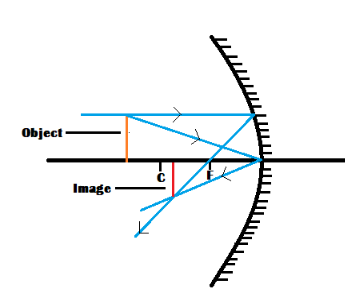
Note: At the picture spot, light rays actually converge. The actual copy of the object would appear projected onto a sheet of paper if a sheet of paper was put at the picture spot.Magnification is the proportion of the size of an image to the size of the object that produced it in optics.
Complete answer:
The ratio of image length to object length measured in planes perpendicular to the optical axis is called linear magnification (also called lateral or transverse magnification). Inverted images are represented by a negative linear magnification value.
The picture will still be centred somewhere between the centre of curvature and the focal point when the object is located outside the centre of curvature. The picture will be in the designated region regardless of the exact location of the object. The result would be an inverted image in this case. That is to say, if the object is upright, the picture would be upside down.
The image is shrunk in this case; that is, the image dimensions are smaller than the object dimensions. The picture is less than six feet tall if the object is a six-foot tall human. The magnification's absolute value is less than one in this situation. Real image is formed. We can see the image formation of the object placed beyond the centre of curvature in the figure depicted below:
Note: At the picture spot, light rays actually converge. The actual copy of the object would appear projected onto a sheet of paper if a sheet of paper was put at the picture spot.Magnification is the proportion of the size of an image to the size of the object that produced it in optics.
Recently Updated Pages
Class 10 Question and Answer - Your Ultimate Solutions Guide

Master Class 12 Economics: Engaging Questions & Answers for Success
Master Class 12 Social Science: Engaging Questions & Answers for Success
Master Class 12 English: Engaging Questions & Answers for Success
Master Class 12 Maths: Engaging Questions & Answers for Success
Master Class 12 Physics: Engaging Questions & Answers for Success
Trending doubts
Explain the Treaty of Vienna of 1815 class 10 social science CBSE
The slogan Jai Hind was given by A Lal Bahadur Shastri class 10 social science CBSE
10 examples of evaporation in daily life with explanations
What is the full form of POSCO class 10 social science CBSE
Identify the feminine form of noun nephew a shenephew class 10 english CBSE
CSIR full form?