




In a class of 35 students, 17 have taken mathematics, 10 have taken mathematics but not economics. If each student has taken either mathematics or economics or both then the number of students who have taken economics bot not mathematics is:
(A)7
(B)25
(C)18
(D)32
Answer
 Verified
595.5k+ views
Hint:Generally in these types of questions we will start with a Venn diagram and the term ‘AND’ is used for intersection and term ‘OR’ is used for union. Formula which we can use in these types of question is
$n\left( {M \cup E} \right) = n\left( M \right) + n\left( E \right) - n\left( {M \cap E} \right)$
Complete step-by-step answer:
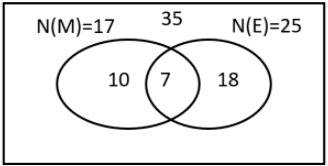
Number of total students = $35$
Number of students who taken mathematics = $n\left( M \right) = 17$
Number of students have taken mathematics but not economics = $n\left( {M \cap E'} \right) = 10$
$n\left( {M \cap E} \right) = $Number of students who have math and economics both.
So, according to question
$n\left( {M \cap E} \right) = n\left( M \right) - n\left( {M \cap E'} \right)$
$n\left( {M \cap E} \right) = 17 - 10$
$n\left( {M \cap E} \right) = 7$
$n\left( E \right) = $Number of students with economics.
$n\left( {M \cup E} \right) = $Number of students with maths or economics or we can say that total number of students
$n\left( {M \cup E} \right) = n\left( M \right) + n\left( E \right) - n\left( {M \cap E} \right)$
$
35 = 17 + n\left( E \right) - 7 \\
n\left( E \right) = 42 - 17 \\
n\left( E \right) = 25 \\
$
So, the number of students who have taken economics is $25$.
$n\left( {E \cap M'} \right) = $Number of students with economics but not math’s.
$n\left( {E \cap M'} \right) = n\left( E \right) - n\left( {E \cup M'} \right)$
$
7 = 25 - n\left( {E \cup M'} \right) \\
n\left( {E \cup M'} \right) = 25 - 7 \\
n\left( {E \cup M'} \right) = 18 \\
$
So, students who has taken economics but not mathematics is $18$
So the correct option is C.
Note:In these types of questions generally one can make mistakes in drawing a Venn diagram. So we careful while making that diagram and be careful about terms ‘AND’ and ‘OR’.
$n\left( {M \cup E} \right) = n\left( M \right) + n\left( E \right) - n\left( {M \cap E} \right)$
Complete step-by-step answer:
Number of total students = $35$
Number of students who taken mathematics = $n\left( M \right) = 17$
Number of students have taken mathematics but not economics = $n\left( {M \cap E'} \right) = 10$
$n\left( {M \cap E} \right) = $Number of students who have math and economics both.
So, according to question
$n\left( {M \cap E} \right) = n\left( M \right) - n\left( {M \cap E'} \right)$
$n\left( {M \cap E} \right) = 17 - 10$
$n\left( {M \cap E} \right) = 7$
$n\left( E \right) = $Number of students with economics.
$n\left( {M \cup E} \right) = $Number of students with maths or economics or we can say that total number of students
$n\left( {M \cup E} \right) = n\left( M \right) + n\left( E \right) - n\left( {M \cap E} \right)$
$
35 = 17 + n\left( E \right) - 7 \\
n\left( E \right) = 42 - 17 \\
n\left( E \right) = 25 \\
$
So, the number of students who have taken economics is $25$.
$n\left( {E \cap M'} \right) = $Number of students with economics but not math’s.
$n\left( {E \cap M'} \right) = n\left( E \right) - n\left( {E \cup M'} \right)$
$
7 = 25 - n\left( {E \cup M'} \right) \\
n\left( {E \cup M'} \right) = 25 - 7 \\
n\left( {E \cup M'} \right) = 18 \\
$
So, students who has taken economics but not mathematics is $18$
So the correct option is C.
Note:In these types of questions generally one can make mistakes in drawing a Venn diagram. So we careful while making that diagram and be careful about terms ‘AND’ and ‘OR’.
Recently Updated Pages
Master Class 11 Computer Science: Engaging Questions & Answers for Success

Master Class 11 Business Studies: Engaging Questions & Answers for Success
Master Class 11 Economics: Engaging Questions & Answers for Success
Master Class 11 English: Engaging Questions & Answers for Success
Master Class 11 Maths: Engaging Questions & Answers for Success
Master Class 11 Biology: Engaging Questions & Answers for Success
Trending doubts
One Metric ton is equal to kg A 10000 B 1000 C 100 class 11 physics CBSE
There are 720 permutations of the digits 1 2 3 4 5 class 11 maths CBSE
Discuss the various forms of bacteria class 11 biology CBSE
Draw a diagram of a plant cell and label at least eight class 11 biology CBSE
State the laws of reflection of light
Explain zero factorial class 11 maths CBSE