




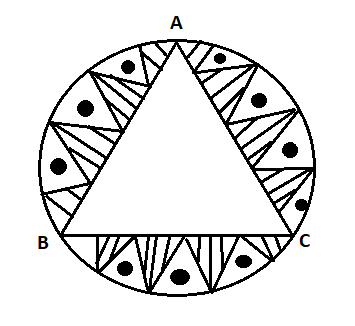
In a circular table cover of radius 32cm, a design is formed leaving an equilateral triangle ABC in the middle as shown in the figure. Find the area of the design (Shaded region).
Answer
 Verified
601.2k+ views
Hint: According to given in the question we have to determine the area of the design (Shaded region) when in a circular table cover of radius 32cm, a design is formed leaving an equilateral triangle ABC in the middle as shown in the figure as above. So, first of all we have to draw the centre and then radius of the given circle.
Now, as mentioned in the question that inside the circular table there is a equilateral triangle so first of all we have to understand about the equilateral triangle which is as explained below:
Equilateral triangle: A triangle which has all the three sides equal to each other and all the interior angles are equal to is each other and all the interior angles are \[{60^0}\]in dimensions.
Now, we have to determine the dimensions of sides of the given equilateral triangle with the help of the interior angles.
Now, we have to determine the area of the given equilateral triangle with the help of the formula as mentioned below:
Formula used:
$ \Rightarrow $Area of triangle$ = \dfrac{1}{2} \times b \times h.................(A)$
Where, b is the base of the triangle and h is the height of the triangle.
Hence, with the help of the formula (A) above we can easily determine the area of the equilateral triangle.
Now, we have to determine the area of the given circular table which is circular in the shape so we have to determine the area of the circle with the help of the formula as mentioned below:
$ \Rightarrow $Area of circle$ = \pi {r^2}..........................(B)$
Where, r is the radius of the given circle.
Now, to determine the area of the shaded region we have to subtract the area of the equilateral triangle obtained by the area of the circle.
Complete step by step answer:
Step 1: First of all we have to draw the radius and the centre of the given circle in the diagram as mentioned in the question. Hence,
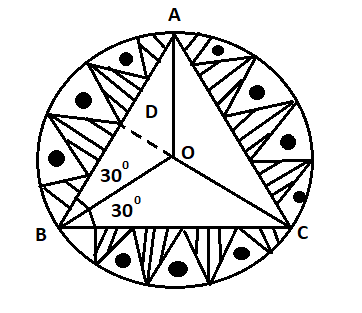
Where, AO, BO, and CO are the radiuses and O is the centre of the circle.
Step 2: Now, as we have already understand about the equilateral triangle which is as explained in the solution hint so, we have to determine the base and height of the given equilateral triangle which is as below:
$ \Rightarrow \cos \theta = \dfrac{{AD}}{{OA}}$
Now, in substituting all the values in the expression as obtained just above, hence,
$ \Rightarrow \cos {30^0} = \dfrac{{AD}}{{32}}$
Now, as we know that $\cos {30^0} = \dfrac{{\sqrt 3 }}{2}$hence,
$
\Rightarrow \dfrac{{\sqrt 3 }}{2} = \dfrac{{AD}}{{32}} \\
\Rightarrow AD = 16\sqrt 3 cm \\
$
Step 2: Now, as we have obtained the AD now we have to determine the side with the help of the AD as obtained in the solution step 1. Hence,
$
\Rightarrow AB = 2AD \\
\Rightarrow AB = 2 \times 16\sqrt 3 \\
\Rightarrow AB = 32\sqrt 3 cm \\
$
Step 3: Now, we have to determine the area of the triangle ABC with the help of the formula (A) as mentioned in the solution hint. Hence,
$
= \dfrac{1}{2} \times 32\sqrt 3 \times 3 \times 16 \\
= 768\sqrt 3 c{m^2} \\
$
Step 4: Now, we have to determine the area of the circle with the help of the formula (B) as mentioned in the solution hint. Hence, on substituting all the values in the formula (B),
$ = \pi \times {(32)^2}c{m^2}$
Now, as we know that $\pi = \dfrac{{22}}{7}$ so, on substituting this value on the area obtained just above,
$
= \dfrac{{22}}{7} \times {(32)^2} \\
= \left( {\dfrac{{22578}}{7}} \right)c{m^2} \\
$
Step 5: Now, we have to determine the area of the shaded region which can be obtained by subtracting the area of the equilateral triangle obtained by the area of the circle. Hence,
\[ = \left( {\dfrac{{22578}}{7} - 768\sqrt 3 } \right)c{m^2}\]
Hence, with the help of the formula (A) and (B) we have obtained the required area of the shaded region which is\[ = \left( {\dfrac{{22578}}{7} - 768\sqrt 3 } \right)c{m^2}\].
Note: To determine the area of the shaded region it is necessary that we have to subtract the obtained area of the triangle ABC by the obtained area of the circle.
To determine the area of the equilateral triangle we have to use the interior angle angles and as we know that all the interior angle of the triangle is ${60^0}$ and if we divide the angle equally by drawing the perpendicular from its vertices.
Now, as mentioned in the question that inside the circular table there is a equilateral triangle so first of all we have to understand about the equilateral triangle which is as explained below:
Equilateral triangle: A triangle which has all the three sides equal to each other and all the interior angles are equal to is each other and all the interior angles are \[{60^0}\]in dimensions.
Now, we have to determine the dimensions of sides of the given equilateral triangle with the help of the interior angles.
Now, we have to determine the area of the given equilateral triangle with the help of the formula as mentioned below:
Formula used:
$ \Rightarrow $Area of triangle$ = \dfrac{1}{2} \times b \times h.................(A)$
Where, b is the base of the triangle and h is the height of the triangle.
Hence, with the help of the formula (A) above we can easily determine the area of the equilateral triangle.
Now, we have to determine the area of the given circular table which is circular in the shape so we have to determine the area of the circle with the help of the formula as mentioned below:
$ \Rightarrow $Area of circle$ = \pi {r^2}..........................(B)$
Where, r is the radius of the given circle.
Now, to determine the area of the shaded region we have to subtract the area of the equilateral triangle obtained by the area of the circle.
Complete step by step answer:
Step 1: First of all we have to draw the radius and the centre of the given circle in the diagram as mentioned in the question. Hence,
Where, AO, BO, and CO are the radiuses and O is the centre of the circle.
Step 2: Now, as we have already understand about the equilateral triangle which is as explained in the solution hint so, we have to determine the base and height of the given equilateral triangle which is as below:
$ \Rightarrow \cos \theta = \dfrac{{AD}}{{OA}}$
Now, in substituting all the values in the expression as obtained just above, hence,
$ \Rightarrow \cos {30^0} = \dfrac{{AD}}{{32}}$
Now, as we know that $\cos {30^0} = \dfrac{{\sqrt 3 }}{2}$hence,
$
\Rightarrow \dfrac{{\sqrt 3 }}{2} = \dfrac{{AD}}{{32}} \\
\Rightarrow AD = 16\sqrt 3 cm \\
$
Step 2: Now, as we have obtained the AD now we have to determine the side with the help of the AD as obtained in the solution step 1. Hence,
$
\Rightarrow AB = 2AD \\
\Rightarrow AB = 2 \times 16\sqrt 3 \\
\Rightarrow AB = 32\sqrt 3 cm \\
$
Step 3: Now, we have to determine the area of the triangle ABC with the help of the formula (A) as mentioned in the solution hint. Hence,
$
= \dfrac{1}{2} \times 32\sqrt 3 \times 3 \times 16 \\
= 768\sqrt 3 c{m^2} \\
$
Step 4: Now, we have to determine the area of the circle with the help of the formula (B) as mentioned in the solution hint. Hence, on substituting all the values in the formula (B),
$ = \pi \times {(32)^2}c{m^2}$
Now, as we know that $\pi = \dfrac{{22}}{7}$ so, on substituting this value on the area obtained just above,
$
= \dfrac{{22}}{7} \times {(32)^2} \\
= \left( {\dfrac{{22578}}{7}} \right)c{m^2} \\
$
Step 5: Now, we have to determine the area of the shaded region which can be obtained by subtracting the area of the equilateral triangle obtained by the area of the circle. Hence,
\[ = \left( {\dfrac{{22578}}{7} - 768\sqrt 3 } \right)c{m^2}\]
Hence, with the help of the formula (A) and (B) we have obtained the required area of the shaded region which is\[ = \left( {\dfrac{{22578}}{7} - 768\sqrt 3 } \right)c{m^2}\].
Note: To determine the area of the shaded region it is necessary that we have to subtract the obtained area of the triangle ABC by the obtained area of the circle.
To determine the area of the equilateral triangle we have to use the interior angle angles and as we know that all the interior angle of the triangle is ${60^0}$ and if we divide the angle equally by drawing the perpendicular from its vertices.
Recently Updated Pages
Master Class 12 Economics: Engaging Questions & Answers for Success

Master Class 12 English: Engaging Questions & Answers for Success
Master Class 12 Social Science: Engaging Questions & Answers for Success
Master Class 12 Maths: Engaging Questions & Answers for Success
Master Class 12 Physics: Engaging Questions & Answers for Success
Master Class 9 General Knowledge: Engaging Questions & Answers for Success
Trending doubts
Find the sum of series 1 + 2 + 3 + 4 + 5 + + 100 class 9 maths CBSE
Difference Between Plant Cell and Animal Cell
Fill the blanks with the suitable prepositions 1 The class 9 english CBSE
What is pollution? How many types of pollution? Define it
Name 10 Living and Non living things class 9 biology CBSE
What is the full form of pH?