




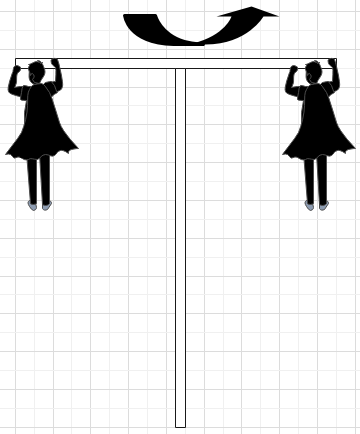
In a children’s park a heavy rod is pivoted at the centre and is made to rotate about the pivot so that the rod always remains horizontal. Two kids hold the rod near the ends and thus rotate with the rod (in fig). Let the mass of each kid is 15kg, between the points of the rod where the two kids hold it be 3.0m and suppose the rod rotates at the rate of 20 revolutions per minute. Find the force of friction exerted by the rod on one of the kids.
Answer
 Verified
575.4k+ views
Hint: Just like any other numerical problem, you could first note down all the given quantities from the question. We could get the distance of each kid from the centre by taking half of the distance between them. Now, we know that the frictional force will be balanced by the centripetal force. So, you could simply substitute the given values in that expression to get the answer.
Complete step by step solution:
The given information in the question are:
Mass of each kid, m = 15kg
Distance between the points that the kids are holding = 3m
So, the distance from the centre of the rod to the point at which each kid is holding,
$R=\dfrac{3}{2}=1.5m$
The number of revolutions that the rod takes in a minute,
$N=20rev/\min $
The frequency of the rod would be,
$f=\dfrac{20}{60}=\dfrac{1}{3}rev/s$
The angular frequency of the rod would be,
$\omega =2\pi f=2\pi \left( \dfrac{1}{3} \right)$
We are supposed to find the frictional force on each kid using the above given information.
We know that the centripetal force would balance the force of friction. That is,
$F=mr{{\omega }^{2}}$
$\Rightarrow F=15\times 1.5\times {{\left( \dfrac{2\pi }{3} \right)}^{2}}$
$\therefore F=10{{\pi }^{2}}$
Therefore, we found the frictional force on one of the kids to be$10{{\pi }^{2}}$.
Note: The frequency of the rod is the number of revolutions made by it in each second and thus we have made the calculation accordingly. The concept behind the above solution is that the frictional force that keeps a kid hanging without sliding is equal in magnitude to the centripetal force. As the masses of the kids are the same, each will have the same magnitude of force on them.
Complete step by step solution:
The given information in the question are:
Mass of each kid, m = 15kg
Distance between the points that the kids are holding = 3m
So, the distance from the centre of the rod to the point at which each kid is holding,
$R=\dfrac{3}{2}=1.5m$
The number of revolutions that the rod takes in a minute,
$N=20rev/\min $
The frequency of the rod would be,
$f=\dfrac{20}{60}=\dfrac{1}{3}rev/s$
The angular frequency of the rod would be,
$\omega =2\pi f=2\pi \left( \dfrac{1}{3} \right)$
We are supposed to find the frictional force on each kid using the above given information.
We know that the centripetal force would balance the force of friction. That is,
$F=mr{{\omega }^{2}}$
$\Rightarrow F=15\times 1.5\times {{\left( \dfrac{2\pi }{3} \right)}^{2}}$
$\therefore F=10{{\pi }^{2}}$
Therefore, we found the frictional force on one of the kids to be$10{{\pi }^{2}}$.
Note: The frequency of the rod is the number of revolutions made by it in each second and thus we have made the calculation accordingly. The concept behind the above solution is that the frictional force that keeps a kid hanging without sliding is equal in magnitude to the centripetal force. As the masses of the kids are the same, each will have the same magnitude of force on them.
Recently Updated Pages
Master Class 12 Economics: Engaging Questions & Answers for Success

Master Class 12 English: Engaging Questions & Answers for Success
Master Class 12 Social Science: Engaging Questions & Answers for Success
Master Class 12 Maths: Engaging Questions & Answers for Success
Master Class 12 Physics: Engaging Questions & Answers for Success
Master Class 11 Social Science: Engaging Questions & Answers for Success
Trending doubts
One Metric ton is equal to kg A 10000 B 1000 C 100 class 11 physics CBSE
Difference Between Prokaryotic Cells and Eukaryotic Cells
Find the value of the expression given below sin 30circ class 11 maths CBSE
Two of the body parts which do not appear in MRI are class 11 biology CBSE
Draw a diagram of nephron and explain its structur class 11 biology CBSE
10 examples of friction in our daily life