




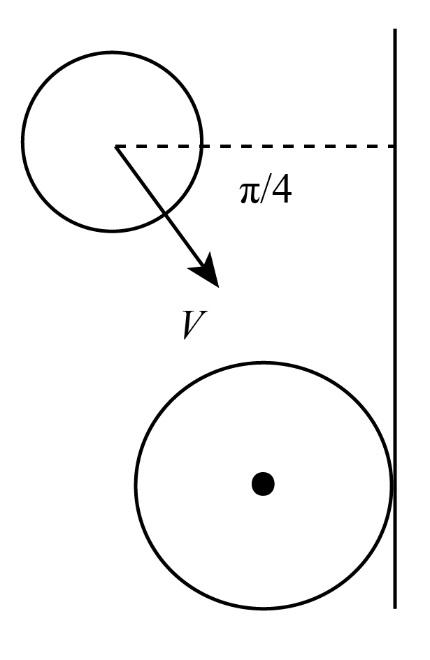
In a carrom-board game the striker and the coins are identical and of mass m. In a particular hit the coin is hit when it is placed close to the edge of the board as shown in the figure such that the coin travels parallel to the edge. If the striker is moving with speed v before strike, then the net impulse on the striker during collision of it moves perpendicular to the edge is (assume all collisions to be perfectly elastic).
(A) $mv\sqrt {\dfrac{5}{2}} $
(B) 2mv
(C) $\dfrac{{mv\sqrt 3 }}{2}$
(D) mv
Answer
 Verified
609.6k+ views
Hint: This question uses the concept of conservation of linear momentum and impulse. You need first to calculate the component of velocity of the striker in the horizontal and vertical direction. Then you need to calculate the change in impulse in both the directions. Later, you can calculate net impulse by a change in impulse in the horizontal direction and vertical direction.
Complete step by step answer:
In the question it is given that, the mass of the striker and the coin is m. The speed of the striker, before it strikes the coin is v. Also, it is mentioned that the collision is a perfectly elastic collision.
As we know, in the case of perfectly elastic collision, $e = 1$.
The x-component of speed of the striker is given as ${v_x} = v\cos 45^\circ $ and the y-component of the speed of the striker is given as ${v_y} = v\sin 45^\circ $.
On applying the conservation of linear momentum along the x-axis, we get,
$\begin{array}
mv\cos 45^\circ = - mv'\\
v' = \dfrac{v}{{\sqrt 2 }}
\end{array}$
Similarly, on applying the conservation of linear momentum along the y-axis, we get,
$\begin{array}
mv\sin 45^\circ = 0\\
v = 0
\end{array}$
This means that there is no motion along the y-direction.
The change in impulse of the striker along the x-axis can be given as,
$\begin{array}
\Delta {I_x} = \dfrac{{mv}}{{\sqrt 2 }} - \left( { - \dfrac{{mv}}{{\sqrt 2 }}} \right)\\
\Delta {I_x} = mv\sqrt 2
\end{array}$
Similarly we can calculate the change in impulse of the striker along the y-axis as,
$\Delta {I_y} = \dfrac{{mv}}{{\sqrt 2 }}$
So we can calculate the net impulse on the striker as,
$
{I_{net}} = \sqrt {\Delta I_x^2 + \Delta I_y^2} \\
\implies {I_{net}} = \sqrt {{{\left( {mv\sqrt 2 } \right)}^2} + {{\left( {\dfrac{{mv}}{{\sqrt 2 }}} \right)}^2}}
$
On further solving the above expression,
$
{I_{net}} = \sqrt {{{\left( {mv\sqrt 2 } \right)}^2} + {{\left( {\dfrac{{mv}}{{\sqrt 2 }}} \right)}^2}} \
\implies {I_{net}} = mv\sqrt {2 + \dfrac{1}{2}} \\
\implies {I_{net}} = mv\sqrt {\dfrac{5}{2}}
$
Therefore, the net impulse of the striker during the collision is $mv\sqrt {\dfrac{5}{2}} $.
So, the correct answer is “Option A”.
Note:
You can make mistakes in the calculation part as it is very complex.
As it is mentioned in the question that, all the collisions are perfectly elastic, so the value of coefficient of restitution will be 1.
The component of velocity of the striker in the horizontal and vertical direction.
Complete step by step answer:
In the question it is given that, the mass of the striker and the coin is m. The speed of the striker, before it strikes the coin is v. Also, it is mentioned that the collision is a perfectly elastic collision.
As we know, in the case of perfectly elastic collision, $e = 1$.
The x-component of speed of the striker is given as ${v_x} = v\cos 45^\circ $ and the y-component of the speed of the striker is given as ${v_y} = v\sin 45^\circ $.
On applying the conservation of linear momentum along the x-axis, we get,
$\begin{array}
mv\cos 45^\circ = - mv'\\
v' = \dfrac{v}{{\sqrt 2 }}
\end{array}$
Similarly, on applying the conservation of linear momentum along the y-axis, we get,
$\begin{array}
mv\sin 45^\circ = 0\\
v = 0
\end{array}$
This means that there is no motion along the y-direction.
The change in impulse of the striker along the x-axis can be given as,
$\begin{array}
\Delta {I_x} = \dfrac{{mv}}{{\sqrt 2 }} - \left( { - \dfrac{{mv}}{{\sqrt 2 }}} \right)\\
\Delta {I_x} = mv\sqrt 2
\end{array}$
Similarly we can calculate the change in impulse of the striker along the y-axis as,
$\Delta {I_y} = \dfrac{{mv}}{{\sqrt 2 }}$
So we can calculate the net impulse on the striker as,
$
{I_{net}} = \sqrt {\Delta I_x^2 + \Delta I_y^2} \\
\implies {I_{net}} = \sqrt {{{\left( {mv\sqrt 2 } \right)}^2} + {{\left( {\dfrac{{mv}}{{\sqrt 2 }}} \right)}^2}}
$
On further solving the above expression,
$
{I_{net}} = \sqrt {{{\left( {mv\sqrt 2 } \right)}^2} + {{\left( {\dfrac{{mv}}{{\sqrt 2 }}} \right)}^2}} \
\implies {I_{net}} = mv\sqrt {2 + \dfrac{1}{2}} \\
\implies {I_{net}} = mv\sqrt {\dfrac{5}{2}}
$
Therefore, the net impulse of the striker during the collision is $mv\sqrt {\dfrac{5}{2}} $.
So, the correct answer is “Option A”.
Note:
You can make mistakes in the calculation part as it is very complex.
As it is mentioned in the question that, all the collisions are perfectly elastic, so the value of coefficient of restitution will be 1.
The component of velocity of the striker in the horizontal and vertical direction.
Recently Updated Pages
Master Class 12 Economics: Engaging Questions & Answers for Success

Master Class 12 English: Engaging Questions & Answers for Success
Master Class 12 Social Science: Engaging Questions & Answers for Success
Master Class 12 Maths: Engaging Questions & Answers for Success
Master Class 12 Physics: Engaging Questions & Answers for Success
Master Class 9 General Knowledge: Engaging Questions & Answers for Success
Trending doubts
One Metric ton is equal to kg A 10000 B 1000 C 100 class 11 physics CBSE
Difference Between Prokaryotic Cells and Eukaryotic Cells
Two of the body parts which do not appear in MRI are class 11 biology CBSE
Find the value of the expression given below sin 30circ class 11 maths CBSE
1 ton equals to A 100 kg B 1000 kg C 10 kg D 10000 class 11 physics CBSE
Draw a diagram of nephron and explain its structur class 11 biology CBSE