




In a board examination, $40$ students failed in physics, $40$ in chemistry and $35$ in math, $20$ failed in maths & physics, $17$ in physics and chemistry, $15$ in maths and chemistry and $5$ in all three subjects. If $350$ students appeared in the examination, how many of them did not fail in any subjects?
Answer
 Verified
612k+ views
Hint: In this question, we have to work with the no. of students who do not fail in any exam. This question can be solved in two ways. First Venn diagram, draw three intersecting circles one for physics and remaining for math and chemistry. Write down the information & solve it out.
Another way, by using Set theory, i.e. Set formulae approach.
Complete step by step answer:
Venn Diagram:
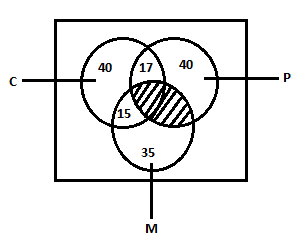
No. of students failed in every subject $ = 5$.
No. of students failed in only Physics & chemistry$ = 17 - 5 = 12$
No. of students failed in only chemistry & math’s$ = 15 - 5 = 10$
No. of students failed in only maths & Physics$ = 20 - 5 = 15$
$\therefore $No. of students failed in only math’s $ = 35 - 10 - 15 - 5 = 5$
No. of students failed in only chemistry $ = 40 - 15 - 5 - 17 = 3$
No. of students failed in only Physics$ = 40 - 12 - 5 - 15 = 8$
$\therefore $Total no. of students failed $ = 5 + 3 + 8 + 12 + 10 + 15 + 5 = 58$
$\therefore $ Total no. of students does not fail $ = 350 - 58 = 292$
Since, total students $ = 350$
Note:
We can solve this problem by using Set Formulae Approach also:
Consider, No. of students failed in Physics $ = n\left( P \right) = 40$
No. of students failed in chemistry $ = n\left( C \right) = 40$
No. of students failed in math’s $ = n\left( M \right) = 35$
No. of students failed in Physics & chemistry $ = n\left( {P \cap C} \right) = 17$
No. of students failed in chemistry & maths $ = n\left( {C \cap M} \right) = 15$
No. of students failed in maths & Physics $ = n\left( {M \cap P} \right) = 20$
No. of students failed in all subjects $ = n\left( {M \cap P \cap C} \right) = 5$
Therefore, Total no. of students failed in at least on subject $ = n\left( {M \cap P \cap C} \right)$
We know –
$ = n\left( {M \cup P \cup C} \right) = n\left( M \right) + n\left( P \right) + n\left( C \right) - n\left( {M \cap P} \right) - n\left( {P \cap C} \right) - n\left( {C \cap M} \right) + n\left( {M \cap P \cap C} \right)$
$ = 40 + 40 + 35 - 17 - 15 - 20 + 5$
$ = 68$
No. of students do not fail in any subjects –
$ = n\left( {M \cup P \cup C} \right) = \cup - n\left( {M \cup P \cup C} \right)$
$ = 350 - 68$
$ = 282$
(Total students are $350$ given)
No. of students do not fail are $282$.
Another way, by using Set theory, i.e. Set formulae approach.
Complete step by step answer:
Venn Diagram:
No. of students failed in every subject $ = 5$.
No. of students failed in only Physics & chemistry$ = 17 - 5 = 12$
No. of students failed in only chemistry & math’s$ = 15 - 5 = 10$
No. of students failed in only maths & Physics$ = 20 - 5 = 15$
$\therefore $No. of students failed in only math’s $ = 35 - 10 - 15 - 5 = 5$
No. of students failed in only chemistry $ = 40 - 15 - 5 - 17 = 3$
No. of students failed in only Physics$ = 40 - 12 - 5 - 15 = 8$
$\therefore $Total no. of students failed $ = 5 + 3 + 8 + 12 + 10 + 15 + 5 = 58$
$\therefore $ Total no. of students does not fail $ = 350 - 58 = 292$
Since, total students $ = 350$
Note:
We can solve this problem by using Set Formulae Approach also:
Consider, No. of students failed in Physics $ = n\left( P \right) = 40$
No. of students failed in chemistry $ = n\left( C \right) = 40$
No. of students failed in math’s $ = n\left( M \right) = 35$
No. of students failed in Physics & chemistry $ = n\left( {P \cap C} \right) = 17$
No. of students failed in chemistry & maths $ = n\left( {C \cap M} \right) = 15$
No. of students failed in maths & Physics $ = n\left( {M \cap P} \right) = 20$
No. of students failed in all subjects $ = n\left( {M \cap P \cap C} \right) = 5$
Therefore, Total no. of students failed in at least on subject $ = n\left( {M \cap P \cap C} \right)$
We know –
$ = n\left( {M \cup P \cup C} \right) = n\left( M \right) + n\left( P \right) + n\left( C \right) - n\left( {M \cap P} \right) - n\left( {P \cap C} \right) - n\left( {C \cap M} \right) + n\left( {M \cap P \cap C} \right)$
$ = 40 + 40 + 35 - 17 - 15 - 20 + 5$
$ = 68$
No. of students do not fail in any subjects –
$ = n\left( {M \cup P \cup C} \right) = \cup - n\left( {M \cup P \cup C} \right)$
$ = 350 - 68$
$ = 282$
(Total students are $350$ given)
No. of students do not fail are $282$.
Recently Updated Pages
Master Class 11 Social Science: Engaging Questions & Answers for Success

Master Class 11 English: Engaging Questions & Answers for Success
Master Class 11 Maths: Engaging Questions & Answers for Success
Master Class 11 Chemistry: Engaging Questions & Answers for Success
Master Class 11 Biology: Engaging Questions & Answers for Success
Master Class 11 Physics: Engaging Questions & Answers for Success
Trending doubts
One Metric ton is equal to kg A 10000 B 1000 C 100 class 11 physics CBSE
Difference Between Prokaryotic Cells and Eukaryotic Cells
Draw a diagram of a plant cell and label at least eight class 11 biology CBSE
Two of the body parts which do not appear in MRI are class 11 biology CBSE
Which gas is abundant in air class 11 chemistry CBSE
10 examples of friction in our daily life