




In a ∆ABC, P and Q are points on sides AB and AC respectively, such that PQ || BC. If AP = 2.4 cm, AQ = 2 cm, QC = 3 cm and BC = 6 cm, find the AB and PQ.
Answer
 Verified
549.7k+ views
Hint- Proceed the solution of this question, first with the help of basic proportionality theorem find the unknown side that we can easily so that we can prove two corresponding triangles similar. Hence once we show a triangle similar then easily with the help of properties of a similar triangle we can find the desired sides of the triangle.
Complete step-by-step solution -
In the question it is given that Δ ABC, AP = 2.4 cm, AQ = 2 cm, QC = 3 cm, and BC = 6 cm. Also, PQ ∥ BC. And we were required to find: AB and PQ.
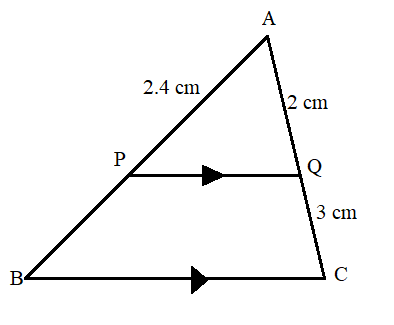
By using Thales Theorem, which is a Basic proportionality theorem,
we have [As it’s given that PQ ∥ BC]
\[ \Rightarrow \dfrac{{{\text{AP}}}}{{{\text{PB}}}} = \dfrac{{{\text{AQ}}}}{{{\text{QC}}}}\]
\[ \Rightarrow \dfrac{{2.4}}{{{\text{PB}}}} = \dfrac{2}{3}\]
On cross multiplication
\[ \Rightarrow {\text{PB}} = \dfrac{{2.4 \times 3}}{2} = 3.6{\text{ cm}}\]
Now finding, AB = AP + PB
AB = 2.4 + 3.6 ⇒ AB = 6 cm
Now, considering Δ APQ and Δ ABC
We have,
⇒∠A = ∠A (common)
⇒ ∠APQ = ∠ABC (Corresponding angles are equal, PQ||BC and AB being a transversal)
We know that the mathematical definition for similar triangles states that the triangles (Δ APQ and Δ ABC) have proportional corresponding sides and all the corresponding angles are the same. The Angle-Angle (AA) criterion tells us that two triangles are similar if two corresponding angles are equal to each other.
Thus, Δ APQ and Δ ABC are similar to each other by AA criteria.
Now, we know that Corresponding parts of similar triangles are proportional.
\[ \Rightarrow \dfrac{{{\text{AP}}}}{{{\text{AB}}}} = \dfrac{{{\text{PQ}}}}{{{\text{BC}}}}\]
On cross multiplication
\[ \Rightarrow {\text{PQ}} = \dfrac{{{\text{AP}} \times {\text{BC}}}}{{{\text{AB}}}}\]
\[ \Rightarrow {\text{PQ}} = \dfrac{{2.4 \times 6}}{6}\]
\[\therefore {\text{PQ = }}2.4{\text{ cm}}\]
Note- In this particular system we should know that Thales theorem states that
If two lines AB and CD as shown in below figure. When AC and BD intersect at a point E, and when E is either (1) a point interior to both segment AC and segment BD or else (2) exterior to both segments, then the triangles AEB and CED (1) share the angle ∠AEB = angle ∠CED or else (2) these two angles are vertical angles. Then for such a figure as shown below
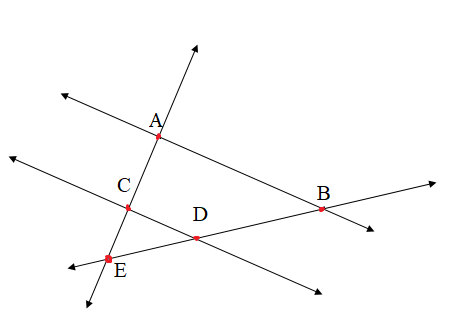
Line AB is parallel to line CD if and only if
Triangle AEB is similar to triangle CED if and only if
$\dfrac{{{\text{EC}}}}{{{\text{EA}}}} = \dfrac{{{\text{ED}}}}{{{\text{EB}}}}$
Complete step-by-step solution -
In the question it is given that Δ ABC, AP = 2.4 cm, AQ = 2 cm, QC = 3 cm, and BC = 6 cm. Also, PQ ∥ BC. And we were required to find: AB and PQ.
By using Thales Theorem, which is a Basic proportionality theorem,
we have [As it’s given that PQ ∥ BC]
\[ \Rightarrow \dfrac{{{\text{AP}}}}{{{\text{PB}}}} = \dfrac{{{\text{AQ}}}}{{{\text{QC}}}}\]
\[ \Rightarrow \dfrac{{2.4}}{{{\text{PB}}}} = \dfrac{2}{3}\]
On cross multiplication
\[ \Rightarrow {\text{PB}} = \dfrac{{2.4 \times 3}}{2} = 3.6{\text{ cm}}\]
Now finding, AB = AP + PB
AB = 2.4 + 3.6 ⇒ AB = 6 cm
Now, considering Δ APQ and Δ ABC
We have,
⇒∠A = ∠A (common)
⇒ ∠APQ = ∠ABC (Corresponding angles are equal, PQ||BC and AB being a transversal)
We know that the mathematical definition for similar triangles states that the triangles (Δ APQ and Δ ABC) have proportional corresponding sides and all the corresponding angles are the same. The Angle-Angle (AA) criterion tells us that two triangles are similar if two corresponding angles are equal to each other.
Thus, Δ APQ and Δ ABC are similar to each other by AA criteria.
Now, we know that Corresponding parts of similar triangles are proportional.
\[ \Rightarrow \dfrac{{{\text{AP}}}}{{{\text{AB}}}} = \dfrac{{{\text{PQ}}}}{{{\text{BC}}}}\]
On cross multiplication
\[ \Rightarrow {\text{PQ}} = \dfrac{{{\text{AP}} \times {\text{BC}}}}{{{\text{AB}}}}\]
\[ \Rightarrow {\text{PQ}} = \dfrac{{2.4 \times 6}}{6}\]
\[\therefore {\text{PQ = }}2.4{\text{ cm}}\]
Note- In this particular system we should know that Thales theorem states that
If two lines AB and CD as shown in below figure. When AC and BD intersect at a point E, and when E is either (1) a point interior to both segment AC and segment BD or else (2) exterior to both segments, then the triangles AEB and CED (1) share the angle ∠AEB = angle ∠CED or else (2) these two angles are vertical angles. Then for such a figure as shown below
Line AB is parallel to line CD if and only if
Triangle AEB is similar to triangle CED if and only if
$\dfrac{{{\text{EC}}}}{{{\text{EA}}}} = \dfrac{{{\text{ED}}}}{{{\text{EB}}}}$
Recently Updated Pages
Master Class 10 Computer Science: Engaging Questions & Answers for Success

Master Class 11 English: Engaging Questions & Answers for Success
Master Class 11 Maths: Engaging Questions & Answers for Success
Class 11 Question and Answer - Your Ultimate Solutions Guide
Master Class 11 Biology: Engaging Questions & Answers for Success
Master Class 11 Physics: Engaging Questions & Answers for Success
Trending doubts
Explain the Treaty of Vienna of 1815 class 10 social science CBSE
Who Won 36 Oscar Awards? Record Holder Revealed
What is the median of the first 10 natural numbers class 10 maths CBSE
Why is it 530 pm in india when it is 1200 afternoon class 10 social science CBSE
Select the word that is correctly spelled a Twelveth class 10 english CBSE
Why is there a time difference of about 5 hours between class 10 social science CBSE