




In 3-methyl-2-cyclohexenone which hydrogen cannot undergo deuterium exchange when it reacts with $ C{H_3}{{\text{O}}^\Theta }/C{H_3}OD $ ?
(A) $ {{\text{H}}_1}\;,\;{{\text{H}}_4} $
(B) $ \;{{\text{H}}_4} $
(C) $ {{\text{H}}_3}\;,\;{{\text{H}}_2} $
(D) $ {{\text{H}}_5}\;,\;{{\text{H}}_3} $
Answer
 Verified
563.1k+ views
Hint : This question talks abouts exchange of isotopes of Hydrogen. For this kind of question, we have to know about the Kinetic Isotopic effect in Tautomerism which says If we take a heavier isotope of Hydrogen then all the $ {\text{\alpha }} $ Hydrogen and the hydrogen which are in conjugation with the carbonyl group will be replaced by the heavier isotope of Hydrogen. So, in this question we will identify the $ {\text{\alpha }} $ Hydrogens and replace them with the heavier Isotope.
Complete Step By Step Answer:
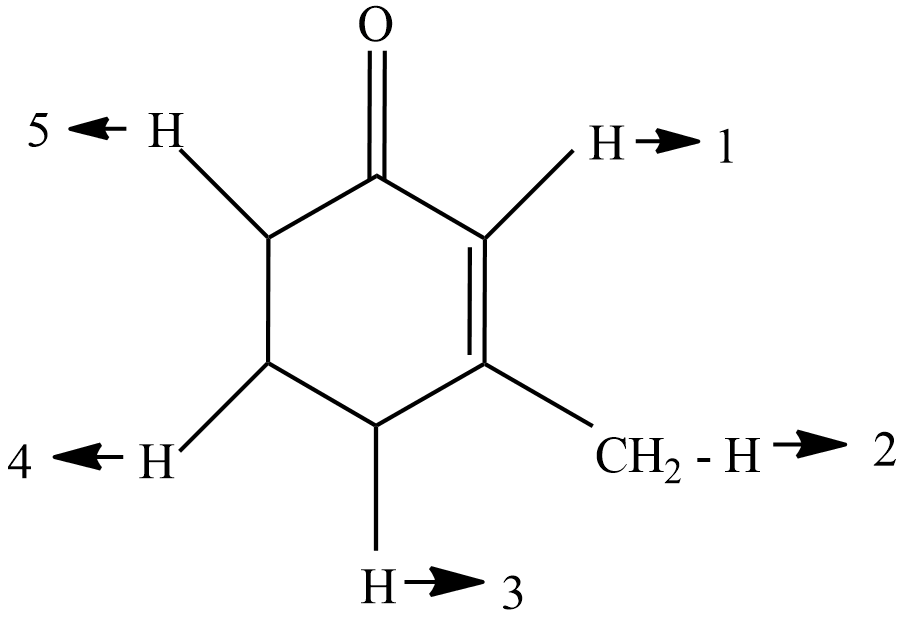
Now, if we see in the diagram $ {{\text{H}}_1} $ and $ {{\text{H}}_5} $ are the alpha hydrogen because they are directly connected to the carbonyl group, so they will react with $ C{H_3}{{\text{O}}^\Theta }/C{H_3}OD $ they will get replaced. now $ {{\text{H}}_2} $ and $ {{\text{H}}_3} $ hydrogen are in conjugated hydrogen they will also get replaced when reacted with ch3 now we are left the $ {{\text{H}}_4} $ hydrogen if we see the diagram then it is clear that $ {{\text{H}}_4} $ hydrogen is neither a alpha hydrogen nor a conjugated hydrogen so it will not react with the $ C{H_3}{{\text{O}}^\Theta }/C{H_3}OD $ and will not be replaced.
The carbon atoms directly attached to the functional group are known as $ {\text{\alpha }} $ Carbon, Hydrogen atoms attached to $ {\text{\alpha }} $ carbon atoms are $ {\text{\alpha }} $ Hydrogen. Since they are directly attached to the $ {\text{\alpha }} $ carbon they become more reactive. So carefully observe the diagram to identify them.
The reaction taking place will be
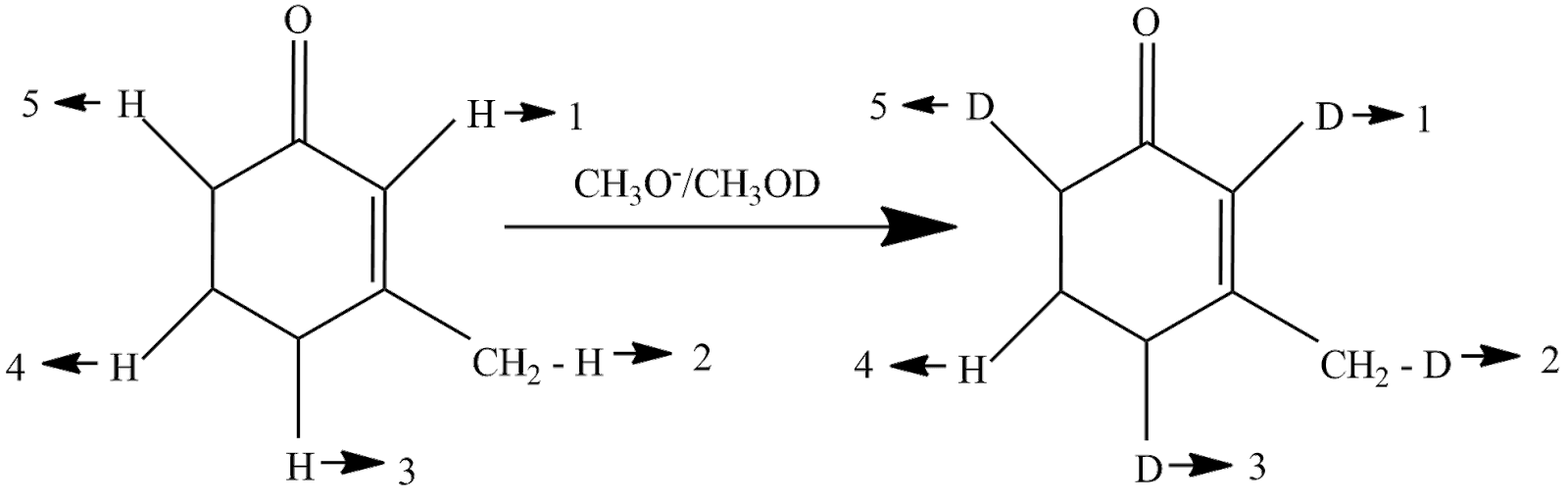
So, the answer is option (C).
Note :
Deuterium is an isotope of hydrogen also known as heavy Hydrogen with a nucleus containing one proton and one neutron so it has twice the mass of a normal hydrogen. When Deuterium is reacted with oxygen it forms $ {D_2}O $ also known as Heavy Water.
Complete Step By Step Answer:
Now, if we see in the diagram $ {{\text{H}}_1} $ and $ {{\text{H}}_5} $ are the alpha hydrogen because they are directly connected to the carbonyl group, so they will react with $ C{H_3}{{\text{O}}^\Theta }/C{H_3}OD $ they will get replaced. now $ {{\text{H}}_2} $ and $ {{\text{H}}_3} $ hydrogen are in conjugated hydrogen they will also get replaced when reacted with ch3 now we are left the $ {{\text{H}}_4} $ hydrogen if we see the diagram then it is clear that $ {{\text{H}}_4} $ hydrogen is neither a alpha hydrogen nor a conjugated hydrogen so it will not react with the $ C{H_3}{{\text{O}}^\Theta }/C{H_3}OD $ and will not be replaced.
The carbon atoms directly attached to the functional group are known as $ {\text{\alpha }} $ Carbon, Hydrogen atoms attached to $ {\text{\alpha }} $ carbon atoms are $ {\text{\alpha }} $ Hydrogen. Since they are directly attached to the $ {\text{\alpha }} $ carbon they become more reactive. So carefully observe the diagram to identify them.
The reaction taking place will be
So, the answer is option (C).
Note :
Deuterium is an isotope of hydrogen also known as heavy Hydrogen with a nucleus containing one proton and one neutron so it has twice the mass of a normal hydrogen. When Deuterium is reacted with oxygen it forms $ {D_2}O $ also known as Heavy Water.
Recently Updated Pages
Master Class 11 English: Engaging Questions & Answers for Success

Master Class 11 Physics: Engaging Questions & Answers for Success
Master Class 11 Computer Science: Engaging Questions & Answers for Success
Master Class 11 Chemistry: Engaging Questions & Answers for Success
Master Class 11 Social Science: Engaging Questions & Answers for Success
Master Class 11 Accountancy: Engaging Questions & Answers for Success
Trending doubts
Difference Between Prokaryotic Cells and Eukaryotic Cells
Two of the body parts which do not appear in MRI are class 11 biology CBSE
One Metric ton is equal to kg A 10000 B 1000 C 100 class 11 physics CBSE
10 examples of friction in our daily life
Draw a diagram of nephron and explain its structur class 11 biology CBSE
Draw a diagram of a plant cell and label at least eight class 11 biology CBSE