




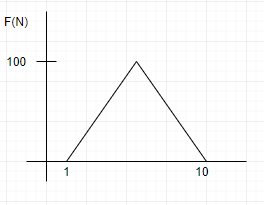
What is the impulse of force shown in the following figure?
A. 205 Ns
B. 450 Ns
C. 800 Ns
D. 1000 Ns
Answer
 Verified
600.6k+ views
Hint: In the figure, we are given a F-t graph, and it depicts the variation of force with respect to time. Impulse is measured with respect to force and time and we can easily find its value by calculating the area under the graph, with the help of the given values.
Formula Used:
Formula for Impulse:
$I=\int{F(t).dt}$, where F is the force of the body and t is the time in which the force acts on the body.
Complete step by step answer:
Impulse, which is symbolised as I or Imp, is defined in classical mechanics as the integral of the force over a given time interval in which the force acts. We know that force is a vector quantity. Hence we can say that impulse is also a vector value.
When impulse is applied to an object, it can produce an equivalent change in vector for its linear momentum and it takes place in the same direction.
Impulsive forces act for a very short period of time. Hence we can say that it is a momentary force.
Impulse can be calculated by,
$I=\int{F(t).dt}$
This is the area under the f-t graph.
Hence, impulse equals to the area of the triangle
$I=\dfrac{1}{2}F\times t=\dfrac{1}{2}\times 100\times (10-1)=450Ns$
Hence the value of the impulse is $450Ns$
Therefore we can conclude that option B is the correct answer among the given options.
Note:The topic of jerks is often confused with impulse. Students must remember that impulse is the change in momentum which considers the mass of the object whereas jerk is only the rate of change of acceleration of the body. The mass is irrelevant in that case.
Formula Used:
Formula for Impulse:
$I=\int{F(t).dt}$, where F is the force of the body and t is the time in which the force acts on the body.
Complete step by step answer:
Impulse, which is symbolised as I or Imp, is defined in classical mechanics as the integral of the force over a given time interval in which the force acts. We know that force is a vector quantity. Hence we can say that impulse is also a vector value.
When impulse is applied to an object, it can produce an equivalent change in vector for its linear momentum and it takes place in the same direction.
Impulsive forces act for a very short period of time. Hence we can say that it is a momentary force.
Impulse can be calculated by,
$I=\int{F(t).dt}$
This is the area under the f-t graph.
Hence, impulse equals to the area of the triangle
$I=\dfrac{1}{2}F\times t=\dfrac{1}{2}\times 100\times (10-1)=450Ns$
Hence the value of the impulse is $450Ns$
Therefore we can conclude that option B is the correct answer among the given options.
Note:The topic of jerks is often confused with impulse. Students must remember that impulse is the change in momentum which considers the mass of the object whereas jerk is only the rate of change of acceleration of the body. The mass is irrelevant in that case.
Recently Updated Pages
Master Class 11 Social Science: Engaging Questions & Answers for Success

Master Class 11 Chemistry: Engaging Questions & Answers for Success
Master Class 12 Business Studies: Engaging Questions & Answers for Success
Master Class 12 Chemistry: Engaging Questions & Answers for Success
Master Class 12 Biology: Engaging Questions & Answers for Success
Class 12 Question and Answer - Your Ultimate Solutions Guide
Trending doubts
One Metric ton is equal to kg A 10000 B 1000 C 100 class 11 physics CBSE
Difference Between Prokaryotic Cells and Eukaryotic Cells
How many of the following diseases can be studied with class 11 biology CBSE
Two of the body parts which do not appear in MRI are class 11 biology CBSE
Which of the following enzymes is used for carboxylation class 11 biology CBSE
Explain zero factorial class 11 maths CBSE