




Image formed by a convex _______ is always virtual and smaller in size.
A. mirror
B. lens
C. Plano mirrors
D. none
Answer
 Verified
626.1k+ views
Hint: A virtual image is an image that forms when rays appear to diverge from a point (or extended object) behind the mirror. Image formed by a plane mirror is an example of virtual image but the size of the image and the object remain the same.
Complete step-by-step solution:
When light from an object Falls on a mirror or a lens, it gets reflected or refracted and creates an image of the object. When the light rays from the object after reflection or refraction actually converge at a point we get a real image. When the light rays after reflection or refraction appear to diverge from a point, we get a virtual image of the object at that point. Real image is usually inverted and can be obtained on a screen wild virtual image is erect and is formed behind the mirror or in front of the lens.
A convex lens forms a virtual image when the object is kept between the lens and its focus but the image formed is an enlarged one. A convex lens acts as a magnifying lens. Therefore we can rule out option (B).
Whereas in the case of convex mirrors, the light falling on the mirror always appears to diverge from its image behind the mirror. So it does not matter where we place the object in front of the convex mirror the image formed will always be virtual and erect. The magnification is the ratio of height of the image to height of the object. The image formed by a convex mirror is always diminished in size. Consider the following convex mirror and notice that the focus of the mirror is present behind the mirror.
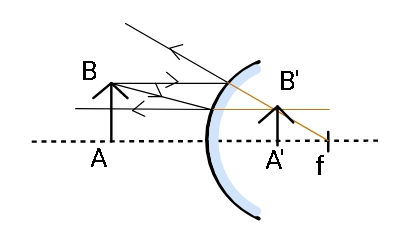
Therefore, the correct answer is option (A). Image formed by a convex mirror is always virtual and smaller in size.
Note: Convex mirrors our primary used as rear view mirrors while primary application of a convex lens is magnification. Convex lens is also called a magnifying lens. Therefore, this can sort out the answer easily for anyone. Also, on the rearview mirror, one would have noticed how small the vehicles look. This might give a hint about the nature of the image. If none of it works, one can always draw Ray diagrams to confirm the answer.
Complete step-by-step solution:
When light from an object Falls on a mirror or a lens, it gets reflected or refracted and creates an image of the object. When the light rays from the object after reflection or refraction actually converge at a point we get a real image. When the light rays after reflection or refraction appear to diverge from a point, we get a virtual image of the object at that point. Real image is usually inverted and can be obtained on a screen wild virtual image is erect and is formed behind the mirror or in front of the lens.
A convex lens forms a virtual image when the object is kept between the lens and its focus but the image formed is an enlarged one. A convex lens acts as a magnifying lens. Therefore we can rule out option (B).
Whereas in the case of convex mirrors, the light falling on the mirror always appears to diverge from its image behind the mirror. So it does not matter where we place the object in front of the convex mirror the image formed will always be virtual and erect. The magnification is the ratio of height of the image to height of the object. The image formed by a convex mirror is always diminished in size. Consider the following convex mirror and notice that the focus of the mirror is present behind the mirror.
Therefore, the correct answer is option (A). Image formed by a convex mirror is always virtual and smaller in size.
Note: Convex mirrors our primary used as rear view mirrors while primary application of a convex lens is magnification. Convex lens is also called a magnifying lens. Therefore, this can sort out the answer easily for anyone. Also, on the rearview mirror, one would have noticed how small the vehicles look. This might give a hint about the nature of the image. If none of it works, one can always draw Ray diagrams to confirm the answer.
Recently Updated Pages
Write any three differences between metals and nonmetals class 10 social science CBSE

Amit standing on a horizontal plane finds a bird flying class 10 maths CBSE
Two circles of radii 5 cm and 3 cm intersect at two class 10 maths CBSE
Solve the following i John and Jivanti together have class 10 maths CBSE
What is the relation between orthocenter circumcentre class 10 maths CBSE
Two plane mirrors are inclined at 70circ A ray incident class 10 physics CBSE
Trending doubts
Explain the Treaty of Vienna of 1815 class 10 social science CBSE
1 GB equals how many MB?
10 examples of evaporation in daily life with explanations
What is the full form of POSCO class 10 social science CBSE
Which is the hottest planet in the Solar system A Earth class 10 social science CBSE
Name any four life processes in living things class 10 biology CBSE