




If T be the period of revolution of a planet revolving around sun in an orbit of mean radius R, then identify the correct graph from the following.
A.
B.
C.
D. None-of these
Answer
 Verified
628.8k+ views
Hint: The above problem can be resolved using the fundamental relation of Kepler's law. The basic statement for Kepler's law is that when any planet revolves around some orbit then, the square of the time taken by the planet to revolve around the planet will be directly proportional to the radius of the path of orbit, around which the planet is undergoing its revolution. The significance for Kepler's law is that it can draw out the various graphical relations between the period and the radius of circular, which can be determined and analysed using the mathematical relation of Kepler's law.
Complete step by step answer:
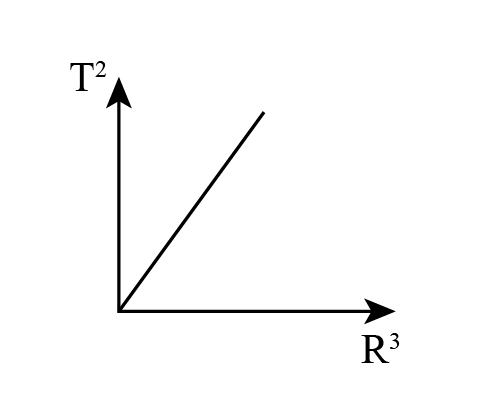
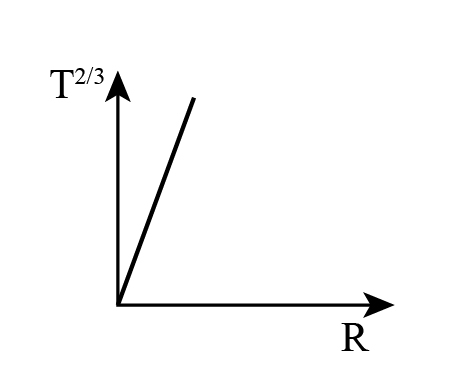
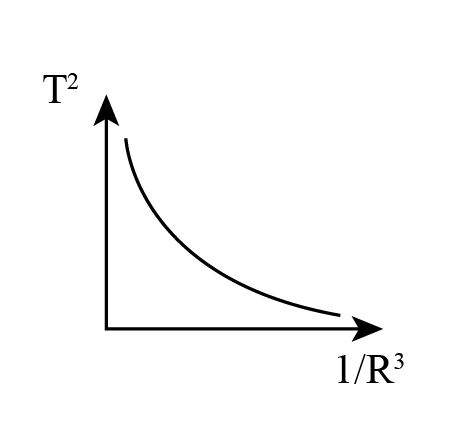
The relation between the time period and the radius of the orbit by the Kepler’s law is given as,
\[\begin{array}{l}
{T^2} \propto {R^3}..................\left( 1 \right)\\
R \propto {T^{2/3}}......................\left( 2 \right)\\
{T^2} \propto \dfrac{1}{{1/{R^3}}}........................\left( 3 \right)
\end{array}\]
The above equation 1 represents the graph 1.
The equation 2 represents the graph 2.
And, equation 3 represents graph 3.
Therefore, all the graphs are correct
So, the correct answer is “Option A,B and C”.
Note:
To resolve the given problem, one must understand the concept of Kepler's law. There are basically three statements under the Kepler's law, first of which is that every planet revolving around the orbits, is observed with the sun as the locus. The second statement is that while there is a rotation around the planet, the line joining the planet will swipe the same areas in an equal interval of time. Moreover, the third statements say that the square of the time taken by any planet to revolve according to the orbits is directly proportional to that of the radius of the orbit.
Complete step by step answer:
The relation between the time period and the radius of the orbit by the Kepler’s law is given as,
\[\begin{array}{l}
{T^2} \propto {R^3}..................\left( 1 \right)\\
R \propto {T^{2/3}}......................\left( 2 \right)\\
{T^2} \propto \dfrac{1}{{1/{R^3}}}........................\left( 3 \right)
\end{array}\]
The above equation 1 represents the graph 1.
The equation 2 represents the graph 2.
And, equation 3 represents graph 3.
Therefore, all the graphs are correct
So, the correct answer is “Option A,B and C”.
Note:
To resolve the given problem, one must understand the concept of Kepler's law. There are basically three statements under the Kepler's law, first of which is that every planet revolving around the orbits, is observed with the sun as the locus. The second statement is that while there is a rotation around the planet, the line joining the planet will swipe the same areas in an equal interval of time. Moreover, the third statements say that the square of the time taken by any planet to revolve according to the orbits is directly proportional to that of the radius of the orbit.
Recently Updated Pages
Master Class 11 English: Engaging Questions & Answers for Success

Master Class 11 Social Science: Engaging Questions & Answers for Success
Master Class 11 Maths: Engaging Questions & Answers for Success
Master Class 11 Biology: Engaging Questions & Answers for Success
Master Class 11 Physics: Engaging Questions & Answers for Success
Master Class 11 Chemistry: Engaging Questions & Answers for Success
Trending doubts
One Metric ton is equal to kg A 10000 B 1000 C 100 class 11 physics CBSE
What is cell theory Who formulated it class 11 biology CBSE
Phyllotaxy is the arrangement of ALeaflets BLeaves class 11 biology CBSE
Difference Between Prokaryotic Cells and Eukaryotic Cells
The symbiotic association of fungi and algae is called class 11 biology CBSE
Cell theory was formulated by A Schleiden and Schwann class 11 biology CBSE