




If \[y = mx + c\] is the normal at a point on the parabola \[{y^2} = 8x\] whose focal distance is 8 units, then |c| is equal to.
A.\[ 2\sqrt 3 \\ \]
B. \[ 10\sqrt 3 \\ \]
C. \[ 8\sqrt 3 \\ \]
D. \[ 16\sqrt 3 \\ \]
Answer
 Verified
602.1k+ views
Hint: Here, you can see the question is based on a parabola whose focal distance is given and the normal of the parabola at a point. So , we need to know what a parabola is. A plane curve formed by the intersection of a right circular cone with a plane parallel to a generator of the cone, the set of points o=in a plane that are equidistant from a fixed line and a fixed point in the same plane or in a parallel line.
Step wise solution:
Given data:1) The normal at a point on the parabola is given \[y = mx + c\]
2) The equation of parabola can be given as \[{y^2} = 8x\]
3) The focal distance of the parabola is 8 units.
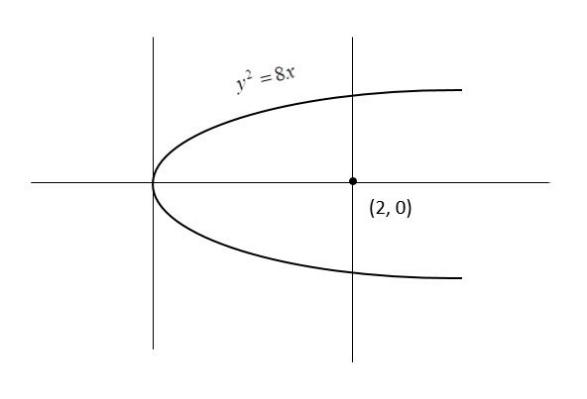
To find out the value of a
Here, \[{y^2} = 8x\]
Differentiating both sides with respect to x, we get
\[ \dfrac{d}{{dx}}{(y^2)} = \dfrac{d}{{dx}}(8x)\\ \]
\[ \Rightarrow 2y(\dfrac{{dy}}{{dx}}) = 8\\ \]
\[ \Rightarrow 2yy' = 8 [y' = \dfrac{{dy}}{{dx}}]\\ \]
\[ \Rightarrow y' = \dfrac{4}{y}\\ \]
We know that, focal distance if a point \[(2{t^2},4t)\] is equal to \[2(1 + {t^2})\]
Here, \[2(1 + {t^2}) = 8\,\,units\]
i.e.: $ 2(1 + {t^2}) = 8\\
\Rightarrow (1 + {t^2}) = \dfrac{8}{2}\\
\Rightarrow {t^2} = 4 - 1\\
\Rightarrow t = \pm \sqrt 3
$
Now,
\[ \Rightarrow 2{t^2} = 2 \times {( \pm \sqrt 3 )^2}\\ \]
\[ = 2 \times 3 = 6\\ \]
and \[ \,4t = 4 \times ( \pm \sqrt 3 )\\ \]
\[ = \pm 4\sqrt 3 \\ \]
So, the slope of tangent at \[(2{t^2},4t)\,\,i.e.:(6, \pm 4\sqrt 3 )\] is given by
\[
\dfrac{4}{y}{|_{y = \pm 4\sqrt 3 }}\\
= \dfrac{4}{{ \pm 4\sqrt 3 }}\\
= \pm \dfrac{1}{{\sqrt 3 }}
\]
Since, the product of slope of tangent and slope of normal is equal to 1.
i.e.:Slope \[ {\rm{ }}of{\rm{ }}normal = \dfrac{1}{{ \pm \dfrac{1}{{\sqrt 3 }}}}\\
\Rightarrow m = \pm \sqrt 3 \]
Given that, \[y = mx + c\]
Putting the value of \[m = \pm \sqrt 3 \] is the equation \[y = mx + c\] , we obtain,
\[ y = \pm \sqrt 3 x + c .....(i)\]
This line passes through \[(6, \pm 4\sqrt 3 )\] , equation (i) can be written,
\[
\pm 4\sqrt 3 = \pm \sqrt 3 x \times 6 + c\\
\Rightarrow c = \pm 10\sqrt 3 \\
\Rightarrow \left| c \right| = 10\sqrt 3 \\ \]
Hence, the correct answer is (B) \[10\sqrt 3 \] .
Note: This type of question needs a little bit of brainstorming. You should have a good grasp in parabola and equations and also knowledge about slope of tangent, slope of normal to solve such problems.
Step wise solution:
Given data:1) The normal at a point on the parabola is given \[y = mx + c\]
2) The equation of parabola can be given as \[{y^2} = 8x\]
3) The focal distance of the parabola is 8 units.
To find out the value of a
Here, \[{y^2} = 8x\]
Differentiating both sides with respect to x, we get
\[ \dfrac{d}{{dx}}{(y^2)} = \dfrac{d}{{dx}}(8x)\\ \]
\[ \Rightarrow 2y(\dfrac{{dy}}{{dx}}) = 8\\ \]
\[ \Rightarrow 2yy' = 8 [y' = \dfrac{{dy}}{{dx}}]\\ \]
\[ \Rightarrow y' = \dfrac{4}{y}\\ \]
We know that, focal distance if a point \[(2{t^2},4t)\] is equal to \[2(1 + {t^2})\]
Here, \[2(1 + {t^2}) = 8\,\,units\]
i.e.: $ 2(1 + {t^2}) = 8\\
\Rightarrow (1 + {t^2}) = \dfrac{8}{2}\\
\Rightarrow {t^2} = 4 - 1\\
\Rightarrow t = \pm \sqrt 3
$
Now,
\[ \Rightarrow 2{t^2} = 2 \times {( \pm \sqrt 3 )^2}\\ \]
\[ = 2 \times 3 = 6\\ \]
and \[ \,4t = 4 \times ( \pm \sqrt 3 )\\ \]
\[ = \pm 4\sqrt 3 \\ \]
So, the slope of tangent at \[(2{t^2},4t)\,\,i.e.:(6, \pm 4\sqrt 3 )\] is given by
\[
\dfrac{4}{y}{|_{y = \pm 4\sqrt 3 }}\\
= \dfrac{4}{{ \pm 4\sqrt 3 }}\\
= \pm \dfrac{1}{{\sqrt 3 }}
\]
Since, the product of slope of tangent and slope of normal is equal to 1.
i.e.:Slope \[ {\rm{ }}of{\rm{ }}normal = \dfrac{1}{{ \pm \dfrac{1}{{\sqrt 3 }}}}\\
\Rightarrow m = \pm \sqrt 3 \]
Given that, \[y = mx + c\]
Putting the value of \[m = \pm \sqrt 3 \] is the equation \[y = mx + c\] , we obtain,
\[ y = \pm \sqrt 3 x + c .....(i)\]
This line passes through \[(6, \pm 4\sqrt 3 )\] , equation (i) can be written,
\[
\pm 4\sqrt 3 = \pm \sqrt 3 x \times 6 + c\\
\Rightarrow c = \pm 10\sqrt 3 \\
\Rightarrow \left| c \right| = 10\sqrt 3 \\ \]
Hence, the correct answer is (B) \[10\sqrt 3 \] .
Note: This type of question needs a little bit of brainstorming. You should have a good grasp in parabola and equations and also knowledge about slope of tangent, slope of normal to solve such problems.
Recently Updated Pages
Master Class 11 Social Science: Engaging Questions & Answers for Success

Master Class 11 Physics: Engaging Questions & Answers for Success
Master Class 11 Maths: Engaging Questions & Answers for Success
Master Class 11 Economics: Engaging Questions & Answers for Success
Master Class 11 Computer Science: Engaging Questions & Answers for Success
Master Class 11 Chemistry: Engaging Questions & Answers for Success
Trending doubts
One Metric ton is equal to kg A 10000 B 1000 C 100 class 11 physics CBSE
How many bones are in the spine class 11 biology CBSE
1 Quintal is equal to a 110 kg b 10 kg c 100kg d 1000 class 11 physics CBSE
There are 720 permutations of the digits 1 2 3 4 5 class 11 maths CBSE
State and prove Bernoullis theorem class 11 physics CBSE
Difference Between Prokaryotic Cells and Eukaryotic Cells