




If ${{x}^{2}}-x+a-3<0$ for at least one negative value of x, then complete set of values of a is
$\begin{align}
& a)\left( -\infty ,4 \right) \\
& b)\left( -\infty ,2 \right) \\
& c)\left( -\infty ,3 \right) \\
& d)\left( -\infty ,1 \right) \\
\end{align}$
Answer
 Verified
531.9k+ views
Hint: Now we know that the given parabola is an upward facing parabola. To attain the given condition we must have the lesser root of the equation negative. We know that the roots of the equation is given by the formula $\dfrac{-b\pm \sqrt{{{b}^{2}}-4ac}}{2a}$. Hence we will find the lesser root substituting the values and solve the inequality such that this root is negative. Hence we will get the condition on a.
Complete step by step answer:
Now the given equation ${{x}^{2}}-x+a-3<0$ is a quadratic equation in the form $a{{x}^{2}}+bx+c$ where a = 1, b = -1 and c = a – 3.
Now here the value of a is positive. Hence the parabola is upwards facing the parabola.
Hence we have infinite points at which the function is positive. Now the function will be negative between the roots.
Now we want the function to be negative for the negative value of x. Hence we must have the lesser root as negative.
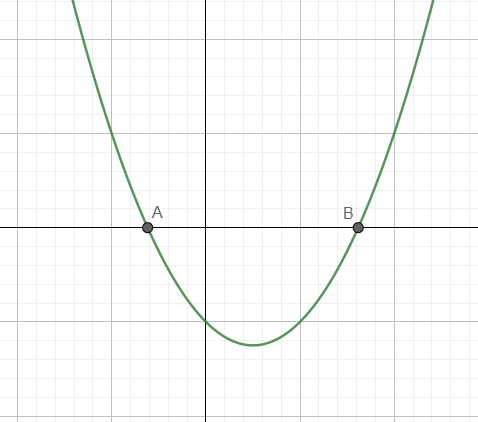
Now we know that the roots of the quadratic equation are given by the formula $\dfrac{-b\pm \sqrt{{{b}^{2}}-4ac}}{2a}$.
Now we can say that the root $\dfrac{-b-\sqrt{{{b}^{2}}-4ac}}{2a}$ .
Now consider the equation ${{x}^{2}}-x+a-3<0$
Now the lesser root of the equation will be $\dfrac{-1-\sqrt{1-4\left( 1 \right)\left( a-3 \right)}}{2}$ .
Now we want the lesser root to be negative. Hence we get,
$\begin{align}
& \Rightarrow \dfrac{-1-\sqrt{1-4\left( 1 \right)\left( a-3 \right)}}{2}<0 \\
& \Rightarrow -1-\sqrt{1-4a+12}<0 \\
& \Rightarrow -1<\sqrt{13-4a} \\
& \Rightarrow 1<13-4a \\
& \Rightarrow 4a<12 \\
& \Rightarrow a<3 \\
\end{align}$
Hence the value of a can be any real number in the set \[\left( -\infty ,3 \right)\]
So, the correct answer is “Option c”.
Note: Now note that if we have a as negative then the parabola is downward facing parabola and hence will have infinitely many negative values. The sign of the function changes after it attains the roots. If the roots of the function are not real then the function is entirely positive or entirely negative.
Complete step by step answer:
Now the given equation ${{x}^{2}}-x+a-3<0$ is a quadratic equation in the form $a{{x}^{2}}+bx+c$ where a = 1, b = -1 and c = a – 3.
Now here the value of a is positive. Hence the parabola is upwards facing the parabola.
Hence we have infinite points at which the function is positive. Now the function will be negative between the roots.
Now we want the function to be negative for the negative value of x. Hence we must have the lesser root as negative.
Now we know that the roots of the quadratic equation are given by the formula $\dfrac{-b\pm \sqrt{{{b}^{2}}-4ac}}{2a}$.
Now we can say that the root $\dfrac{-b-\sqrt{{{b}^{2}}-4ac}}{2a}$ .
Now consider the equation ${{x}^{2}}-x+a-3<0$
Now the lesser root of the equation will be $\dfrac{-1-\sqrt{1-4\left( 1 \right)\left( a-3 \right)}}{2}$ .
Now we want the lesser root to be negative. Hence we get,
$\begin{align}
& \Rightarrow \dfrac{-1-\sqrt{1-4\left( 1 \right)\left( a-3 \right)}}{2}<0 \\
& \Rightarrow -1-\sqrt{1-4a+12}<0 \\
& \Rightarrow -1<\sqrt{13-4a} \\
& \Rightarrow 1<13-4a \\
& \Rightarrow 4a<12 \\
& \Rightarrow a<3 \\
\end{align}$
Hence the value of a can be any real number in the set \[\left( -\infty ,3 \right)\]
So, the correct answer is “Option c”.
Note: Now note that if we have a as negative then the parabola is downward facing parabola and hence will have infinitely many negative values. The sign of the function changes after it attains the roots. If the roots of the function are not real then the function is entirely positive or entirely negative.
Recently Updated Pages
Master Class 10 Computer Science: Engaging Questions & Answers for Success

Master Class 10 General Knowledge: Engaging Questions & Answers for Success
Master Class 10 English: Engaging Questions & Answers for Success
Master Class 10 Social Science: Engaging Questions & Answers for Success
Master Class 10 Maths: Engaging Questions & Answers for Success
Master Class 10 Science: Engaging Questions & Answers for Success
Trending doubts
Which women's tennis player has 24 Grand Slam singles titles?
Who is the Brand Ambassador of Incredible India?
Why is there a time difference of about 5 hours between class 10 social science CBSE
Which Country is Called "The Land of Festivals"?
What type of cell is found in the Seminiferous tub class 10 biology CBSE
What are the public facilities provided by the government? Also explain each facility