




If \[{{x}^{2}}+2hxy+{{y}^{2}}=0(h\ne 0)\] represents the equations of the straight lines through the origin (having slopes \[{{m}_{1}}\]and \[{{m}_{2}}\]) which make an angle \[\alpha \] with the straight line\[y+x=0\] then
(a). \[\text{sec 2}\alpha =h\]
(b). \[\cos \alpha =\sqrt{\dfrac{1+h}{2h}}\]
(c). \[{{m}_{1}}+{{m}_{2}}=-2\sec 2\alpha \]
(d). \[\cot \alpha =\sqrt{\dfrac{h+1}{h-1}}\]
Answer
 Verified
615.6k+ views
- Hint: The given equation of the straight line represents two lines. Find out the slope of the pair of straight lines. The formula of angle between two lines having slopes \[{{m}_{1}},{{m}_{2}}\] is given by the formula, \[\tan \alpha =\dfrac{{{m}_{1}}-{{m}_{2}}}{1+{{m}_{1}}{{m}_{2}}}\] . Apply this formula to obtain the angle between the pair of lines. Now convert the obtained angle into the desired result.
Complete step-by-step solution -
The equations of straight line through origin is \[{{x}^{2}}+2hxy+{{y}^{2}}=0(h\ne 0)\].
As it is given that the slope of the lines are \[{{m}_{1}}\]and \[{{m}_{2}}\], so the equations of the pair of lines be \[y={{m}_{1}}x\] and \[y={{m}_{2}}x\].
It is also given that the pair of lines is making an angle \[\alpha \] with the straight line\[y+x=0\] as shown below,
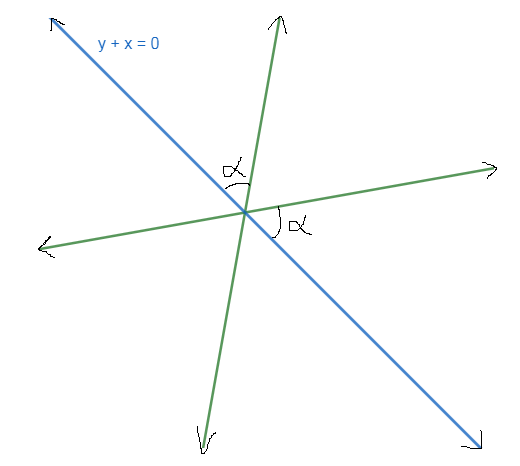
\[y+x=0\] can be written as \[y=-x\], comparing this with the general equation of line, i.e., \[y=mx+c\], the slope of this line is \['-1'\].
We know angle between two lines having slopes \[{{m}_{1}},{{m}_{2}}\] is given by the formula,
\[\tan \alpha =\dfrac{{{m}_{1}}-{{m}_{2}}}{1+{{m}_{1}}{{m}_{2}}}\]
Now we will find the angle between line \[y={{m}_{1}}x\]and \[y+x=0\], we have
\[\begin{align}
& \tan \alpha =\dfrac{{{m}_{1}}-(-1)}{1+{{m}_{1}}(-1)} \\
& \Rightarrow \tan \alpha =\dfrac{{{m}_{1}}+1}{1-{{m}_{1}}} \\
& \Rightarrow \tan \alpha (1-{{m}_{1}})=1+{{m}_{1}} \\
& \Rightarrow \tan \alpha -{{m}_{1}}\tan \alpha =1+{{m}_{1}} \\
\end{align}\]
Bringing like terms on one side, we get
\[\begin{align}
& \tan \alpha -1={{m}_{1}}+{{m}_{1}}\tan \alpha \\
& \Rightarrow {{m}_{1}}(1+\tan \alpha )=\tan \alpha -1 \\
& \Rightarrow {{m}_{1}}=\dfrac{\tan \alpha -1}{\tan \alpha +1}.........(i) \\
\end{align}\]
Now we will find the angle between line \[y+x=0\] and \[y={{m}_{2}}x\], we have
\[\begin{align}
& \tan \alpha =\dfrac{(-1)-{{m}_{2}}}{1+{{m}_{2}}(-1)} \\
& \Rightarrow \tan \alpha =\dfrac{-({{m}_{2}}+1)}{1-{{m}_{2}}} \\
& \Rightarrow \tan \alpha (1-{{m}_{2}})=-(1+{{m}_{2}}) \\
& \Rightarrow \tan \alpha -{{m}_{2}}\tan \alpha =-(1+{{m}_{2}}) \\
\end{align}\]
Bringing like terms on one side, we get
\[\begin{align}
& \tan \alpha +1={{m}_{2}}\tan \alpha -{{m}_{2}} \\
& \Rightarrow {{m}_{2}}(\tan \alpha -1)=\tan \alpha +1 \\
& \Rightarrow {{m}_{2}}=\dfrac{\tan \alpha +1}{\tan \alpha -1}.........(ii) \\
\end{align}\]
Now as per the theorem, if \[a{{x}^{2}}+2hxy+b{{y}^{2}}=0\] is the equation of the lines with slope \[{{m}_{1}},{{m}_{2}}\], then sum of slopes is given by the formula,
\[{{m}_{1}}+{{m}_{2}}=\dfrac{-2h}{b}\]
Using this formula and substituting our values from equation (i) and (ii), we get
\[\left( \dfrac{\tan \alpha -1}{\tan \alpha +1} \right)+\left( \dfrac{\tan \alpha +1}{\tan \alpha -1} \right)=\dfrac{-2h}{b}\]
And from the given equation of line \[{{x}^{2}}+2hxy+{{y}^{2}}=0(h\ne 0)\], we see that \['b=1'\] , so above equation becomes,
\[\begin{align}
& \left( \dfrac{\tan \alpha -1}{\tan \alpha +1} \right)+\left( \dfrac{\tan \alpha +1}{\tan \alpha -1} \right)=-2 \\
& \Rightarrow \dfrac{{{(\tan \alpha -1)}^{2}}+{{(\tan \alpha +1)}^{2}}}{(\tan \alpha +1)(\tan \alpha -1)}=-2h \\
& \Rightarrow \dfrac{{{(\tan \alpha -1)}^{2}}+{{(\tan \alpha +1)}^{2}}}{({{\tan }^{2}}\alpha -1)}=-2h \\
\end{align}\]
Now opening the brackets, we get
\[\begin{align}
& \Rightarrow \dfrac{{{\tan }^{2}}\alpha +1-2\tan \alpha +{{\tan }^{2}}\alpha +1+2\tan \alpha }{({{\tan }^{2}}\alpha -1)}=-2h \\
& \Rightarrow \dfrac{2({{\tan }^{2}}\alpha +1)}{({{\tan }^{2}}\alpha -1)}=-2h \\
& \Rightarrow -\dfrac{({{\tan }^{2}}\alpha +1)}{({{\tan }^{2}}\alpha -1)}=h \\
\end{align}\]
But we know, \[\tan \alpha =\dfrac{\sin \alpha }{\cos \alpha }\], so above equation becomes,
\[\begin{align}
& \Rightarrow -\dfrac{\left( \dfrac{{{\sin }^{2}}\alpha }{{{\cos }^{2}}\alpha }+1 \right)}{\left( \dfrac{{{\sin }^{2}}\alpha }{{{\cos }^{2}}\alpha }-1 \right)}=h \\
& \Rightarrow -\dfrac{\left( \dfrac{{{\sin }^{2}}\alpha +{{\cos }^{2}}\alpha }{{{\cos }^{2}}\alpha } \right)}{\left( \dfrac{{{\sin }^{2}}\alpha -{{\cos }^{2}}\alpha }{{{\cos }^{2}}\alpha } \right)}=h \\
& \Rightarrow -\dfrac{{{\sin }^{2}}\alpha +{{\cos }^{2}}\alpha }{{{\sin }^{2}}\alpha -{{\cos }^{2}}\alpha }=h \\
\end{align}\]
We know, \[{{\sin }^{2}}\alpha +{{\cos }^{2}}\alpha =1\] , so above equation becomes,
\[\begin{align}
& \Rightarrow -\dfrac{1}{{{\sin }^{2}}\alpha -{{\cos }^{2}}\alpha }=h \\
& \Rightarrow \dfrac{1}{{{\cos }^{2}}\alpha -{{\sin }^{2}}\alpha }=h \\
\end{align}\]
But we know, \[{{\cos }^{2}}\alpha -{{\sin }^{2}}\alpha =\cos 2\alpha \], we get
\[\Rightarrow h=\dfrac{1}{\cos 2\alpha }\]
But, \[\dfrac{1}{\cos \alpha }=\sec \alpha \], so above equation becomes,
\[\Rightarrow h=\sec 2\alpha \]
Hence the correct answer is option (a).
Note: The possibility of mistake is that the student can come to the conclusion that ${{m}_{1}}$ and ${{m}_{2}}$ are equal by applying the angle between the two lines formula. But this will lead to the wrong answer as if the slopes are equal then there won’t be two lines. So take care of this.
Complete step-by-step solution -
The equations of straight line through origin is \[{{x}^{2}}+2hxy+{{y}^{2}}=0(h\ne 0)\].
As it is given that the slope of the lines are \[{{m}_{1}}\]and \[{{m}_{2}}\], so the equations of the pair of lines be \[y={{m}_{1}}x\] and \[y={{m}_{2}}x\].
It is also given that the pair of lines is making an angle \[\alpha \] with the straight line\[y+x=0\] as shown below,
\[y+x=0\] can be written as \[y=-x\], comparing this with the general equation of line, i.e., \[y=mx+c\], the slope of this line is \['-1'\].
We know angle between two lines having slopes \[{{m}_{1}},{{m}_{2}}\] is given by the formula,
\[\tan \alpha =\dfrac{{{m}_{1}}-{{m}_{2}}}{1+{{m}_{1}}{{m}_{2}}}\]
Now we will find the angle between line \[y={{m}_{1}}x\]and \[y+x=0\], we have
\[\begin{align}
& \tan \alpha =\dfrac{{{m}_{1}}-(-1)}{1+{{m}_{1}}(-1)} \\
& \Rightarrow \tan \alpha =\dfrac{{{m}_{1}}+1}{1-{{m}_{1}}} \\
& \Rightarrow \tan \alpha (1-{{m}_{1}})=1+{{m}_{1}} \\
& \Rightarrow \tan \alpha -{{m}_{1}}\tan \alpha =1+{{m}_{1}} \\
\end{align}\]
Bringing like terms on one side, we get
\[\begin{align}
& \tan \alpha -1={{m}_{1}}+{{m}_{1}}\tan \alpha \\
& \Rightarrow {{m}_{1}}(1+\tan \alpha )=\tan \alpha -1 \\
& \Rightarrow {{m}_{1}}=\dfrac{\tan \alpha -1}{\tan \alpha +1}.........(i) \\
\end{align}\]
Now we will find the angle between line \[y+x=0\] and \[y={{m}_{2}}x\], we have
\[\begin{align}
& \tan \alpha =\dfrac{(-1)-{{m}_{2}}}{1+{{m}_{2}}(-1)} \\
& \Rightarrow \tan \alpha =\dfrac{-({{m}_{2}}+1)}{1-{{m}_{2}}} \\
& \Rightarrow \tan \alpha (1-{{m}_{2}})=-(1+{{m}_{2}}) \\
& \Rightarrow \tan \alpha -{{m}_{2}}\tan \alpha =-(1+{{m}_{2}}) \\
\end{align}\]
Bringing like terms on one side, we get
\[\begin{align}
& \tan \alpha +1={{m}_{2}}\tan \alpha -{{m}_{2}} \\
& \Rightarrow {{m}_{2}}(\tan \alpha -1)=\tan \alpha +1 \\
& \Rightarrow {{m}_{2}}=\dfrac{\tan \alpha +1}{\tan \alpha -1}.........(ii) \\
\end{align}\]
Now as per the theorem, if \[a{{x}^{2}}+2hxy+b{{y}^{2}}=0\] is the equation of the lines with slope \[{{m}_{1}},{{m}_{2}}\], then sum of slopes is given by the formula,
\[{{m}_{1}}+{{m}_{2}}=\dfrac{-2h}{b}\]
Using this formula and substituting our values from equation (i) and (ii), we get
\[\left( \dfrac{\tan \alpha -1}{\tan \alpha +1} \right)+\left( \dfrac{\tan \alpha +1}{\tan \alpha -1} \right)=\dfrac{-2h}{b}\]
And from the given equation of line \[{{x}^{2}}+2hxy+{{y}^{2}}=0(h\ne 0)\], we see that \['b=1'\] , so above equation becomes,
\[\begin{align}
& \left( \dfrac{\tan \alpha -1}{\tan \alpha +1} \right)+\left( \dfrac{\tan \alpha +1}{\tan \alpha -1} \right)=-2 \\
& \Rightarrow \dfrac{{{(\tan \alpha -1)}^{2}}+{{(\tan \alpha +1)}^{2}}}{(\tan \alpha +1)(\tan \alpha -1)}=-2h \\
& \Rightarrow \dfrac{{{(\tan \alpha -1)}^{2}}+{{(\tan \alpha +1)}^{2}}}{({{\tan }^{2}}\alpha -1)}=-2h \\
\end{align}\]
Now opening the brackets, we get
\[\begin{align}
& \Rightarrow \dfrac{{{\tan }^{2}}\alpha +1-2\tan \alpha +{{\tan }^{2}}\alpha +1+2\tan \alpha }{({{\tan }^{2}}\alpha -1)}=-2h \\
& \Rightarrow \dfrac{2({{\tan }^{2}}\alpha +1)}{({{\tan }^{2}}\alpha -1)}=-2h \\
& \Rightarrow -\dfrac{({{\tan }^{2}}\alpha +1)}{({{\tan }^{2}}\alpha -1)}=h \\
\end{align}\]
But we know, \[\tan \alpha =\dfrac{\sin \alpha }{\cos \alpha }\], so above equation becomes,
\[\begin{align}
& \Rightarrow -\dfrac{\left( \dfrac{{{\sin }^{2}}\alpha }{{{\cos }^{2}}\alpha }+1 \right)}{\left( \dfrac{{{\sin }^{2}}\alpha }{{{\cos }^{2}}\alpha }-1 \right)}=h \\
& \Rightarrow -\dfrac{\left( \dfrac{{{\sin }^{2}}\alpha +{{\cos }^{2}}\alpha }{{{\cos }^{2}}\alpha } \right)}{\left( \dfrac{{{\sin }^{2}}\alpha -{{\cos }^{2}}\alpha }{{{\cos }^{2}}\alpha } \right)}=h \\
& \Rightarrow -\dfrac{{{\sin }^{2}}\alpha +{{\cos }^{2}}\alpha }{{{\sin }^{2}}\alpha -{{\cos }^{2}}\alpha }=h \\
\end{align}\]
We know, \[{{\sin }^{2}}\alpha +{{\cos }^{2}}\alpha =1\] , so above equation becomes,
\[\begin{align}
& \Rightarrow -\dfrac{1}{{{\sin }^{2}}\alpha -{{\cos }^{2}}\alpha }=h \\
& \Rightarrow \dfrac{1}{{{\cos }^{2}}\alpha -{{\sin }^{2}}\alpha }=h \\
\end{align}\]
But we know, \[{{\cos }^{2}}\alpha -{{\sin }^{2}}\alpha =\cos 2\alpha \], we get
\[\Rightarrow h=\dfrac{1}{\cos 2\alpha }\]
But, \[\dfrac{1}{\cos \alpha }=\sec \alpha \], so above equation becomes,
\[\Rightarrow h=\sec 2\alpha \]
Hence the correct answer is option (a).
Note: The possibility of mistake is that the student can come to the conclusion that ${{m}_{1}}$ and ${{m}_{2}}$ are equal by applying the angle between the two lines formula. But this will lead to the wrong answer as if the slopes are equal then there won’t be two lines. So take care of this.
Recently Updated Pages
Master Class 11 Computer Science: Engaging Questions & Answers for Success

Master Class 11 Business Studies: Engaging Questions & Answers for Success
Master Class 11 Economics: Engaging Questions & Answers for Success
Master Class 11 English: Engaging Questions & Answers for Success
Master Class 11 Maths: Engaging Questions & Answers for Success
Master Class 11 Biology: Engaging Questions & Answers for Success
Trending doubts
One Metric ton is equal to kg A 10000 B 1000 C 100 class 11 physics CBSE
There are 720 permutations of the digits 1 2 3 4 5 class 11 maths CBSE
Discuss the various forms of bacteria class 11 biology CBSE
Draw a diagram of a plant cell and label at least eight class 11 biology CBSE
State the laws of reflection of light
Explain zero factorial class 11 maths CBSE