




If we have a trigonometric ratio as \[\tan x = \dfrac{6}{8}\], how do you find \[\cos x\]?
Answer
 Verified
595.2k+ views
Hint: Consider a right angled triangle with perpendicular length six units and base length eight units and then use Pythagoras theorem to evaluate the hypotenuse of the triangle.
Complete step-by-step solution:
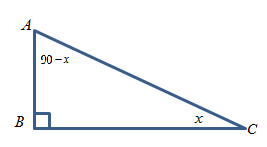
Consider a right angled triangle \[ABC\] with right angle at \[\angle B\] and \[\angle C = x^\circ \].
It is known that the sum of all interior angles of a triangle is \[180^\circ \].
\[\angle A + \angle B + \angle C = 180^\circ \]
Substitute \[\angle B\] as \[90^\circ \] and \[\angle C\] as \[x\] degree to obtain the expression for \[\angle A\] as shown below.
\[ \Rightarrow \angle A + 90 + x = 180\]
\[ \Rightarrow \angle A = 90 - x\]
Therefore, the \[\angle A\] can be expressed as \[\left( {90 - x} \right)\] degree.
The right triangle \[ABC\] with right angle at \[\angle B\], \[\angle C = x\] and so \[\angle A = 90 - x\] is shown in the figure below.
Now, use the definition of trigonometric ratio for \[\tan x\].
For an angle \[x\] as argument, side \[AB\] act as perpendicular (side in front of the argument angle), side \[BC\] act as base and side \[AC\] always be hypotenuse for this triangle.
The trigonometry ratio \[\tan x\] is defined as the ratio of perpendicular to the base with respect to angle \[x\].
\[\tan x = \dfrac{P}{B}\]
\[ \Rightarrow \tan x = \dfrac{{AB}}{{BC}}\]
As it is given in the question that \[\tan x = \dfrac{6}{8}\], it implies that the ratio of side \[AB\] to side \[BC\] is \[6:8\].
So, we can consider the length of side \[AB\] as \[6l\] and side \[BC\] as \[8l\].
Use Pythagoras theorem to evaluate the hypotenuse of the triangle as shown below.
\[A{B^2} + B{C^2} = A{C^2}\]
Substitute length of \[AB\] as \[6l\] and length of \[BC\] as \[8l\] to calculate the length of side \[AC\] as shown below.
\[ \Rightarrow {\left( {6l} \right)^2} + {\left( {8l} \right)^2} = A{C^2}\]
\[ \Rightarrow 36{l^2} + 64{l^2} = A{C^2}\]
\[ \Rightarrow 100{l^2} = A{C^2}\]
\[ \Rightarrow {\left( {10l} \right)^2} = A{C^2}\]
Thus, the length of the side \[AC\] is \[10l\].
Now, calculate the trigonometry ratio \[\cos x\] by the use of definition that it is the ratio of base to the hypotenuse with respect to angle \[x\].
\[\cos x = \dfrac{B}{H}\]
\[ \Rightarrow \cos x = \dfrac{{BC}}{{AC}}\]
Substitute the length of side \[BC\] and \[AC\] in the above equation and solve further as shown below.
\[ \Rightarrow \cos x = \dfrac{{8l}}{{10l}}\]
\[ \Rightarrow \cos x = \dfrac{8}{{10}}\]
\[ \Rightarrow \cos x = \dfrac{4}{5}\]
Thus, the value for \[\cos x\] is \[\dfrac{4}{5}\], if the value for \[\tan x\] is \[\dfrac{6}{8}\].
Note: The perpendicular side and base side in a right angled triangle is defined with respect to one of the acute angles from the given triangle but hypotenuse is the same for both acute angles (longest side of a triangle or side opposite to the right angle).
Complete step-by-step solution:
Consider a right angled triangle \[ABC\] with right angle at \[\angle B\] and \[\angle C = x^\circ \].
It is known that the sum of all interior angles of a triangle is \[180^\circ \].
\[\angle A + \angle B + \angle C = 180^\circ \]
Substitute \[\angle B\] as \[90^\circ \] and \[\angle C\] as \[x\] degree to obtain the expression for \[\angle A\] as shown below.
\[ \Rightarrow \angle A + 90 + x = 180\]
\[ \Rightarrow \angle A = 90 - x\]
Therefore, the \[\angle A\] can be expressed as \[\left( {90 - x} \right)\] degree.
The right triangle \[ABC\] with right angle at \[\angle B\], \[\angle C = x\] and so \[\angle A = 90 - x\] is shown in the figure below.
Now, use the definition of trigonometric ratio for \[\tan x\].
For an angle \[x\] as argument, side \[AB\] act as perpendicular (side in front of the argument angle), side \[BC\] act as base and side \[AC\] always be hypotenuse for this triangle.
The trigonometry ratio \[\tan x\] is defined as the ratio of perpendicular to the base with respect to angle \[x\].
\[\tan x = \dfrac{P}{B}\]
\[ \Rightarrow \tan x = \dfrac{{AB}}{{BC}}\]
As it is given in the question that \[\tan x = \dfrac{6}{8}\], it implies that the ratio of side \[AB\] to side \[BC\] is \[6:8\].
So, we can consider the length of side \[AB\] as \[6l\] and side \[BC\] as \[8l\].
Use Pythagoras theorem to evaluate the hypotenuse of the triangle as shown below.
\[A{B^2} + B{C^2} = A{C^2}\]
Substitute length of \[AB\] as \[6l\] and length of \[BC\] as \[8l\] to calculate the length of side \[AC\] as shown below.
\[ \Rightarrow {\left( {6l} \right)^2} + {\left( {8l} \right)^2} = A{C^2}\]
\[ \Rightarrow 36{l^2} + 64{l^2} = A{C^2}\]
\[ \Rightarrow 100{l^2} = A{C^2}\]
\[ \Rightarrow {\left( {10l} \right)^2} = A{C^2}\]
Thus, the length of the side \[AC\] is \[10l\].
Now, calculate the trigonometry ratio \[\cos x\] by the use of definition that it is the ratio of base to the hypotenuse with respect to angle \[x\].
\[\cos x = \dfrac{B}{H}\]
\[ \Rightarrow \cos x = \dfrac{{BC}}{{AC}}\]
Substitute the length of side \[BC\] and \[AC\] in the above equation and solve further as shown below.
\[ \Rightarrow \cos x = \dfrac{{8l}}{{10l}}\]
\[ \Rightarrow \cos x = \dfrac{8}{{10}}\]
\[ \Rightarrow \cos x = \dfrac{4}{5}\]
Thus, the value for \[\cos x\] is \[\dfrac{4}{5}\], if the value for \[\tan x\] is \[\dfrac{6}{8}\].
Note: The perpendicular side and base side in a right angled triangle is defined with respect to one of the acute angles from the given triangle but hypotenuse is the same for both acute angles (longest side of a triangle or side opposite to the right angle).
Recently Updated Pages
Class 10 Question and Answer - Your Ultimate Solutions Guide

Master Class 10 Computer Science: Engaging Questions & Answers for Success
Master Class 10 General Knowledge: Engaging Questions & Answers for Success
Master Class 12 Economics: Engaging Questions & Answers for Success
Master Class 12 Social Science: Engaging Questions & Answers for Success
Master Class 12 English: Engaging Questions & Answers for Success
Trending doubts
Explain the Treaty of Vienna of 1815 class 10 social science CBSE
The slogan Jai Hind was given by A Lal Bahadur Shastri class 10 social science CBSE
10 examples of evaporation in daily life with explanations
What is the full form of POSCO class 10 social science CBSE
Five things I will do to build a great India class 10 english CBSE
Identify the feminine form of noun nephew a shenephew class 10 english CBSE