




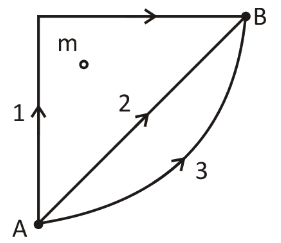
If ${W_1}$, ${W_2}$ and ${W_3}$ represent the work done in moving a particle from A to B along three different paths $1$, $2$ and $3$ respectively in the gravitational field of a point mass $m$, find the correct relation between ${W_1}$, ${W_2}$ and ${W_3}$.
A. ${W_1} > {W_2} > {W_3}$
B. ${W_1} = {W_2} = {W_3}$
C. ${W_1} < {W_2} < {W_3}$
D. ${W_2} > {W_1} > {W_3}$
Answer
 Verified
619.5k+ views
Hint:Here we have to apply the concept of gravitational field and gravitational potential energy: Owing to its location in a gravitational field, gravitational potential energy is the energy an object has. For an object near the Earth's surface, the most common application of gravitational potential energy is where the gravitational acceleration can be expected to be stable at around $9.8\,m{s^{ - 2}}$ .
Complete answer:
Since at any point the zero of the gravitational potential energy can be selected (such as the zero choice of the coordinate system), the potential energy at a height h above that point is equal to the work required to raise the object to that height without any net change in the kinetic energy. Since the force required to lift it is equal to its weight, it follows that the potential gravitational energy is equal to the height to which it is lifted, times its weight.
Gravitational force is an example of a conservative force, while frictional force is an example of a non-conservatory force. The elastic spring force, the electrostatic force between two electric charges, and the magnetic force between two magnetic poles are other examples of conservative forces.
Since the gravitational field is a conservative field, the work performed by taking a particle from one point to another in a gravitational field is independent of the direction.
${W_1} = {W_2} = {W_3}$
Hence, option B is correct.
Note:Since, the gravitational field is mentioned in the question, so, the paths for work done are independent. So, we have to pay attention to what is asked in the question. Gravitation or just gravity is the force of attraction between any two bodies. All the objects in the universe attract each other with a certain amount of force, but in most of the cases, the force is too weak to be observed due to the very large distance of separation. Besides, gravity’s range is infinite but the effect becomes weaker as objects move away.
Complete answer:
Since at any point the zero of the gravitational potential energy can be selected (such as the zero choice of the coordinate system), the potential energy at a height h above that point is equal to the work required to raise the object to that height without any net change in the kinetic energy. Since the force required to lift it is equal to its weight, it follows that the potential gravitational energy is equal to the height to which it is lifted, times its weight.
Gravitational force is an example of a conservative force, while frictional force is an example of a non-conservatory force. The elastic spring force, the electrostatic force between two electric charges, and the magnetic force between two magnetic poles are other examples of conservative forces.
Since the gravitational field is a conservative field, the work performed by taking a particle from one point to another in a gravitational field is independent of the direction.
${W_1} = {W_2} = {W_3}$
Hence, option B is correct.
Note:Since, the gravitational field is mentioned in the question, so, the paths for work done are independent. So, we have to pay attention to what is asked in the question. Gravitation or just gravity is the force of attraction between any two bodies. All the objects in the universe attract each other with a certain amount of force, but in most of the cases, the force is too weak to be observed due to the very large distance of separation. Besides, gravity’s range is infinite but the effect becomes weaker as objects move away.
Recently Updated Pages
Master Class 11 English: Engaging Questions & Answers for Success

Master Class 11 Physics: Engaging Questions & Answers for Success
Master Class 11 Computer Science: Engaging Questions & Answers for Success
Master Class 11 Chemistry: Engaging Questions & Answers for Success
Master Class 11 Social Science: Engaging Questions & Answers for Success
Master Class 11 Accountancy: Engaging Questions & Answers for Success
Trending doubts
Difference Between Prokaryotic Cells and Eukaryotic Cells
Two of the body parts which do not appear in MRI are class 11 biology CBSE
One Metric ton is equal to kg A 10000 B 1000 C 100 class 11 physics CBSE
10 examples of friction in our daily life
Draw a diagram of nephron and explain its structur class 11 biology CBSE
Draw a diagram of a plant cell and label at least eight class 11 biology CBSE