



If $\vartriangle ABC \sim \vartriangle QRP$, $\dfrac{{Ar(ABC)}}{{Ar(RQP)}} = \dfrac{9}{4},AB = 18cm{\text{ and }}BC = 15cm$, then what is the value of PR?
A. $10cm$
B. $12cm$
C. $20cm$
D. $8cm$
Answer
 Verified
613.5k+ views
Hint: In this question, we have to find one side of the triangle when it is given that the two triangles are similar to each other and the ratio of their areas is also given. We can use the property of the triangles which states that - “If two triangles are similar, then the ratio of their areas is proportional to the squares of their corresponding sides.” Then, we will substitute the values given in the question in the relation to find the required side.
Formula used: ${\left( {\dfrac{{AB}}{{QP}}} \right)^2} = \dfrac{{Ar(ABC)}}{{Ar(QPR)}}$
Complete step-by-step answer:
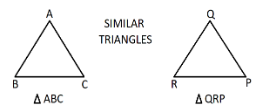
We are given that $\vartriangle ABC \sim \vartriangle QRP$, it implies that $\dfrac{{AB}}{{QR}} = \dfrac{{BC}}{{RP}} = \dfrac{{AC}}{{QP}}$
Also, we know that the square of the ratio of 2 corresponding sides is equal to the ratio of their areas. Hence, we will be using ${\left( {\dfrac{{BC}}{{RP}}} \right)^2} = \dfrac{{Ar(ABC)}}{{Ar(QRP)}}$
Putting all the values as given in the question,
$\Rightarrow$${\left( {\dfrac{{15}}{{PR}}} \right)^2} = \dfrac{9}{4}$
Square rooting both the sides,
$\Rightarrow$$\sqrt {{{\left( {\dfrac{{15}}{{PR}}} \right)}^2}} = \sqrt {\left( {\dfrac{9}{4}} \right)} $
$\Rightarrow$$\dfrac{{15}}{{PR}} = \dfrac{3}{2}$
Cross multiplying and finding the value of PR,
$\Rightarrow$$\dfrac{{15 \times 2}}{3} = PR$
Simplifying,
$\Rightarrow$$10 = PR$
$\Rightarrow$Hence, PR = 10cm
The value of PR is equal to 10cm.
Option A is the correct answer.
Note: Two triangles are said to be similar when the ratio of their corresponding sides is equal or when the corresponding angles are equal or congruent.
The formation of the triangles must be duly noted as it will affect the corresponding sides and hence, the ratio. For example, if $\vartriangle ABC \sim \vartriangle PQR$ then, $\dfrac{{AB}}{{PQ}} = \dfrac{{BC}}{{QR}} = \dfrac{{AC}}{{PR}}$.
Formula used: ${\left( {\dfrac{{AB}}{{QP}}} \right)^2} = \dfrac{{Ar(ABC)}}{{Ar(QPR)}}$
Complete step-by-step answer:
We are given that $\vartriangle ABC \sim \vartriangle QRP$, it implies that $\dfrac{{AB}}{{QR}} = \dfrac{{BC}}{{RP}} = \dfrac{{AC}}{{QP}}$
Also, we know that the square of the ratio of 2 corresponding sides is equal to the ratio of their areas. Hence, we will be using ${\left( {\dfrac{{BC}}{{RP}}} \right)^2} = \dfrac{{Ar(ABC)}}{{Ar(QRP)}}$
Putting all the values as given in the question,
$\Rightarrow$${\left( {\dfrac{{15}}{{PR}}} \right)^2} = \dfrac{9}{4}$
Square rooting both the sides,
$\Rightarrow$$\sqrt {{{\left( {\dfrac{{15}}{{PR}}} \right)}^2}} = \sqrt {\left( {\dfrac{9}{4}} \right)} $
$\Rightarrow$$\dfrac{{15}}{{PR}} = \dfrac{3}{2}$
Cross multiplying and finding the value of PR,
$\Rightarrow$$\dfrac{{15 \times 2}}{3} = PR$
Simplifying,
$\Rightarrow$$10 = PR$
$\Rightarrow$Hence, PR = 10cm
The value of PR is equal to 10cm.
Option A is the correct answer.
Note: Two triangles are said to be similar when the ratio of their corresponding sides is equal or when the corresponding angles are equal or congruent.
The formation of the triangles must be duly noted as it will affect the corresponding sides and hence, the ratio. For example, if $\vartriangle ABC \sim \vartriangle PQR$ then, $\dfrac{{AB}}{{PQ}} = \dfrac{{BC}}{{QR}} = \dfrac{{AC}}{{PR}}$.

Recently Updated Pages
Master Class 12 Economics: Engaging Questions & Answers for Success

Master Class 12 English: Engaging Questions & Answers for Success
Master Class 12 Social Science: Engaging Questions & Answers for Success
Master Class 12 Maths: Engaging Questions & Answers for Success
Master Class 12 Physics: Engaging Questions & Answers for Success
Master Class 9 General Knowledge: Engaging Questions & Answers for Success
Trending doubts
Find the sum of series 1 + 2 + 3 + 4 + 5 + + 100 class 9 maths CBSE
Difference Between Plant Cell and Animal Cell
Fill the blanks with the suitable prepositions 1 The class 9 english CBSE
What is pollution? How many types of pollution? Define it
Name 10 Living and Non living things class 9 biology CBSE
What is the full form of pH?