




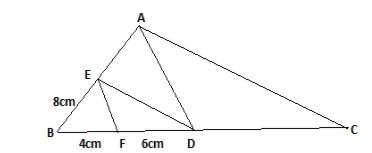
If value of BF= 4cm, FD=6cm, BE= 8cm. Then find BC=?
Answer
 Verified
630.9k+ views
Hint: Using B.P.T.( .(Basic proportionality Theorem) or Thales's Theorem. Because parallel lines are a part of a triangle. Also, there are no angular measurements given.
That states,“In a triangle a line is drawn parallel to any one side of the triangle then this parallel intersects the other two sides proportionally.”
Complete step-by-step answer:
We can observe many triangles in this figure. But we need only those having mentioned parallel lines.
In given figure, consider ∆ABD,
\[EF\parallel AD\]
Here using B.P.T.(Basic proportionality Theorem) or Thale’s theorem
\[
\therefore \dfrac{{BF}}{{FD}} = \dfrac{{BE}}{{EA}} \\
\therefore \dfrac{4}{6} = \dfrac{8}{{EA}} \\
\therefore EA = 8 \times \dfrac{6}{4} \\
\therefore EA = 12cm \\
\]
Similarly in ∆ABC,
\[ED\parallel AC\]
\[
\therefore \dfrac{{BD}}{{DC}} = \dfrac{{BE}}{{EA}} \\
\therefore \dfrac{{10}}{{DC}} = \dfrac{8}{{12}} \\
\therefore DC = 10 \times \dfrac{{12}}{8} \\
\therefore DC = 15cm \\
Now, BC = BD + DC \\
\therefore BC = 10 + 15 \\
\therefore BC = 25cm \\
\]
Thus, BC=25cm.
Note: In such geometrical problems first observe the figure and read given information carefully.
Then check any theorem or property or corollary if it can be used.
Now here the condition of parallel lines with one of the lines of the triangle will help you to get an idea which theorem is to be used.
Basic proportionality theorem is used only in case when a line drawn is parallel to one side of a triangle.
Proportionality is nothing but ratios. Ratio on right hand side and left hand side should be in the same proportion. Here we have considered ratios between sides of a triangle. We have just split the side of the triangle.
That states,“In a triangle a line is drawn parallel to any one side of the triangle then this parallel intersects the other two sides proportionally.”
Complete step-by-step answer:
We can observe many triangles in this figure. But we need only those having mentioned parallel lines.
In given figure, consider ∆ABD,
\[EF\parallel AD\]
Here using B.P.T.(Basic proportionality Theorem) or Thale’s theorem
\[
\therefore \dfrac{{BF}}{{FD}} = \dfrac{{BE}}{{EA}} \\
\therefore \dfrac{4}{6} = \dfrac{8}{{EA}} \\
\therefore EA = 8 \times \dfrac{6}{4} \\
\therefore EA = 12cm \\
\]
Similarly in ∆ABC,
\[ED\parallel AC\]
\[
\therefore \dfrac{{BD}}{{DC}} = \dfrac{{BE}}{{EA}} \\
\therefore \dfrac{{10}}{{DC}} = \dfrac{8}{{12}} \\
\therefore DC = 10 \times \dfrac{{12}}{8} \\
\therefore DC = 15cm \\
Now, BC = BD + DC \\
\therefore BC = 10 + 15 \\
\therefore BC = 25cm \\
\]
Thus, BC=25cm.
Note: In such geometrical problems first observe the figure and read given information carefully.
Then check any theorem or property or corollary if it can be used.
Now here the condition of parallel lines with one of the lines of the triangle will help you to get an idea which theorem is to be used.
Basic proportionality theorem is used only in case when a line drawn is parallel to one side of a triangle.
Proportionality is nothing but ratios. Ratio on right hand side and left hand side should be in the same proportion. Here we have considered ratios between sides of a triangle. We have just split the side of the triangle.
Recently Updated Pages
Master Class 11 English: Engaging Questions & Answers for Success

Master Class 11 Social Science: Engaging Questions & Answers for Success
Master Class 11 Maths: Engaging Questions & Answers for Success
Master Class 11 Biology: Engaging Questions & Answers for Success
Master Class 11 Physics: Engaging Questions & Answers for Success
Master Class 11 Chemistry: Engaging Questions & Answers for Success