




If two vertices of a parallelogram are $(3,2),( - 1,0)$ and its diagonals meet at $(2, - 5)$ , find the other two vertices of the parallelogram.
Answer
 Verified
547.8k+ views
Hint: First, we will draw a parallelogram and label all the points and draw the diagonals. In a parallelogram, the diagonals always bisect each other. So, using this property we can find the other two vertices of the parallelogram.
Complete step-by-step solution:
Let the parallelogram be $ABCD$ with diagonals intersecting at point $O$.
The coordinates are $A(3,2),B( - 1,0),C(u,v),D(p,q),O(2, - 5)$.
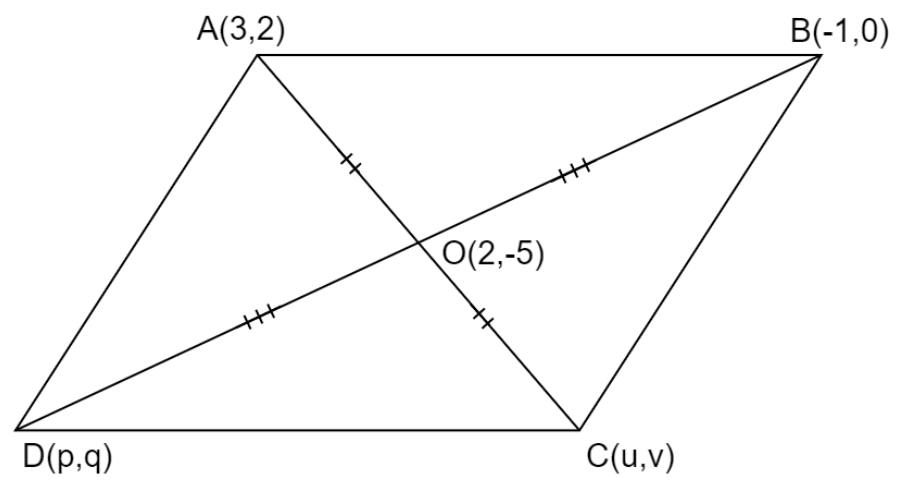
Since the diagonals of a parallelogram bisects each other, we can see that Point $O$ is the midpoint of diagonal $AC$ and diagonal $BD$.
We can use the midpoint formula to find the value of C(u, v) and D(p, q).
The midpoint formula for a line having end points as $({x_1},{y_1})and({x_2},{y_2})$ then the coordinates of the midpoint are given by $\left( {\dfrac{{{x_1} + {x_2}}}{2},\dfrac{{{y_1} + {y_2}}}{2}} \right)$.
Applying the midpoint formula for diagonal $AC$ with midpoint $O(2, - 5)$,
$2 = \dfrac{{3 + u}}{2}, - 5 = \dfrac{{2 + v}}{2}$
Taking the denominator $2$ to the other side,
$2 \times 2 = 3 + u, - 5 \times 2 = 2 + v$
Multiplying the terms,
$4 = 3 + u, - 10 = 2 + v$
Isolating u and v,
$u = 4 - 3,v = - 10 - 2$
Solving the equation,
$u = 1,v = - 12$
Therefore, the coordinates of point $C$ are $(1, - 12)$.
Similarly applying the midpoint formula for diagonal $BD$ with midpoint $O(2, - 5)$,
$2 = \dfrac{{ - 1 + p}}{2}, - 5 = \dfrac{{0 + q}}{2}$
Taking the denominator $2$ to the other side,
$2 \times 2 = - 1 + p, - 5 \times 2 = 0 + q$
Multiplying the terms,
$4 = - 1 + p, - 10 = q$
Isolating u and v,
$p = 4 + 1,q = - 10$
Solving the equation,
$p = 5,q = - 10$
Therefore, the coordinates of point $D$ are $(5, - 10)$.
Hence, the other two vertices of the parallelogram are $(1, - 12)$ and $(5, - 10)$.
Note: The diagonals of a parallelogram always bisect but are unequal whereas in rhombus the diagonals bisect each other and are always equal. Bisecting means dividing into two equal halves. It can be the length of an angle.
Complete step-by-step solution:
Let the parallelogram be $ABCD$ with diagonals intersecting at point $O$.
The coordinates are $A(3,2),B( - 1,0),C(u,v),D(p,q),O(2, - 5)$.
Since the diagonals of a parallelogram bisects each other, we can see that Point $O$ is the midpoint of diagonal $AC$ and diagonal $BD$.
We can use the midpoint formula to find the value of C(u, v) and D(p, q).
The midpoint formula for a line having end points as $({x_1},{y_1})and({x_2},{y_2})$ then the coordinates of the midpoint are given by $\left( {\dfrac{{{x_1} + {x_2}}}{2},\dfrac{{{y_1} + {y_2}}}{2}} \right)$.
Applying the midpoint formula for diagonal $AC$ with midpoint $O(2, - 5)$,
$2 = \dfrac{{3 + u}}{2}, - 5 = \dfrac{{2 + v}}{2}$
Taking the denominator $2$ to the other side,
$2 \times 2 = 3 + u, - 5 \times 2 = 2 + v$
Multiplying the terms,
$4 = 3 + u, - 10 = 2 + v$
Isolating u and v,
$u = 4 - 3,v = - 10 - 2$
Solving the equation,
$u = 1,v = - 12$
Therefore, the coordinates of point $C$ are $(1, - 12)$.
Similarly applying the midpoint formula for diagonal $BD$ with midpoint $O(2, - 5)$,
$2 = \dfrac{{ - 1 + p}}{2}, - 5 = \dfrac{{0 + q}}{2}$
Taking the denominator $2$ to the other side,
$2 \times 2 = - 1 + p, - 5 \times 2 = 0 + q$
Multiplying the terms,
$4 = - 1 + p, - 10 = q$
Isolating u and v,
$p = 4 + 1,q = - 10$
Solving the equation,
$p = 5,q = - 10$
Therefore, the coordinates of point $D$ are $(5, - 10)$.
Hence, the other two vertices of the parallelogram are $(1, - 12)$ and $(5, - 10)$.
Note: The diagonals of a parallelogram always bisect but are unequal whereas in rhombus the diagonals bisect each other and are always equal. Bisecting means dividing into two equal halves. It can be the length of an angle.
Recently Updated Pages
Basicity of sulphurous acid and sulphuric acid are

Master Class 10 Computer Science: Engaging Questions & Answers for Success
Master Class 10 Social Science: Engaging Questions & Answers for Success
Master Class 10 Science: Engaging Questions & Answers for Success
Class 10 Question and Answer - Your Ultimate Solutions Guide
Master Class 10 Maths: Engaging Questions & Answers for Success
Trending doubts
What is the Total Duration of Football Match?
Explain the Treaty of Vienna of 1815 class 10 social science CBSE
In football, which nation is called "La Roja"?
Why is there a time difference of about 5 hours between class 10 social science CBSE
10 examples of evaporation in daily life with explanations
What is the full form of POSCO class 10 social science CBSE