



If two parallel lines are intersected by a transversal, then pairs of corresponding angles are
A. Equal \[\]
B. Unequal \[\]
C. Insufficient data \[\]
D. none of the above\[\]
Answer
 Verified
604.5k+ views
Hint: We recall definitions of parallel lines, transversal and corresponding angles as one interior and one exterior angles subtended at the same side with distinct vertex points by the transversal at the points of intersection with two parallel lines. We choose the correct option using corresponding angle postulate which states corresponding angles are equal.
Complete step by step answer:
We know that two straight lines are called intersecting lines if they cut each other at one point and they are called parallel lines if they never intersect each other. They maintain equal distance between them in both directions. The line that cuts both the parallel lines is called transversal.
We draw the figure of parallel lines $\overleftrightarrow{AB},\overleftrightarrow{CD}$ and the transversal $\overleftrightarrow{PQ}$ that cuts $\overleftrightarrow{AB},\overleftrightarrow{CD}$ at points $P,Q$ respectively. \[\]
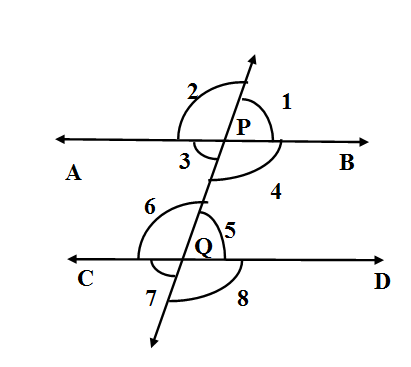
We see that the transversal subtends 8 angles at the point of intersection which we have denoted as $\angle 1,\angle 2,\angle 3,\angle 4,\angle 5,\angle 6,\angle 7,\angle 8$. The angles subtended inside the parallel lines are called interior angles and outside the parallel lines are called exterior angles. \[\] Corresponding angles are a pair of angles one exterior and one interior which do not share any common vertex. Here the corresponding angles are $\angle 1$ and $\angle 5$,$\angle 2$ and $\angle 6$,$\angle 3$ and $\angle 7$, $\angle 4$ and $\angle 8$.\[\]
We know from the corresponding angle postulate that the measure corresponding angles are equal which means.
\[\angle 1=\angle 5,\angle 2=\angle 6,\angle 3=\angle 7,\angle 4=\angle 8\]
So, the correct answer is “Option A”.
Note: We note that a ‘postulate’ means a geometrical statement which we have to accept without the need of proof. The pair of angles that lie on opposite sides of the transversal do not share a common vertex and both lie in either exterior or interior are called alternate angles. We can use the equality of corresponding angles to prove equality of alternate angles.
Complete step by step answer:
We know that two straight lines are called intersecting lines if they cut each other at one point and they are called parallel lines if they never intersect each other. They maintain equal distance between them in both directions. The line that cuts both the parallel lines is called transversal.
We draw the figure of parallel lines $\overleftrightarrow{AB},\overleftrightarrow{CD}$ and the transversal $\overleftrightarrow{PQ}$ that cuts $\overleftrightarrow{AB},\overleftrightarrow{CD}$ at points $P,Q$ respectively. \[\]
We see that the transversal subtends 8 angles at the point of intersection which we have denoted as $\angle 1,\angle 2,\angle 3,\angle 4,\angle 5,\angle 6,\angle 7,\angle 8$. The angles subtended inside the parallel lines are called interior angles and outside the parallel lines are called exterior angles. \[\] Corresponding angles are a pair of angles one exterior and one interior which do not share any common vertex. Here the corresponding angles are $\angle 1$ and $\angle 5$,$\angle 2$ and $\angle 6$,$\angle 3$ and $\angle 7$, $\angle 4$ and $\angle 8$.\[\]
We know from the corresponding angle postulate that the measure corresponding angles are equal which means.
\[\angle 1=\angle 5,\angle 2=\angle 6,\angle 3=\angle 7,\angle 4=\angle 8\]
So, the correct answer is “Option A”.
Note: We note that a ‘postulate’ means a geometrical statement which we have to accept without the need of proof. The pair of angles that lie on opposite sides of the transversal do not share a common vertex and both lie in either exterior or interior are called alternate angles. We can use the equality of corresponding angles to prove equality of alternate angles.
Recently Updated Pages
Master Class 12 Economics: Engaging Questions & Answers for Success

Master Class 12 English: Engaging Questions & Answers for Success
Master Class 12 Social Science: Engaging Questions & Answers for Success
Master Class 12 Maths: Engaging Questions & Answers for Success
Master Class 12 Physics: Engaging Questions & Answers for Success
Master Class 9 General Knowledge: Engaging Questions & Answers for Success
Trending doubts
Find the sum of series 1 + 2 + 3 + 4 + 5 + + 100 class 9 maths CBSE
Difference Between Plant Cell and Animal Cell
Fill the blanks with the suitable prepositions 1 The class 9 english CBSE
What is pollution? How many types of pollution? Define it
Name 10 Living and Non living things class 9 biology CBSE
What is the full form of pH?