




If two parallel lines are intersected by a transversal, then prove that bisectors of the interior angles form a rectangle.
Answer
 Verified
557k+ views
Hint: First of all, construct a quadrilateral with two parallel lines intersected by a transversal and the bisectors of the interior angles. Then show that the formed quadrilateral is parallelogram and one of its angles is the right angle then the given quadrilateral is a rectangle.
Complete step-by-step answer:
Construction: Two parallel lines AB and CD and a transversal EF intersect them at G and H respectively. GM, HM, GL and HL are the bisectors of the two pairs of interior angles.
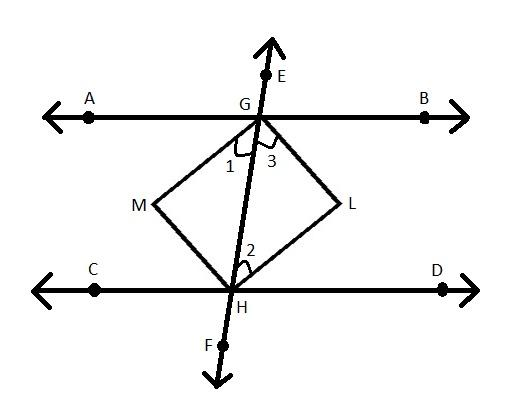
To prove: GHML is a rectangle.
Proof:
Since \[AB\parallel CD\]
\[\angle AGH = \angle DHG{\text{ }}\left( {{\text{Alternate interior angles}}} \right)\]
Dividing both side by 2, we have
\[
\Rightarrow \dfrac{1}{2}\angle AGH = \dfrac{1}{2}\angle DHG \\
\Rightarrow \angle 1 = \angle 2{\text{ }}\left( {{\text{GM & HL are bisectors of }}\angle {\text{AGH and }}\angle {\text{DHG respectively}}} \right) \\
\Rightarrow GM\parallel HL{\text{ }}\left( {\angle 1{\text{ and }}\angle {\text{2 from a pair of alternate interior angles are equal}}} \right) \\
\]
Similarly, \[GL\parallel MH\]
So, GMHL is a parallelogram.
Since \[AB\parallel CD\]
We have \[\angle BGH + \angle DHG = {180^\circ}\] as the sum of interior angles on the same side of the transversal is equal to \[{180^\circ}\].
Dividing both sides by 2, we have
\[
\Rightarrow \dfrac{1}{2}\angle BGH + \dfrac{1}{2}\angle DHG = {90^\circ} \\
\Rightarrow \angle 3 + \angle 2 = {90^\circ}........................................................\left( 1 \right) \\
\]
In \[\Delta GLH\] as the sum of the angles is equal to \[{180^\circ}\], we have
\[
\Rightarrow \angle 2 + \angle 3 + \angle L = {180^\circ} \\
\Rightarrow {90^\circ} + \angle L = {180^\circ}{\text{ }}\left( {{\text{Using }}\left( 1 \right)} \right) \\
\Rightarrow \angle L = {180^\circ} - {90^\circ} \\
\therefore \angle L = {90^\circ} \\
\]
Thus, in a parallelogram GMHL, \[\angle L = {90^\circ}\]
We know that if one of the angles is the right angle in the parallelogram then it is also a rectangle.
Hence, proved that GHML is a rectangle.
Thus, if two parallel lines are intersected by a transversal, then bisectors of the interior angles form a rectangle.
Note: The sum of interior angles on the same side of the transversal is equal to \[{180^\circ}\]. When two lines are crossed by another line which is called as the transversal the alternate interior angles are equal.
Complete step-by-step answer:
Construction: Two parallel lines AB and CD and a transversal EF intersect them at G and H respectively. GM, HM, GL and HL are the bisectors of the two pairs of interior angles.
To prove: GHML is a rectangle.
Proof:
Since \[AB\parallel CD\]
\[\angle AGH = \angle DHG{\text{ }}\left( {{\text{Alternate interior angles}}} \right)\]
Dividing both side by 2, we have
\[
\Rightarrow \dfrac{1}{2}\angle AGH = \dfrac{1}{2}\angle DHG \\
\Rightarrow \angle 1 = \angle 2{\text{ }}\left( {{\text{GM & HL are bisectors of }}\angle {\text{AGH and }}\angle {\text{DHG respectively}}} \right) \\
\Rightarrow GM\parallel HL{\text{ }}\left( {\angle 1{\text{ and }}\angle {\text{2 from a pair of alternate interior angles are equal}}} \right) \\
\]
Similarly, \[GL\parallel MH\]
So, GMHL is a parallelogram.
Since \[AB\parallel CD\]
We have \[\angle BGH + \angle DHG = {180^\circ}\] as the sum of interior angles on the same side of the transversal is equal to \[{180^\circ}\].
Dividing both sides by 2, we have
\[
\Rightarrow \dfrac{1}{2}\angle BGH + \dfrac{1}{2}\angle DHG = {90^\circ} \\
\Rightarrow \angle 3 + \angle 2 = {90^\circ}........................................................\left( 1 \right) \\
\]
In \[\Delta GLH\] as the sum of the angles is equal to \[{180^\circ}\], we have
\[
\Rightarrow \angle 2 + \angle 3 + \angle L = {180^\circ} \\
\Rightarrow {90^\circ} + \angle L = {180^\circ}{\text{ }}\left( {{\text{Using }}\left( 1 \right)} \right) \\
\Rightarrow \angle L = {180^\circ} - {90^\circ} \\
\therefore \angle L = {90^\circ} \\
\]
Thus, in a parallelogram GMHL, \[\angle L = {90^\circ}\]
We know that if one of the angles is the right angle in the parallelogram then it is also a rectangle.
Hence, proved that GHML is a rectangle.
Thus, if two parallel lines are intersected by a transversal, then bisectors of the interior angles form a rectangle.
Note: The sum of interior angles on the same side of the transversal is equal to \[{180^\circ}\]. When two lines are crossed by another line which is called as the transversal the alternate interior angles are equal.
Recently Updated Pages
Master Class 11 Social Science: Engaging Questions & Answers for Success

Master Class 11 English: Engaging Questions & Answers for Success
Master Class 11 Maths: Engaging Questions & Answers for Success
Master Class 11 Chemistry: Engaging Questions & Answers for Success
Master Class 11 Biology: Engaging Questions & Answers for Success
Class 11 Question and Answer - Your Ultimate Solutions Guide
Trending doubts
Explain the Treaty of Vienna of 1815 class 10 social science CBSE
Why is it 530 pm in india when it is 1200 afternoon class 10 social science CBSE
What is the full form of POSCO class 10 social science CBSE
Define Potential, Developed, Stock and Reserved resources
Which Country Has the Largest Border with India?
Choose the feminine form of the given noun Fox AFoxess class 10 english CBSE