




If two lines are perpendicular to the third line, then those two line are
A) Parallel to each other
B) Perpendicular to each other
C) Either parallel or perpendicular
D) Neither parallel nor perpendicular
Answer
 Verified
649.2k+ views
Hint: Here, we will suppose the two lines which are perpendicular to the third line. Also, follow the properties of the two parallel and perpendicular lines.
Complete step by step answer:
Let, \[l{\text{, m, and n}}\] be the three lines, in such a way that line m and line n are perpendicular to the third line $l$.
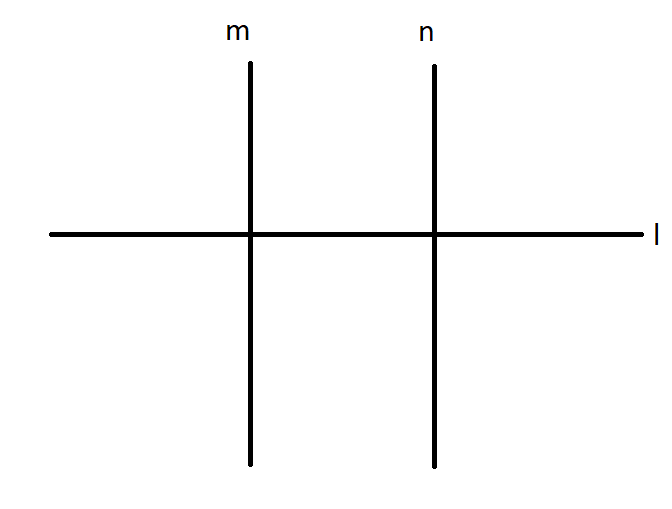
From the above diagram it is clear that if line m and line n are perpendicular to the third line l, lines m and line n are parallel to each other as line m and line n makes the right angles with the third line.
Also, by the theorem perpendicular transversal theorem-
In the plane, if a transversal is perpendicular to one or the two parallel lines, then it is perpendicular to the other line.
If,
$
m \bot l \\
n \bot l \\
$
Then, $m\parallel n$
If two lines are perpendicular to the third line then those two lines are parallel to each other as per the property of the parallel lines they would never meet. Since, they do not touch or intersect each other they are said to be parallel to each other.
Therefore, from the given multiple choices, option A is the correct answer.
Note: Parallel lines are the lines in the plane that are always the same and are equal distance apart. Parallel lines are the lines which never intersect and the perpendicular lines are the lines which intersect at the right angles i.e. $90^\circ $
Complete step by step answer:
Let, \[l{\text{, m, and n}}\] be the three lines, in such a way that line m and line n are perpendicular to the third line $l$.
From the above diagram it is clear that if line m and line n are perpendicular to the third line l, lines m and line n are parallel to each other as line m and line n makes the right angles with the third line.
Also, by the theorem perpendicular transversal theorem-
In the plane, if a transversal is perpendicular to one or the two parallel lines, then it is perpendicular to the other line.
If,
$
m \bot l \\
n \bot l \\
$
Then, $m\parallel n$
If two lines are perpendicular to the third line then those two lines are parallel to each other as per the property of the parallel lines they would never meet. Since, they do not touch or intersect each other they are said to be parallel to each other.
Therefore, from the given multiple choices, option A is the correct answer.
Note: Parallel lines are the lines in the plane that are always the same and are equal distance apart. Parallel lines are the lines which never intersect and the perpendicular lines are the lines which intersect at the right angles i.e. $90^\circ $
Recently Updated Pages
Class 10 Question and Answer - Your Ultimate Solutions Guide

Master Class 10 Computer Science: Engaging Questions & Answers for Success
Master Class 10 General Knowledge: Engaging Questions & Answers for Success
Master Class 12 Economics: Engaging Questions & Answers for Success
Master Class 12 Social Science: Engaging Questions & Answers for Success
Master Class 12 English: Engaging Questions & Answers for Success
Trending doubts
Explain the Treaty of Vienna of 1815 class 10 social science CBSE
The slogan Jai Hind was given by A Lal Bahadur Shastri class 10 social science CBSE
10 examples of evaporation in daily life with explanations
What is the full form of POSCO class 10 social science CBSE
Identify the feminine form of noun nephew a shenephew class 10 english CBSE
CSIR full form?