




If two distinct chords of parabola \[{{y}^{2}}=4ax\], passing through \[\left( a,2a \right)\] are bisected on the line \[x+y=1\], then the length of latus rectum is
(a) 2
(b) 1
(c) 4
(d) 5
Answer
 Verified
627k+ views
Hint: The figure showing the given data is
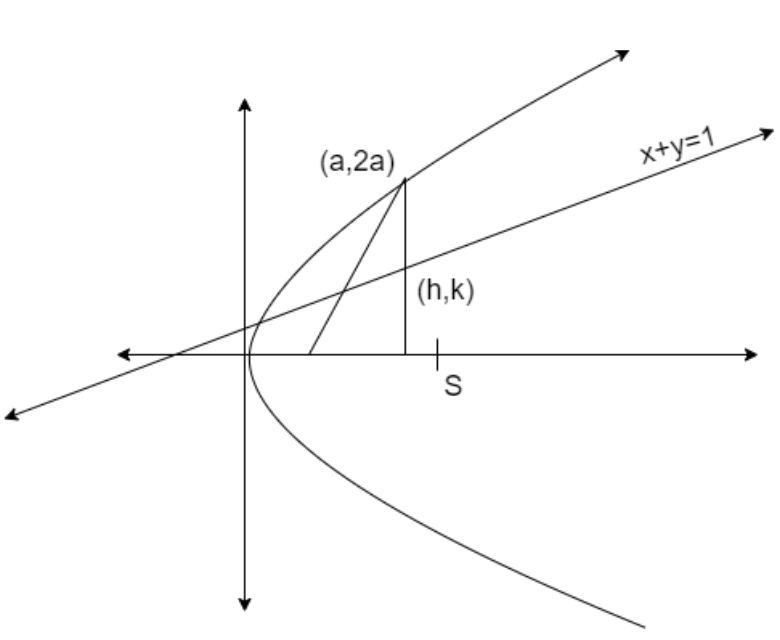
We solve this problem by assuming the mid - point as \[\left( h,k \right)\] that lies on the line \[x+y=1\]. Then we use the formula of the line equation having the mid – point of a curve \[S\]that is \[{{S}_{1}}={{S}_{11}}\]. If \[S\equiv {{y}^{2}}-4ax=0\] then the representation \[{{S}_{1}},{{S}_{11}}\] with respect to point \[\left( {{x}_{1}},{{y}_{1}} \right)\] is given as
\[\Rightarrow {{S}_{1}}=y{{y}_{1}}-2a\left( x+{{x}_{1}} \right)\]
\[\Rightarrow {{S}_{11}}={{y}_{1}}^{2}-4a{{x}_{1}}\]
By using the above results we find the range of \['a'\] to get the latus rectum as \['4a'\]
Complete step-by-step solution:
Let us assume that the point at which the chords are bisected as \[\left( h,k \right)\]
We are given that the chords are bisected on the line \[x+y=1\]
We know that the point \[\left( h,k \right)\] satisfies the equation \[x+y=1\]
Now, by substituting the point in the line we get
\[\begin{align}
& \Rightarrow h+k=1 \\
& \Rightarrow k=1-h \\
\end{align}\]
So, we can take the mid – point as \[\left( h,1-h \right)\]
We know that the formula of line equation having mid – point of a curve \[S\] that is \[{{S}_{1}}={{S}_{11}}\].
If \[S\equiv {{y}^{2}}-4ax=0\] then the representation \[{{S}_{1}},{{S}_{11}}\] with respect to point \[\left( {{x}_{1}},{{y}_{1}} \right)\] is given as
\[\Rightarrow {{S}_{1}}=y{{y}_{1}}-2a\left( x+{{x}_{1}} \right)\]
\[\Rightarrow {{S}_{11}}={{y}_{1}}^{2}-4a{{x}_{1}}\]
Now, by using the mid – point \[\left( h,1-h \right)\] to the curve \[S\equiv {{y}^{2}}-4ax=0\] we get the equation of chord as
\[\begin{align}
& \Rightarrow {{S}_{1}}={{S}_{11}} \\
& \Rightarrow y\left( 1-h \right)-2a\left( x+h \right)={{\left( 1-h \right)}^{2}}-4ah \\
& \Rightarrow y\left( 1-h \right)-2ax={{\left( 1-h \right)}^{2}}-2ah \\
\end{align}\]
We are given that the chords are drawn from the point \[\left( a,2a \right)\] so, we can say that the point \[\left( a,2a \right)\] satisfies the above equation.
By substituting the point \[\left( a,2a \right)\] in above equation we get
\[\begin{align}
& \Rightarrow 2a\left( 1-h \right)-2a\left( a \right)={{\left( 1-h \right)}^{2}}-2ah \\
& \Rightarrow 2a-2{{a}^{2}}={{\left( 1-h \right)}^{2}} \\
\end{align}\]
We know that the square of any number is greater than 0. So, we can write
\[\Rightarrow {{\left( 1-h \right)}^{2}}>0\]
By substituting the required equation in above equation we get
\[\Rightarrow 2a-2{{a}^{2}}>0\]
Now, by multiplying with negative sign the inequality changes as
\[\begin{align}
& \Rightarrow 2{{a}^{2}}-2a<0 \\
& \Rightarrow 2a\left( a-1 \right)<0 \\
& \Rightarrow a\in \left( 0,1 \right) \\
\end{align}\]
We know that the length of latus rectum of given parabola is \['4a'\]
Therefore the range of latus rectum can be taken as
\[\Rightarrow 4a\in \left( 0,4 \right)\]
Here, we can say that the length of latus rectum can take any values in the domain \[\left( 0,4 \right)\]
Therefore, the possible values of latus rectum according to options are 1, 2. So, option (a) and option (b) are correct answers.
Note: Students may make mistakes in solving the inequality. While multiplying with a negative sign the inequality changes. Here, we have
\[\Rightarrow 2a-2{{a}^{2}}>0\]
After multiplying with a negative sign the equation changes as
\[\Rightarrow 2{{a}^{2}}-2a<0\]
But students miss this point and do not change the inequality which results in wrong answers.
Also, we have the range of latus rectum as
\[\Rightarrow 4a\in \left( 0,4 \right)\]
This means the latus rectum can have values in the domain \[\left( 0,4 \right)\] but will not equal to ‘0’ or ‘4’. Students may miss this point and give the answer ‘4’ also as the correct answer. This will be wrong.
We solve this problem by assuming the mid - point as \[\left( h,k \right)\] that lies on the line \[x+y=1\]. Then we use the formula of the line equation having the mid – point of a curve \[S\]that is \[{{S}_{1}}={{S}_{11}}\]. If \[S\equiv {{y}^{2}}-4ax=0\] then the representation \[{{S}_{1}},{{S}_{11}}\] with respect to point \[\left( {{x}_{1}},{{y}_{1}} \right)\] is given as
\[\Rightarrow {{S}_{1}}=y{{y}_{1}}-2a\left( x+{{x}_{1}} \right)\]
\[\Rightarrow {{S}_{11}}={{y}_{1}}^{2}-4a{{x}_{1}}\]
By using the above results we find the range of \['a'\] to get the latus rectum as \['4a'\]
Complete step-by-step solution:
Let us assume that the point at which the chords are bisected as \[\left( h,k \right)\]
We are given that the chords are bisected on the line \[x+y=1\]
We know that the point \[\left( h,k \right)\] satisfies the equation \[x+y=1\]
Now, by substituting the point in the line we get
\[\begin{align}
& \Rightarrow h+k=1 \\
& \Rightarrow k=1-h \\
\end{align}\]
So, we can take the mid – point as \[\left( h,1-h \right)\]
We know that the formula of line equation having mid – point of a curve \[S\] that is \[{{S}_{1}}={{S}_{11}}\].
If \[S\equiv {{y}^{2}}-4ax=0\] then the representation \[{{S}_{1}},{{S}_{11}}\] with respect to point \[\left( {{x}_{1}},{{y}_{1}} \right)\] is given as
\[\Rightarrow {{S}_{1}}=y{{y}_{1}}-2a\left( x+{{x}_{1}} \right)\]
\[\Rightarrow {{S}_{11}}={{y}_{1}}^{2}-4a{{x}_{1}}\]
Now, by using the mid – point \[\left( h,1-h \right)\] to the curve \[S\equiv {{y}^{2}}-4ax=0\] we get the equation of chord as
\[\begin{align}
& \Rightarrow {{S}_{1}}={{S}_{11}} \\
& \Rightarrow y\left( 1-h \right)-2a\left( x+h \right)={{\left( 1-h \right)}^{2}}-4ah \\
& \Rightarrow y\left( 1-h \right)-2ax={{\left( 1-h \right)}^{2}}-2ah \\
\end{align}\]
We are given that the chords are drawn from the point \[\left( a,2a \right)\] so, we can say that the point \[\left( a,2a \right)\] satisfies the above equation.
By substituting the point \[\left( a,2a \right)\] in above equation we get
\[\begin{align}
& \Rightarrow 2a\left( 1-h \right)-2a\left( a \right)={{\left( 1-h \right)}^{2}}-2ah \\
& \Rightarrow 2a-2{{a}^{2}}={{\left( 1-h \right)}^{2}} \\
\end{align}\]
We know that the square of any number is greater than 0. So, we can write
\[\Rightarrow {{\left( 1-h \right)}^{2}}>0\]
By substituting the required equation in above equation we get
\[\Rightarrow 2a-2{{a}^{2}}>0\]
Now, by multiplying with negative sign the inequality changes as
\[\begin{align}
& \Rightarrow 2{{a}^{2}}-2a<0 \\
& \Rightarrow 2a\left( a-1 \right)<0 \\
& \Rightarrow a\in \left( 0,1 \right) \\
\end{align}\]
We know that the length of latus rectum of given parabola is \['4a'\]
Therefore the range of latus rectum can be taken as
\[\Rightarrow 4a\in \left( 0,4 \right)\]
Here, we can say that the length of latus rectum can take any values in the domain \[\left( 0,4 \right)\]
Therefore, the possible values of latus rectum according to options are 1, 2. So, option (a) and option (b) are correct answers.
Note: Students may make mistakes in solving the inequality. While multiplying with a negative sign the inequality changes. Here, we have
\[\Rightarrow 2a-2{{a}^{2}}>0\]
After multiplying with a negative sign the equation changes as
\[\Rightarrow 2{{a}^{2}}-2a<0\]
But students miss this point and do not change the inequality which results in wrong answers.
Also, we have the range of latus rectum as
\[\Rightarrow 4a\in \left( 0,4 \right)\]
This means the latus rectum can have values in the domain \[\left( 0,4 \right)\] but will not equal to ‘0’ or ‘4’. Students may miss this point and give the answer ‘4’ also as the correct answer. This will be wrong.
Recently Updated Pages
Basicity of sulphurous acid and sulphuric acid are

Master Class 11 English: Engaging Questions & Answers for Success
Master Class 11 Physics: Engaging Questions & Answers for Success
Master Class 11 Computer Science: Engaging Questions & Answers for Success
Master Class 11 Chemistry: Engaging Questions & Answers for Success
Master Class 11 Social Science: Engaging Questions & Answers for Success
Trending doubts
Difference Between Prokaryotic Cells and Eukaryotic Cells
Two of the body parts which do not appear in MRI are class 11 biology CBSE
One Metric ton is equal to kg A 10000 B 1000 C 100 class 11 physics CBSE
10 examples of friction in our daily life
Draw a diagram of nephron and explain its structur class 11 biology CBSE
What will happen if the mucus is not secreted by the class 11 biology CBSE