




If two distinct chords drawn from the point \[\left( a,b \right)\] of the circle \[{{x}^{2}}+{{y}^{2}}-ax-by=0\](where \[ab\ne 0\]) are bisected by the x-axis, then the roots of the quadratic equation \[b{{x}^{2}}-ax+2b=0\] are necessarily.
A. imaginary
B. real and equal
C. real and unequal
D. rational
Answer
 Verified
608.7k+ views
Hint: In this problem, we have to find the nature of the given roots from the given data. We can first draw the circle with two distinct chords, we can then find the coordinates and substitute in the given equation. We can see that we are given two distinct chords where there will be two distinct values, where discriminant will be greater than 0. Using that we can find the nature of the given root.
Complete step by step answer:
We know that the given equation of the circle is \[{{x}^{2}}+{{y}^{2}}-ax-by=0\]where two distinct chords drawn from the point \[\left( a,b \right)\] and \[{{x}^{2}}+{{y}^{2}}-ax-by=0\](\[ab\ne 0\]) are bisected by the x-axis.
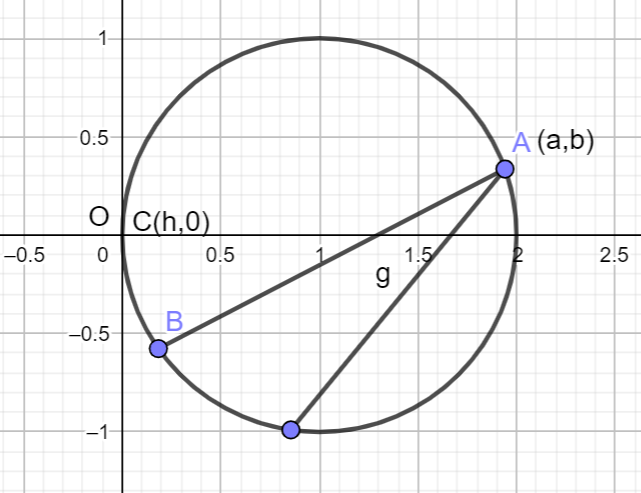
We can see that the point \[A\left( a,b \right)\] and C is the midpoint, where the coordinate is \[C\left( h,0 \right)\].
Then we can say that the coordinate of B is \[\left( -a+2h,-b \right)\].
We can substitute this coordinate in the given equation, we get
\[\Rightarrow {{\left( -a+2h \right)}^{2}}+{{\left( -b \right)}^{2}}=a\left( -a+2h \right)+b\left( -b \right)\]
We can now simplify the above step, we get
\[\begin{align}
& \Rightarrow {{a}^{2}}+4{{h}^{2}}-4ah+{{b}^{2}}=-{{a}^{2}}+2ah-{{b}^{2}} \\
& \Rightarrow 2{{h}^{2}}-3ah+{{a}^{2}}+{{b}^{2}}=0....(1) \\
\end{align}\]
We can see that, if there are two distinct chords which are bisected at x-axis then, there will be two distinct values of h satisfying equation (1).
Therefore, we can say that the discriminant of this quadratic equation must be greater than 0.
\[\Rightarrow D>0\]
We can now use the discriminant formula for the equation (1), we get
\[\begin{align}
& \Rightarrow {{\left( -3a \right)}^{2}}-4\times 2\left( {{a}^{2}}+{{b}^{2}} \right)>0 \\
& \Rightarrow {{a}^{2}}-8{{b}^{2}} \\
& \Rightarrow {{a}^{2}}>8{{b}^{2}} \\
\end{align}\]
We know that we are given a root, \[b{{x}^{2}}-ax+2b=0\].
We can now find the discriminant of the above equation, we get
\[\begin{align}
& \Rightarrow D'={{a}^{2}}-4\times \left( b \right)\left( 2b \right) \\
& \Rightarrow D'={{a}^{2}}-8{{b}^{2}} \\
\end{align}\]
Here we can see that D’ is positive i.e. \[D'>0\].
Therefore, the roots of the given quadratic equation are real and equal.(B)
Note: Students should always remember that the formula for the discriminant is \[{{b}^{2}}-4ac\]. We should also remember that if the discriminant is greater than 0, the roots will be real and equal, if the discriminant is less than zero, we will have imaginary roots and if the discriminant is equal to zero, then the roots will be real and unequal.
Complete step by step answer:
We know that the given equation of the circle is \[{{x}^{2}}+{{y}^{2}}-ax-by=0\]where two distinct chords drawn from the point \[\left( a,b \right)\] and \[{{x}^{2}}+{{y}^{2}}-ax-by=0\](\[ab\ne 0\]) are bisected by the x-axis.
We can see that the point \[A\left( a,b \right)\] and C is the midpoint, where the coordinate is \[C\left( h,0 \right)\].
Then we can say that the coordinate of B is \[\left( -a+2h,-b \right)\].
We can substitute this coordinate in the given equation, we get
\[\Rightarrow {{\left( -a+2h \right)}^{2}}+{{\left( -b \right)}^{2}}=a\left( -a+2h \right)+b\left( -b \right)\]
We can now simplify the above step, we get
\[\begin{align}
& \Rightarrow {{a}^{2}}+4{{h}^{2}}-4ah+{{b}^{2}}=-{{a}^{2}}+2ah-{{b}^{2}} \\
& \Rightarrow 2{{h}^{2}}-3ah+{{a}^{2}}+{{b}^{2}}=0....(1) \\
\end{align}\]
We can see that, if there are two distinct chords which are bisected at x-axis then, there will be two distinct values of h satisfying equation (1).
Therefore, we can say that the discriminant of this quadratic equation must be greater than 0.
\[\Rightarrow D>0\]
We can now use the discriminant formula for the equation (1), we get
\[\begin{align}
& \Rightarrow {{\left( -3a \right)}^{2}}-4\times 2\left( {{a}^{2}}+{{b}^{2}} \right)>0 \\
& \Rightarrow {{a}^{2}}-8{{b}^{2}} \\
& \Rightarrow {{a}^{2}}>8{{b}^{2}} \\
\end{align}\]
We know that we are given a root, \[b{{x}^{2}}-ax+2b=0\].
We can now find the discriminant of the above equation, we get
\[\begin{align}
& \Rightarrow D'={{a}^{2}}-4\times \left( b \right)\left( 2b \right) \\
& \Rightarrow D'={{a}^{2}}-8{{b}^{2}} \\
\end{align}\]
Here we can see that D’ is positive i.e. \[D'>0\].
Therefore, the roots of the given quadratic equation are real and equal.(B)
Note: Students should always remember that the formula for the discriminant is \[{{b}^{2}}-4ac\]. We should also remember that if the discriminant is greater than 0, the roots will be real and equal, if the discriminant is less than zero, we will have imaginary roots and if the discriminant is equal to zero, then the roots will be real and unequal.
Recently Updated Pages
Which will be the least stable resonating structure class 11 chemistry CBSE

How many 5 digit telephone numbers can be construc-class-11-maths-CBSE
How do you find the angle of the resultant vector class 11 physics CBSE
Draw labelled diagram of the following i Gram seed class 11 biology CBSE
1 Quintal is equal to a 110 kg b 10 kg c 100kg d 1000 class 11 physics CBSE
What is the need and importance of classification class 11 biology CBSE
Trending doubts
Find the value of the expression given below sin 30circ class 11 maths CBSE
One Metric ton is equal to kg A 10000 B 1000 C 100 class 11 physics CBSE
10 examples of friction in our daily life
Draw a diagram of a plant cell and label at least eight class 11 biology CBSE
Difference between physical and chemical change class 11 chemistry CBSE
Proton was discovered by A Thomson B Rutherford C Chadwick class 11 chemistry CBSE