




If two dice are thrown simultaneously, then the probability that the sum of the numbers which come up on the dice to be more than 5 is?
(a) $\dfrac{5}{36}$
(b) $\dfrac{1}{6}$
(c) $\dfrac{5}{18}$
(d) $\dfrac{13}{18}$
Answer
 Verified
622.2k+ views
Hint: Find out total number of outcomes when two dice are thrown simultaneously. Then find the total number of events in which the sum of the numbers on two dice is ‘more than 5’. Divide the number of desirable outcomes with the total number of outcomes to find the probability of both the cases.
Complete step-by-step answer:
Since, a cubical dice has six faces and each face has a number that range from 1 to 6. So, the total number of outcomes when 1 dice is thrown is 6. Therefore, when two dice are thrown, the total number of outcomes will be the total combinations of the 6 numbers of one die with the 6 numbers of the other die.
Now, let us come to the question.
Total number of outcomes or total number of sample space $=n(S)=6\times 6=36$
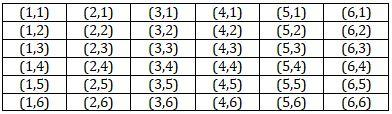
Combinations in which sum is more than 5 are: (1, 5); (1, 6); (2, 4); (2, 5); (2, 6); (3, 3); (3, 4); (3, 5); (3, 6); (4, 2); (4, 3); (4, 4); (4, 5); (4, 6); (5, 1); (5, 2); (5, 3); (5, 4); (5, 5); (5, 6); (6, 1); (6, 2); (6, 3); (6, 4); (6, 5); (6, 6).
Therefore, the total number of outcomes in which sum is more than 5 $=n(E)=26$.
We know that, probability of an event $=\dfrac{\text{number of desired outcome}}{\text{total number of outcome}}=\dfrac{n(E)}{n(S)}$.
Therefore, probability of getting the sum more than 5
$=\dfrac{n(E)}{n(S)}=\dfrac{26}{36}=\dfrac{13}{18}$.
Hence, option (d) is the correct answer.
Note: It would be favourable for us to note all the outcomes in a table otherwise we may get confused in counting the desirable number of events. It is important to note that if ‘n’ number of dice is rolled simultaneously then the total number of outcomes will be ${{6}^{n}}$.
Complete step-by-step answer:
Since, a cubical dice has six faces and each face has a number that range from 1 to 6. So, the total number of outcomes when 1 dice is thrown is 6. Therefore, when two dice are thrown, the total number of outcomes will be the total combinations of the 6 numbers of one die with the 6 numbers of the other die.
Now, let us come to the question.
Total number of outcomes or total number of sample space $=n(S)=6\times 6=36$
Combinations in which sum is more than 5 are: (1, 5); (1, 6); (2, 4); (2, 5); (2, 6); (3, 3); (3, 4); (3, 5); (3, 6); (4, 2); (4, 3); (4, 4); (4, 5); (4, 6); (5, 1); (5, 2); (5, 3); (5, 4); (5, 5); (5, 6); (6, 1); (6, 2); (6, 3); (6, 4); (6, 5); (6, 6).
Therefore, the total number of outcomes in which sum is more than 5 $=n(E)=26$.
We know that, probability of an event $=\dfrac{\text{number of desired outcome}}{\text{total number of outcome}}=\dfrac{n(E)}{n(S)}$.
Therefore, probability of getting the sum more than 5
$=\dfrac{n(E)}{n(S)}=\dfrac{26}{36}=\dfrac{13}{18}$.
Hence, option (d) is the correct answer.
Note: It would be favourable for us to note all the outcomes in a table otherwise we may get confused in counting the desirable number of events. It is important to note that if ‘n’ number of dice is rolled simultaneously then the total number of outcomes will be ${{6}^{n}}$.
Recently Updated Pages
Master Class 10 English: Engaging Questions & Answers for Success

Master Class 10 Social Science: Engaging Questions & Answers for Success
Master Class 10 Computer Science: Engaging Questions & Answers for Success
Class 10 Question and Answer - Your Ultimate Solutions Guide
Master Class 10 General Knowledge: Engaging Questions & Answers for Success
Master Class 10 Maths: Engaging Questions & Answers for Success
Trending doubts
A boat goes 24 km upstream and 28 km downstream in class 10 maths CBSE
State and explain Ohms law class 10 physics CBSE
Distinguish between soap and detergent class 10 chemistry CBSE
a Why did Mendel choose pea plants for his experiments class 10 biology CBSE
What is a "free hit" awarded for in limited-overs cricket?
Draw the diagram of the sectional view of the human class 10 biology CBSE